A GV60 that sat all week in a Brickell garage can look totally dead. An Electrified GV70 on a Miami Beach tower floor can do the same. The screens stay black and the flush handles never pop. The start button does nothing when you press it. That silence is almost never an empty traction pack. It’s the small 12-volt battery that wakes the car. Genesis packs sit in the same condo-tower heat as every other EV here.
The 12-volt is what actually boots the car
The GV60 and Electrified GV70 ride on Hyundai’s E-GMP platform. That’s the same architecture as the Ioniq 5 and the Kia EV6. Two batteries do two jobs. The traction pack turns the motors. The 12-volt pack wakes the computers, locks, lights, and boot module. That module is what brings high voltage online. When the 12-volt is flat, the big pack stays locked out. Miles left in the traction battery don’t help if nothing will boot.
E-GMP cars have a quirk that catches owners. If the traction pack sits very low, the system can stop topping off the 12-volt. Let the car sit a few days after that. The small battery can drain all the way. You can still have range left and a car that won’t wake. The same failure shows up on Hyundai and Kia siblings. Hyundai Ioniq 5 won’t start walks that architecture if you want a parallel checklist.
Heat here is what kills the small battery
South Florida is flat, so range isn’t a hill problem. Miami-Dade’s highest natural ground is the Atlantic Coastal Ridge, about 23 to 24 feet. Broward’s high point is Pine Island Ridge, about 29 feet. What actually burns energy is heat, air conditioning, and long sits.
NWS Miami 1991-2020 normals put July and August average highs at 91F. A normal year sees about 64 days at or above 90F. Recurrent Auto studied about 30,000 EVs and found about 5% range loss at 90F. The same study found about 17 to 18% loss at 100F. Those numbers are about the traction pack. The 12-volt has a harder summer.
Battery University notes that every roughly 15F rise in temperature halves lead-acid life. A battery ages about twice as fast at 93F versus 77F. It ages about four times as fast at 111F. Heat damage can’t be reversed. After one Miami summer, a tired 12-volt is the weak link. What happens when an EV’s 12-volt dies covers that cascade in this climate.
Condo towers, older streets, and who has a plug
These cars live like other luxury crossovers here. A lot of them sit in stacked condos without a dedicated circuit. Florida Power and Light serves essentially all of Miami-Dade and all of Broward. Homestead is the confirmed exception. Homestead Public Services Energy serves parts of that city, and FPL serves other streets. Confirm your provider on the city’s HPS Energy page. No EV-specific program turned up on those pages when they were read. FPL EVolution is FPL’s public charging brand. Confirm current home-charging terms with FPL before you enroll. This page doesn’t publish dollar figures.
Older housing is the other constraint. North Miami’s stock is 82.7% pre-1980, and Miami Springs is 89.5%. Hollywood, which is in Broward County, is 74.7%, and Hialeah is 60.1%. A home Level 2 often isn’t practical in those buildings. Newer tracts look different. Doral is 5.5% pre-1980, Weston is 7.0%, and Parkland is 1.7%. A GV70 in a Doral garage still cooks if the 12-volt is tired. A GV60 on an older Hollywood street just sits more between charges.
Coastal towers add dwell time. Miami Beach is its own city, reached only by causeway. South Beach is a neighborhood of Miami Beach, not a separate city. Brickell sits inside the City of Miami. Miami Beach EV charging is the local hub if you park in those towers. The 12-volt still dies in those garages because the car sits hot and unused. The City of Miami is one of 34 municipalities in Miami-Dade. The University of Miami’s main campus is in Coral Gables, not the City of Miami.
Airport weeks, cruise garages, and a long event sit
This is the call that fools almost everyone. You leave a GV60 at Miami International for a week or two. You come back to a brick. The traction pack usually still has energy. The 12-volt drained keeping modules alive in the heat.
MIA public parking includes the Dolphin Garage at the North Terminal. The Flamingo Garage sits at the Central Terminal. It also includes the Ibis Garage and Park 6, opened in summer 2026. The airport page says the Ibis holds ChargePoint ports across its levels. Park 6 lists EV charging on site. Don’t treat a listed port as a guaranteed stall when you return. Motorist help through garage parking is (305) 876-7536. Confirm current rules on miami-airport.com. Parking rates are prices, and this page doesn’t publish them.
County pages for PortMiami parking list no EV charging. Port Everglades pages for the Heron and Palm garages list none either. A week in a cruise garage is a 12-volt story, not a pack story. Hard Rock Stadium in Miami Gardens hosts the Dolphins and the F1 Miami Grand Prix. A Genesis that sat through a long game can look dead for the same 12-volt reason.
How a dead 12-volt looks versus an empty pack
A flat 12-volt is total silence. You get no interior lights and no chime when a door opens. Flush handles won’t present or unlock with the key. Frunk and charge-port buttons do nothing. The fob seems dead even with a fresh fob cell. You may hear one faint click, then nothing.
If the dash wakes and the screens work, look at the message. A range warning points to the traction pack. So does a car that won’t go into drive. Don’t jump that. You need energy added to the high-voltage battery. A charge-port that won’t open is a separate latch problem. See what to do when the cable won’t unlatch.
GV60 versus GV70: where that battery hides
Layouts split by body, and that’s what trips people. On the GV60 crossover, the auxiliary battery sits up front under the hood. That’s the Ioniq 5 pattern. On the Electrified GV70, the sedan-style E-GMP layout can hide it under trim. You still don’t jump from the battery’s own posts in most cases. The points you want are in the engine bay.
On the driver’s side under the hood, look for a fuse box with a red cap. That cap hides the positive jump terminal. Somewhere in the bay you’ll find a bare, unpainted chassis bolt for ground. The actual 12-volt battery may be in the front compartment or under trim. Year and trim vary. If the bay doesn’t match, use the owner’s manual for your model year.
Jump it from the published points, then don’t stop there
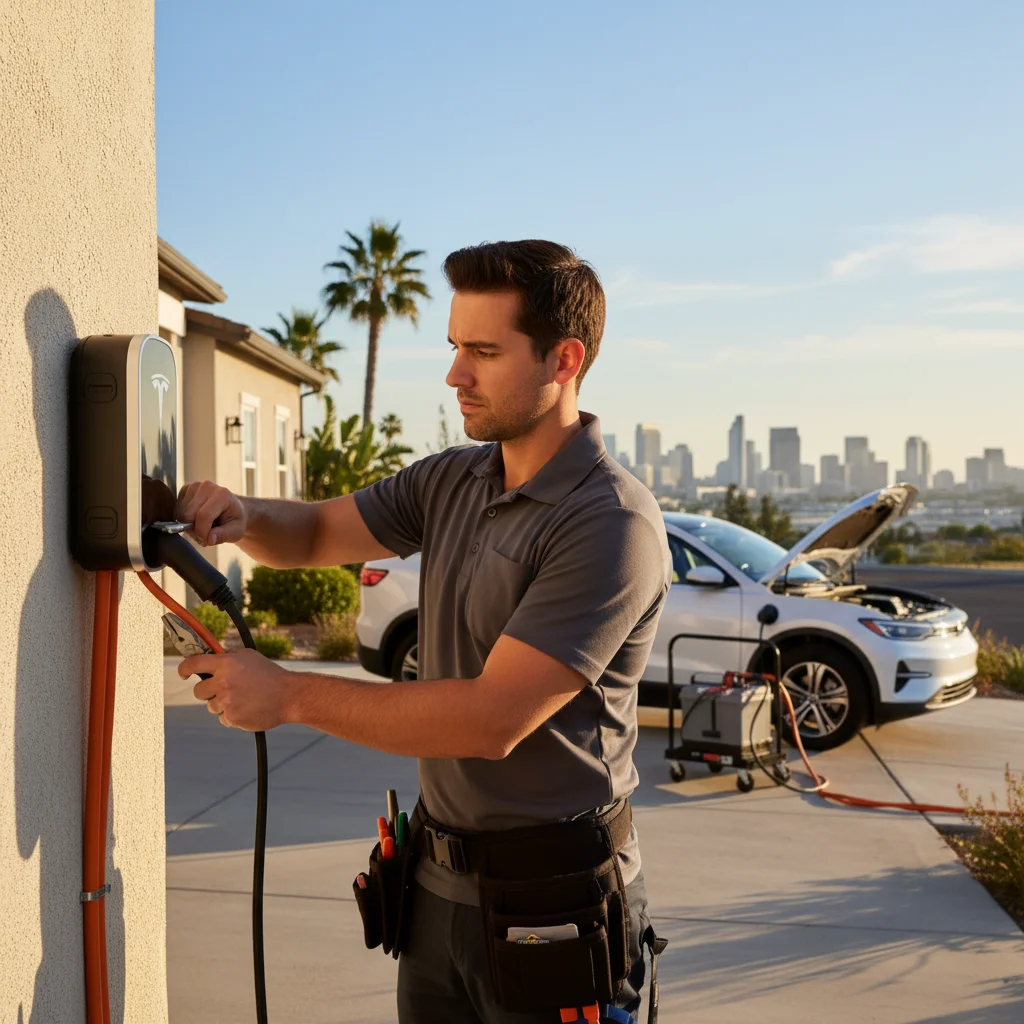
You need a portable jump pack, or a second car with jumper cables. Clamp only the published points. Open the hood with the interior release if the 12-volt has any life left. If that release is dead, you may need an operator on site. Find the driver’s-side fuse box. Lift the red cap and clamp the red lead to the positive terminal. Clamp the black lead to a clean, unpainted chassis bolt. Skip the battery’s negative post. If you’re using a donor car, match positive to positive and negative to negative. Then start the donor. Give the Genesis two to three minutes, then press start. The boot can take longer than usual after a dead 12-volt.
If it wakes, drive to a charger and let the system replenish the 12-volt. A single jump isn’t a repair. If it dies again within an hour, the battery wants replacement, not another boost. How to jump start an electric car covers the same safety order for other EVs. Independent operators in this network can jump or replace a dead 12-volt on site. They handle Tesla and every major EV brand, including Genesis.
When the traction pack is the actual problem
A jump does nothing if the dash is alive and range is gone. Then you need a mobile Level 2 charge, or a tow to a safe plug. Charge Pro MIA is a referral line. It matches you with independent local mobile rescue operators. Those operators bring a 240V Level 2 source to the car. They use a native NACS plug. A CCS or J1772 adapter covers non-Tesla EVs like Genesis. Typical charging time adds about 10 to 20 miles of range. That takes 15 to 30 minutes of charging. That’s charging time. It isn’t a promise of when someone arrives.
Out-of-charge recovery is the service page for an empty pack. Non-Tesla EV rescue is the path for Genesis and other CCS and J1772 cars.
If you’re on a limited-access highway, get off the travel lane first when you can. Florida Statute 316.194 covers stopping on a highway outside a municipality. The vehicle must sit off the main-traveled part where practicable. Leave room for passing traffic and a clear view from 200 feet each way. 316.194(2) exempts a genuinely disabled vehicle that can’t practicably be moved.
Road Rangers are FDOT’s free highway service patrol. Dial *FHP, which is *347, from a mobile phone. They jump-start vehicles and make minor repairs. They also tow a disabled vehicle from the travel lanes to the nearest safe location. That’s free of charge. District 6 covers Miami-Dade on I-95, 95 Express, I-195, I-395, I-75, 75 Express, and SR-826, the Palmetto. District 4 covers Broward’s I-95 from the Miami-Dade line north, plus portions of I-595 and I-75. Published Road Ranger material doesn’t mention electric vehicles or EV charging. They still jump a 12-volt. They still move you off the travel lanes. A Level 2 top-up is what a mobile operator brings after you’re somewhere safe.
If a wrecker is already hooked on private property, Florida Statute 715.07 applies. The operator must stop and return the vehicle if you appear before it’s fully removed. You pay no more than half the posted tow rate in that case. Miami-Dade Code Section 30-476 and Broward Code Section 20-176.22 cap nonconsent rates. Confirm the posted schedule with local consumer protection. This page doesn’t publish dollar caps.
What the referral line actually does
Charge Pro MIA matches stranded EV drivers with independent local mobile rescue operators. It performs no work, owns no trucks, and employs no technicians. It sets no prices and publishes no business hours. It doesn’t hold a trade license. The operator quotes you before starting and bills you directly. The pros we connect you with are licensed and insured. We serve South Florida.
For a dark Genesis, tell the operator whether the car is fully silent or the dash still wakes. That split decides a 12-volt jump versus a Level 2 top-up. Call (786) 963-2995 to match a local operator to a dark GV60 or GV70.
Frequently asked questions
How do you jump a Genesis GV60 that won’t start?
Use the positive post under the red cap in the driver’s-side fuse box, not always the battery itself. Ground the black clamp on a bare chassis bolt. Wait two to three minutes, then try start. Confirm the layout in your owner’s manual.
Can the car die if the traction pack still has charge?
Yes. The 12-volt wakes the computer that boots high voltage. If that small battery is flat, the car stays dark with miles still in the pack. That’s the usual Genesis no-start here.
Do mobile operators handle Genesis, or only Tesla?
Operators in this network handle Tesla and every major EV brand. Genesis uses CCS or an adapter path, not Tesla’s native plug.