A Jaguar I-Pace sat all day in a Brickell tower and came back dark. Miami Beach garages see the same quiet car. The traction pack is usually still charged, and the 12-volt battery isn’t. That little battery wakes the computers, presents the flush handles, and talks to the fob. When it dies, nothing on the car responds. You don’t need a CCS plug first. You need a 12V jump, then CCS only if range is actually low.
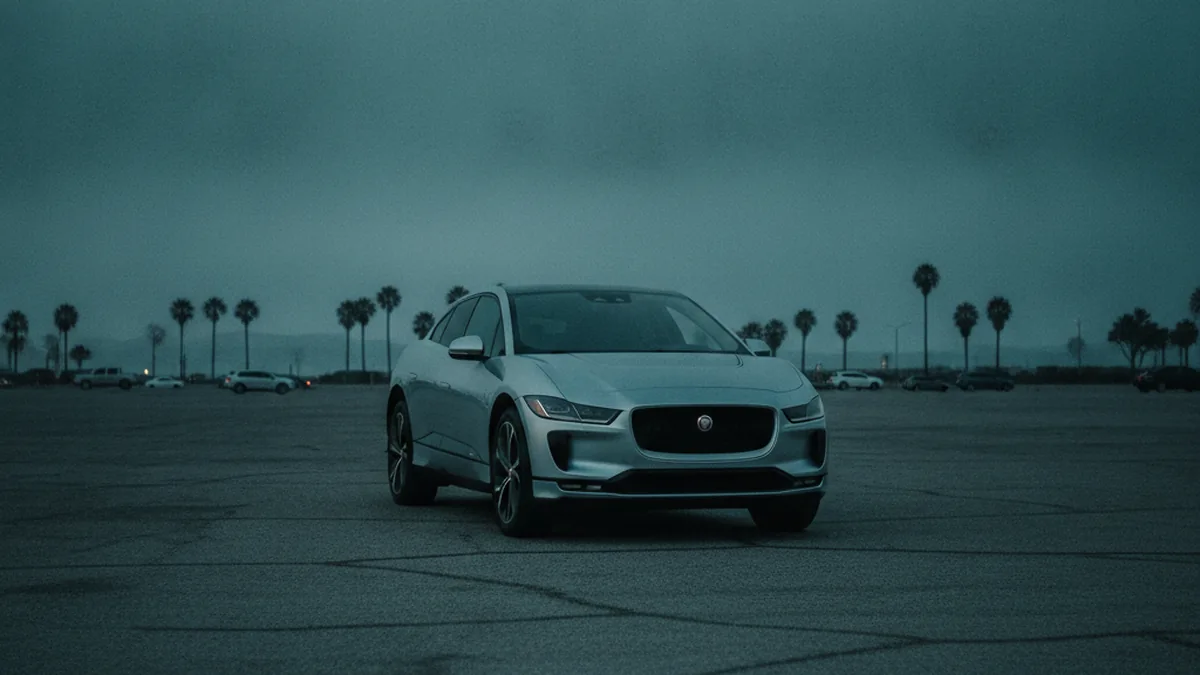
Dark screens usually mean the small battery, not the pack
The I-Pace has two electrical systems that have to cooperate. The high-voltage pack moves the wheels. A separate 12V battery runs the computers that close the contactors and wake that pack. If the 12V is flat, the traction pack stays locked out. Miles on the last drive don’t matter. The car won’t boot.
That’s why an I-Pace can look dead in a Sunny Isles Beach garage. Surfside and Miami Beach towers see the same quiet car. The pack can still sit at a usable percentage. People call for a CCS rescue first. The plug can’t talk to a car whose low-voltage system is offline. Fix the 12V, then look at range.
Signs that point at the 12V, not a drained pack:
- Cabin screens, interior lights, and the instrument cluster stay black
- No welcome chime and no lock clunk when you walk up
- The fob does nothing, even against the pillar
- Flush handles stay retracted and never present
If the cluster lights and then shuts down, stop. That pattern is a different fault. Keep the clamps off and get a Jaguar scan. Jumping a high-voltage or DC-DC failure doesn’t help. For the same 12V pattern across other brands, read what happens when an EV 12V battery dies.
South Florida heat is what cooks this 12V
Early I-Pace cars use a conventional lead-acid 12V. Heat shortens that chemistry in a way you can’t undo. Battery University puts it simply. Every roughly 15F rise in temperature halves lead-acid life. At about 93F it ages twice as fast as it does at 77F. At about 111F it ages four times as fast.
NWS Miami 1991-2020 normals set the July and August average high at 91F. A normal year here has about 64 days at or above 90F. A concrete tower deck holds that heat after the sun drops. The battery still feeds always-on modules while the car sits. You come down from a Brickell apartment and the car is silent. A week on a ship writes the same ending. The 12V is the part that quit.
A lead battery left at a low state of charge also sulfates. That capacity doesn’t come back. If the I-Pace wakes slowly on hot afternoons, get a load test. Don’t wait for a black dash in a garage aisle. After a long park, the 12V still fails first.
Pre-2021 cars hide two 12V batteries in the frunk
Jaguar’s 2018, 2019, and 2020 I-Pace models are the quiet ones. Those years put two 12V batteries under the frunk’s center panel, not one. A weak battery can drag the other down with it. Jaguar changed the layout for the 2021 model year. A pre-MY21 car that never had 12V service is the one to watch. That’s the car that goes dark in a tower.
Because there are two batteries, the jump has to land on the marked positive post. Clipping the neighbor post is how a cable melts. Match the red cap to your year in the owner’s manual before you connect anything. Once the car is in READY, load-test the battery. The 12V replacement guide covers signs, timing, and a stranded car.
If the car dies again in a few days, the 12V is finished. A second jump isn’t a repair. See what it means when the battery dies again after a jump.
Use the hidden door lock, then the frunk cable
Start at the driver’s door, not the fob. The flush handle won’t present, so there’s nothing to grab. The lock cylinder is behind that handle. Push the front of the handle inward, near the small button. The back edge should pivot out. Pull the handle out as far as it will travel. You should see the cylinder.
The metal key blade is inside the fob. Slide the fob release and pull the blade out. Insert it in the cylinder and turn clockwise. The driver’s door should unlock with no power in the car. Don’t lever the handle from the edge. You’ll break the mechanism and still be standing in the aisle.
Once you’re in the cabin, the frunk is next. A dead 12V keeps that lid latched, so the cabin release is the only path. Look in the right-side footwell for a black plug. Behind it is the manual frunk cable. Pull it and the hood should pop. Lift the removable center panel. On a pre-2021 car you’ll see both batteries, with the positive posts under red caps.
Jump the chassis, not the negative post
The detail people miss is the ground. Connect the red clamp to the red-capped positive post. Connect the black clamp to bare, unpainted metal on the chassis. Don’t put the black clamp on the battery’s negative terminal. A spark belongs away from the battery, not on it.
Let the donor source feed the system for two to three minutes. Then try to power the I-Pace and bring it to READY. Pre-MY21 and MY21 layouts aren’t the same. Confirm the post against the manual for your year. If you want the brand-agnostic walk-through, use how to jump start an electric car.
If the key won’t turn, stop. If the cable won’t pop the frunk, stop. If a clean jump leaves the car dark, stop. You’re past DIY, and forcing a handle turns a rescue into bodywork.
CCS comes after the car can wake
A jump only restores the computers. It doesn’t put miles in the traction pack. The US I-Pace charges on CCS, not NACS. The operators we connect you with bring a 240V Level 2 source. They carry a CCS adapter for non-Tesla cars.
That Level 2 session typically adds 10 to 20 miles of range. That’s 15 to 30 minutes of charging, not an arrival time.
Call for CCS after the 12V is up when:
- The car is in READY but the range reading is already thin
- You parked low, then the 12V died on top of a short pack
- You’re in a tower and you need miles to get home
- You were already planning to use a public CCS cabinet before the car went silent
Don’t lead with a charge when the dash is black and the handles are in. The cabinet, and the mobile CCS lead, can’t close contactors the 12V isn’t powering.
If this happened at Brickell City Centre, start with that garage guide.
Tower decks, MIA, and the cruise garages
Tower parking is the usual stage. Brickell, Miami Beach, Sunny Isles Beach, and Aventura stack cars on sealed concrete. Surfside and Hallandale Beach towers run the same pattern. You leave the I-Pace on a level and take the elevator. You come back after dinner or after a weekend. The 12V still worked the whole time in 90-degree air. Add CCS only if the pack was already low when you parked.
Airport parking is the longer version of the same drain. Miami International’s public decks include the Dolphin Garage at the North Terminal. The Flamingo Garage sits at the Central Terminal. There’s also the Ibis Garage, and Park 6, the new long-term garage. Motorist help in the garages is at (305) 876-7536. A week or two in long-term parking keeps modules alive on the 12V. You return from a trip to a silent car. It feels like the pack died. It didn’t. Ibis and Park 6 list charging on site. Use those ports after the car will actually wake, not before.
Cruise parking writes the same 12V story after a week at sea. PortMiami parks northside in Garages A, AA, B, C, D, F, and G. Southside uses Garages J and K, plus surface Lot E. Port Everglades uses the Heron and Palm garages and surface lots. Silence after a cruise is a jump until proven otherwise.
If you’re on I-95 or the Palmetto instead
Get out of the travel lane when you can. Florida Statute 316.194 covers a stop outside a municipality. Leave the car off the main-traveled part when you can. Leave room for passing traffic and a clear view from 200 feet each way. A genuinely disabled car that can’t practicably be moved is exempt under 316.194(2).
Dial *FHP (*347) for Florida Highway Patrol and the Road Ranger Service Patrol. Road Rangers jump-start vehicles and do minor repairs. They change flats, free of charge. They also tow a disabled car from the travel lanes to the nearest safe spot. FDOT District 6 covers Miami-Dade on I-95, 95 Express, I-195, and I-395. It also covers I-75, 75 Express, and SR-826, the Palmetto. District 4 covers Broward’s I-95 from the county line north. It also patrols portions of I-595 and I-75. Road Ranger pages don’t mention EV charging. They can still jump a 12V. They can still move you off the lanes. They don’t carry a Level 2 CCS lead.
When to hand it to an operator
Stop if the blade won’t turn the cylinder. Stop if the footwell cable doesn’t pop the frunk. Stop if a clean jump still leaves a black dash. A tight tower stall is a poor place to run jumper cables. So is the shoulder of I-95 through Fort Lauderdale, the Palmetto, or SR-836.
Charge Pro MIA is a referral line. We match stranded drivers with independent local operators. We don’t own trucks, we don’t employ technicians, and we don’t do the work. The non-Tesla EV rescue those operators bring covers Jaguar, including the I-Pace. They can open a locked car and jump the correct 12V post. They can load-test on site. They can add a CCS charge if the pack is also low. They quote you before they start and bill you directly. For the wider non-Tesla picture, read who still brings a charge to you in South Florida.
Frequently asked questions
Why won’t my Jaguar I-Pace start after it sat in a garage?
A dead 12V battery is the usual cause, not an empty traction pack. The I-Pace won’t close the high-voltage contactors until that small battery can power the computers. Flush handles stay in, the fob goes quiet, and the dash stays black. Jump the 12V first. If a clean jump still fails, it needs a dealer scan, not another charge.
How do I get into an I-Pace when the handles won’t present?
Use the metal key blade inside the fob. On the driver’s door, push the front of the handle in. The back edge pivots out. Pull the handle out to uncover the lock cylinder. Turn the blade clockwise to unlock. Then pull the manual frunk release in the right-side footwell. That’s how you reach the 12V.
Do I need a CCS charge or only a 12V jump?
If the car is fully dark, start with the 12V jump. CCS won’t wake a car that can’t boot. Once it’s in READY, look at the range. If you’re already low, the operator can add a 240V CCS top-up on site. That’s typically 10 to 20 miles in 15 to 30 minutes of charging. If range is healthy, load-test the 12V and drive.
Call Charge Pro MIA at (786) 963-2995 if the I-Pace is still dark. The operator you’re matched with confirms the work and the price before they start.