You walk back into the Dolphin Garage after a week of travel. Your Ford Mustang Mach-E won’t start at all. The screens stay black and the cabin stays silent. The fob doesn’t do anything when you press it. That stall after Miami International Airport parking is usually the 12-volt battery. The traction pack can still be sitting full.
A silent Mach-E after MIA is usually the 12V
Long-term parking is hard on the small battery, not the pack. Auxiliary computers, locks, and receivers keep sipping 12-volt power while you fly. You come back, and the car looks totally dead.
MIA’s public lots are where this call starts. The Dolphin Garage sits at the North Terminal. The Flamingo Garage sits on the Central Terminal side. The Ibis Garage is listed with ChargePoint ports across its levels. Park 6 opened as a long-term garage in summer 2026. The airport lists EV charging on site there. There’s also the Park and Ride lot at 1350 NW 45 Ave. If you need garage staff, motorist help is (305) 876-7536.
A cruise week repeats the same 12V drain. PortMiami parks northside in Garages A, AA, B, C, D, F, and G. Southside uses Garages J and K, plus surface Lot E. You return to a dark Mach-E and assume the pack is empty. The pack is usually still holding plenty of charge.
South Florida heat makes that drain faster. NWS Miami normals for 1991-2020 put July and August highs at 91F. A normal year sees about 64 days at or above 90F. Battery University notes that every roughly 15F rise halves a lead-acid battery’s life. It ages about twice as fast at 93F as at 77F. Heat damage doesn’t reverse. That’s why a Mach-E that sat in MIA parking often won’t wake.
Miami Springs sits next to the airport belt. About 89.5% of its housing is pre-1980. Many owners don’t have a home Level 2 between trips. North Miami’s housing stock is 82.7% pre-1980. The 12V has to survive the garage on its own. For the same airport-parking pattern on Teslas, see Tesla 12V failure after parking.
The pack can be full while the car stays dark
Your Mach-E runs two electrical systems at once. The high-voltage pack moves the wheels. The 12-volt battery wakes the computers, screens, locks, and pack contactors. If that 12V is dead, those contactors never close. It stays dark even with a full pack.
A low pack looks different from a dead 12V. The car often still powers on and may show a low-charge warning. You can sit in the cabin, but Drive won’t go. That’s a range problem, not a wake-up problem. Recurrent Auto’s fleet study of about 30,000 EVs found about 5% range loss at 90F. AAA’s 2019 SAE test found about a 17% drop at 95F with the AC on. South Florida is flat, so hills aren’t stealing miles. Miami-Dade’s highest natural point is the Atlantic Coastal Ridge, at roughly 23 to 24 feet. Range here is heat, air conditioning, and how long the car sat. What happens when an EV 12V dies walks the same split for every brand.
What the dash is trying to tell you
If anything still lights up, read it before you call a wrecker.
A System Off to Save Battery line usually means the 12V is fading. The car is trying to hold the last of that small battery. Key Fob Not Detected can be a coin cell in the fob. It can also be a weak 12V that can’t power the receivers. Swap the fob battery if you have a spare. Then try the door keypad or the Ford app.
A totally blank cabin is the classic dead-12V picture. There’s no chime, no lights, and no latch. That still isn’t proof the pack is empty.
Stop Safely Now is a different class of warning. Treat it as a high-voltage or safety-system fault. Don’t keep trying to drive on that alert. Get the car to a safe spot if it’s already moving. Then wait for a tech who knows EVs.
A Service Vehicle Soon lamp is vaguer than those two. It may not block a start, but it still needs a Ford scan.
Open the frunk before you assume you need a tow
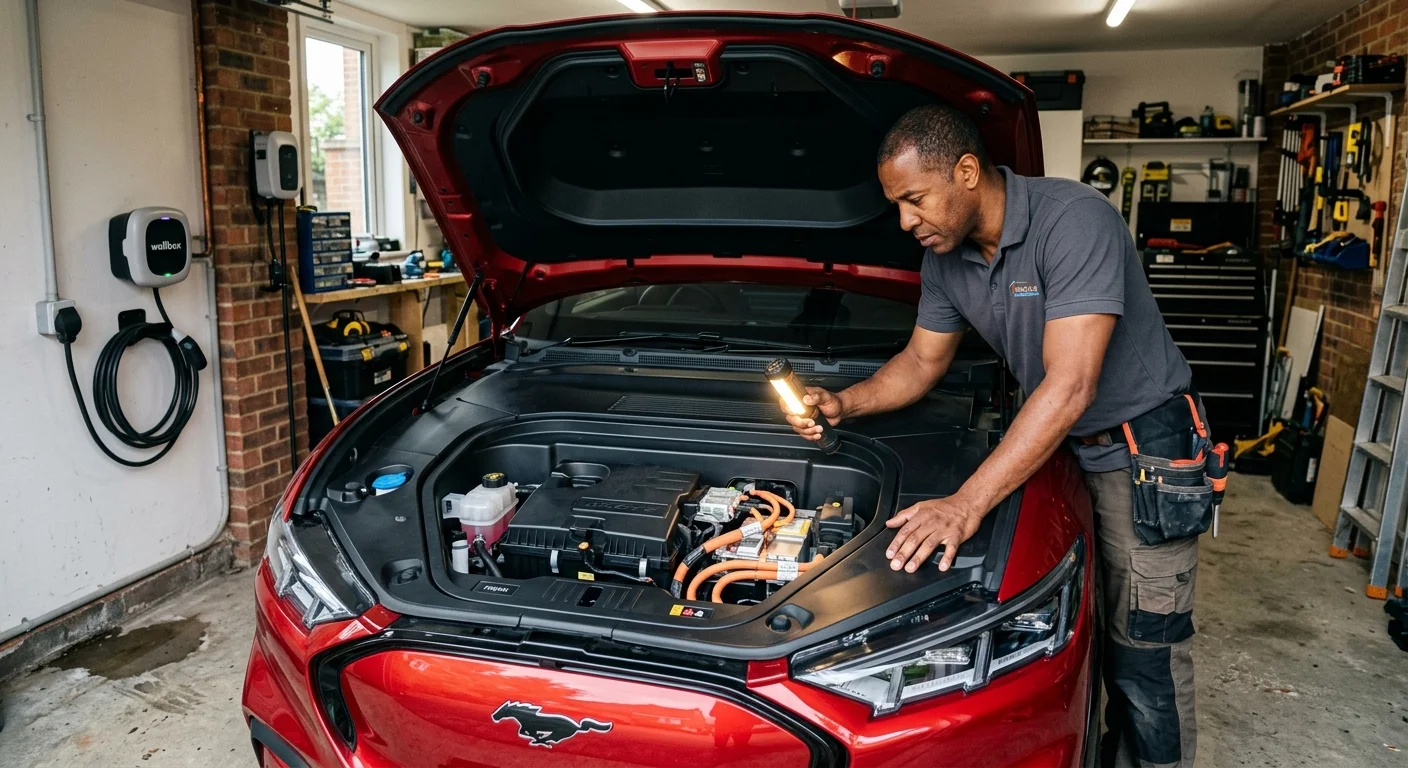
Ford put the Mach-E’s 12V under the hood, in the front trunk. You don’t crawl under the car to reach it. Use the fob or the interior release if any 12V remains. If the frunk won’t open, stop and wait for an operator. A locked frunk with a dead 12V is not a pry-bar job.
On the passenger side of the frunk you’ll find a plastic cover. Clips or small fasteners hold that cover down. Lift it and you’ll see a conventional 12-volt battery. It looks like a small lead-acid unit because it is one.
A cheap multimeter tells you more than a guess. Set it to DC volts, on a 20V scale. Put the red probe on positive and the black on negative. A rested, healthy 12V reads about 12.6 volts. Under 12 volts means it’s discharged or failing. Around 11.5 volts or lower is why the car won’t wake. Confirm the exact procedure in your owner’s manual.
A low reading doesn’t always mean the battery is finished. A jump may wake it for the drive home. Then plug in so the DC-DC converter can refill the 12V from the pack. If it goes dark again the next morning, plan on a replacement.
Jump the 12V terminals, never the high-voltage pack
You’re not jump-starting the traction battery here. You’re only waking the 12-volt system. Follow Ford’s jump points, not a random metal edge.
Ford puts easier jump terminals in the frunk. You don’t have to clamp the battery posts. Look for a positive post under a red cap. The negative is usually a marked ground bolt or bracket nearby. Use a portable jump pack, or another 12-volt vehicle. Both vehicles stay off until the clamps are set.
Clamp red to the Mach-E’s positive jump post first. Clamp black to the Mach-E’s marked ground. Then red to the donor positive, and black to the donor negative or its ground. If you’re using a pack, turn the pack on and wait. If you’re using another car, let it idle a few minutes.
Then try to wake the Mach-E. If the screens come up, the 12V took the charge. Pull the cables off in reverse: donor black, donor red, Mach-E black, Mach-E red. Keep the Mach-E awake after that. Drive it, or plug it in, so the converter can rebuild the 12V. If you shut it off in the same garage, it may go dark after dinner.
If you’ve never jumped an EV, don’t force it in a tight stall. How to jump start an electric car is the safer walkthrough. The Ford F-150 Lightning 12V path is the same idea on Ford’s truck.
Shoulder, expressway, and garage tows are different jobs
A dead Mach-E in a garage isn’t the same as a stall on SR-826. Florida Statute 316.194 says get the car off the main-traveled part when you can. Leave room for passing traffic, and keep a clear view from 200 feet each way. 316.194(2) exempts a genuinely disabled vehicle that can’t reasonably be moved off the road.
On Miami-Dade freeways, Florida’s Road Ranger Service Patrol is the free highway help. Dial *FHP, which is *347, from your phone. Rangers jump-start vehicles, handle minor repairs, and change flats. They also tow a disabled vehicle from the travel lanes to the nearest safe location. District 6 covers Miami-Dade and patrols I-95, 95 Express, I-195, I-395, I-75, 75 Express, and SR-826, the Palmetto.
Road Ranger material doesn’t mention electric vehicles or EV charging. A dead Mach-E can still need a 12V jump or a lane-clearing tow, and Rangers do both. They don’t bring a 240-volt Level 2 source. That’s the job a mobile operator fills.
If you’re on SR-112 or SR-836, GMX runs those airport-side expressways. They’re all-electronic, SunPass or toll-by-plate only. Road Rangers are still the highway answer. Your EV died on the freeway covers the legal first moves.
If a wrecker is already on a private lot, Florida Statute 715.07 still applies. The operator must stop and return the car if you appear before it’s fully removed. You pay no more than half the posted tow rate. Miami-Dade Code Section 30-476 and Broward Code Section 20-176.22 cap non-consent rates. Confirm the posted schedule before you pay.
If the car wakes but still won’t drive
Then you’re in pack or charge-port territory. The 12V already did its job. The car just has no usable range, or it won’t take a plug. Operators we connect you with bring a 240-volt Level 2 source to the car. They use a native NACS plug, or a CCS or J1772 adapter for non-Tesla EVs. That typically adds 10 to 20 miles of range in 15 to 30 minutes of charging. That’s charging time, not an arrival time. The operator quotes you before starting and bills you directly.
Call a local operator when the frunk won’t open
Don’t stand in a dark garage guessing between a DIY jump and a flatbed. Charge Pro MIA is a referral line. We match stranded EV drivers with independent local mobile rescue operators. We don’t hold a trade license, own trucks, or employ technicians. The pros we connect you with are licensed and insured. They jump or replace a dead 12V on site. They handle Tesla and every major EV brand, including the Mach-E.
If you’re still in the airport belt, Miami Springs EV rescue is the local pattern. For a non-Tesla that needs a charge or a 12V, start with non-Tesla EV rescue.
Call (786) 963-2995 and we’ll connect you with a local operator. The operator sets the price and the clock, not this line.