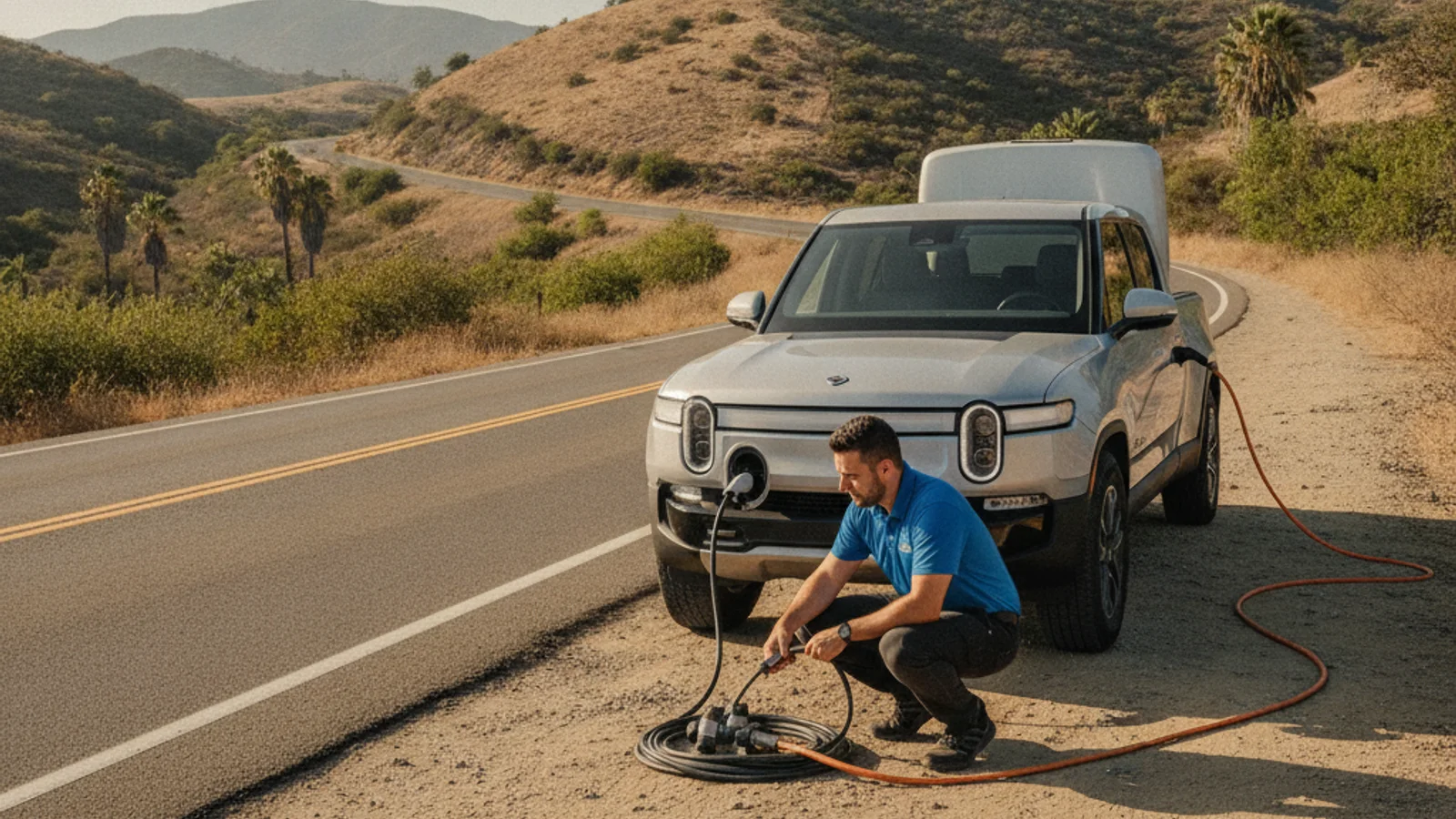
Rivian uses two different charge connectors depending on the model year. Through 2024, the R1T and R1S use the CCS combo connector. From 2025, the same models use NACS, the connector Tesla standardized. A mobile rescue operator working the South Florida metro carries both, with the right adapter for each.
The short answer
A 2024 or older Rivian R1T or R1S uses CCS for fast charging and J1772 for Level 1 and Level 2. A 2025 or newer Rivian uses NACS for both. A mobile operator brings a 240V Level 2 source with both connector types, plus adapters for less common cases. The session typically adds 10 to 20 miles of range in 15 to 30 minutes of charging.
What a 2024 Rivian uses
The 2024 Rivian R1T and R1S use the CCS combo connector for fast charging. CCS combines a J1772 upper half (used for Level 1 and Level 2 AC charging) with two large DC pins underneath for fast charging. Public DC-fast stations in the US are CCS-capable, and Rivian’s own Adventure Network uses CCS.
For Level 2 home and destination charging, the 2024 Rivian uses the J1772 upper half of the CCS connector. Any Level 2 EVSE with a J1772 plug fits the car.
What a 2025 Rivian uses
Rivian adopted NACS starting with the 2025 model year. NACS is the slim oval connector Tesla standardized and that most US automakers have committed to. A 2025 or newer Rivian uses NACS for both fast charging and Level 2 charging. NACS-equipped Rivians can also charge at CCS stations with a NACS-to-CCS adapter, which Rivian sells as an accessory.
What a mobile operator brings
A mobile rescue operator working the South Florida metro brings:
- A 240V Level 2 source with NACS and J1772 connectors.
- A CCS-to-J1772 adapter for non-Tesla EVs that need to slow-charge.
- A NACS-to-CCS adapter for NACS-equipped Rivians that need to fast-charge from a CCS source.
- A 12V jump pack.
- A 12V replacement battery for common Rivian models.
- Tools for a stuck charge port.
The operator brings the right gear for the car on site. If you tell dispatch what you drive, the operator arrives with the right connector.
What to know before you call
A few details help the operator get to you faster.
Make, model, and connector
Tell dispatch what you drive and the model year. A 2024 R1T uses CCS or J1772. A 2025 R1S uses NACS. Knowing the connector prevents the operator from arriving with the wrong cable.
Where the car is parked
A garage level, an apartment lot, a curbside spot, a shopping lot. Garage clearances vary; the operator may have to stage at the lobby and walk to your level.
Symptoms if the car is dead
A 12V-flat car and a traction-pack-empty car look different. The dashboard tells the operator which one you have.
What a Rivian mobile charging session looks like
For a low-pack call:
- The operator confirms the car is drivable and the 12V is healthy.
- The operator connects a 240V Level 2 source with the right connector for the model year.
- The session adds 10 to 20 miles of range in 15 to 30 minutes of charging.
- The driver can drive to a working station under their own power.
For a dead 12V call:
- The operator confirms the 12V is the cause with a multimeter.
- The operator applies a stable external 12V source through the manual’s jump points.
- If the 12V is dead beyond recovery, the operator replaces it on the spot.
- The operator tops up the traction pack from a 240V source if it is also low.
The operator quotes you before starting and bills you directly.
When a tow is the right call
A mobile charge fits most Rivian situations, but a tow is the right call when:
- The high-voltage system has a fault code on the dashboard.
- The car was in a collision and will not move under its own power.
- The car sat in floodwater after a king tide or storm surge.
- The charge port is mechanically jammed.
Florida Statute 316.194 lets a disabled vehicle stay where it is if it cannot practicably be moved. A tow operator on contract with your insurance takes the car to a qualified shop.
A Rivian that sat in floodwater needs special handling. NHTSA warns against parking a flood-exposed EV within 50 feet of a structure and against charging it until it has been inspected. Saltwater residue in a lithium pack can short days or weeks later.
How to keep the next call from happening
- Top up at the stations you know work. Public stations along US-1 in Miami and along I-95 in Broward are the densest.
- Keep the 12V healthy. Replace it every two to three years in this climate.
- Carry a portable Level 1 or Level 2 EVSE for emergencies.
- Watch for 12V warning messages in the weeks before a failure.
Frequently asked questions
What connector does my Rivian use?
A 2024 or older Rivian uses CCS for fast charging and J1772 for Level 1 and Level 2. A 2025 or newer Rivian uses NACS for both.
Can a mobile operator charge a Rivian with a stuck cable?
Yes. The operator brings the tools for the manual release on the R1T and R1S. They quote you before starting.
What does a mobile charge cost?
The operator quotes you before starting. Charge Pro MIA does not set the rate.
When does a Rivian need a tow, not a charge?
If the dashboard shows a high-voltage fault, the car has visible damage, or it sat in floodwater, the next step is a flatbed to a service center.
Where does a mobile operator meet a Rivian in South Florida?
The operator meets the car at the garage level, the apartment lot, the curbside spot, or the shopping lot. The operator brings the right gear for the model year.
When to call us
If your Rivian is low or dead anywhere in Miami-Dade or Broward, call us. A mobile operator meets the car with a 240V Level 2 source and a 12V jump pack. They quote you before starting and bill you directly.
Call us at (786) 963-2995 to reach a local operator.