The screens stay black. The handles don’t pop. Your Tesla sits in a Brickell garage, and it will not wake. This is tesla roadside assistance Miami when the car stays silent. A driver under a tower often can’t tell the difference. A dead 12-volt looks like an empty pack.
Two failures that look identical
A Tesla that won’t wake can be two different problems. The 12-volt battery runs the computers, locks, and contactors. When it’s flat, the high-voltage pack can still be full. The car looks bricked, and doors may not release. The app may not connect. A lot of people ask for a tow they don’t need.
The other failure is a low traction pack. You live on public plugs because the building has a waitlist. Or a few shared stalls serve hundreds of units. One thin week leaves you with almost no range in the garage. The car may still boot. It just can’t climb out to Brickell Avenue with a margin.
Those jobs aren’t the same dispatch. A Tesla 12V battery jump wakes the car. Mobile EV charging adds enough miles to reach a public plug you already use. A flatbed is the last tool, not the first. Start with Tesla won’t start: a checklist you can run before you call.
Brickell towers, Downtown, and a plug you don’t control
Miami is the vertical heart of this market. Brickell and Downtown rise as a wall of residential towers. Edgewater repeats the pattern a little north along Biscayne Boulevard. A driver lives thirty floors up. Florida Power and Light serves the city. The building still decides the garage.
Some towers have no assigned stall with a plug. Some put residents on a waitlist. Some share a handful of stalls among hundreds of units. The feeling is exclusion, not a missing street. You own the car. You still can’t charge where you sleep.
The housing stock makes that common. About 52.4% of City of Miami units were built before 1980. That’s Census ACS 2019-2023. Older panels and apartment wiring block a lot of home Level 2 installs. You live on public charging. Then the car sits. Then it doesn’t wake.
Keep the map honest. The City of Miami is one of 34 municipalities in Miami-Dade County. Brickell is in the city. Miami Beach is a separate city. South Beach is a neighborhood of Miami Beach, not its own city. You reach it on the MacArthur, Julia Tuttle, or Venetian causeway. Key Biscayne has one road, the Rickenbacker Causeway. The toll plaza doesn’t care about your percentage. A low car in a Brickell podium can already be trapped. That’s true if the next move is a bridge.
US-1 is Biscayne Boulevard here. It becomes South Dixie as you head south. I-95 ends downtown. I-395 feeds the MacArthur. SR-836, the Dolphin Expressway, runs west toward the airport. GMX runs the Dolphin. It’s SunPass or toll-by-plate, not cash.
Why the 12-volt dies in this climate
The land is flat. Miami-Dade’s highest natural point is the Atlantic Coastal Ridge at roughly 23 to 24 feet. There’s no grade penalty on range in this county. Heat and air conditioning do the work. NWS Miami 1991-2020 normals put the July and August average high at 91F. A normal year sees about 64 days at or above 90F.
Recurrent Auto studied about 30,000 EVs. It found about 5% range loss at 90F. The loss is about 17 to 18% at 100F. Cooling a 95-degree cabin can take 3 to 5 kW at first. Don’t pin those numbers on Tesla. tesla.com blocks that kind of scrape. The climate still applies.
The 12-volt has a harder life than the pack. Battery University covers heat and lead-acid life. Every roughly 15F rise in temperature halves that life. It ages about twice as fast at 93F versus 77F. It ages about four times as fast at 111F. Heat damage doesn’t reverse. Salt-laden humid air off Biscayne Bay adds corrosion on terminals and trays. Summer afternoons bring daily thunderstorms, roughly 2pm to 6pm. A Tesla that sat a week in a Brickell or Edgewater garage may not wake. The pack can still be healthy once the 12-volt comes back.
The airport version is the same failure at a larger scale. Park a week in MIA’s Dolphin Garage or Flamingo Garage. The accessory battery is the usual failure. Ibis Garage is listed with ChargePoint ports across its levels. Park 6 opened in summer 2026 with charging on site. Confirm what’s live when you leave the car. A plugged stall still doesn’t save a 12-volt that sat too long.
Valet, Kaseya Center, and Brickell City Centre
Downtown and Brickell are thick with valet. Hotel garages on the Miami Beach side do the same drain. That’s after you already crossed a causeway. The car sits with modules awake. You collect it lower than you left it. Sometimes you collect it dark.
Kaseya Center is the current name of the downtown arena, home of the Miami Heat. It was American Airlines Arena, then briefly FTX Arena. Event parking around Bayside Marketplace, Wynwood, and the Design District follows the same dwell pattern. loanDepot park in Little Havana does too.
Brickell City Centre stacks shopping, office, and residential parking in one pile. If the Tesla died in that garage, sort 12-volt versus pack first. Do that before anyone hooks a bumper. The garage walk-through is here: EV died at Brickell City Centre? How to get a charge in the garage.
Rental and Turo Teslas fail in this core for a simpler reason. The driver doesn’t know Brickell Avenue from Collins Avenue. They don’t know Miami Beach isn’t Miami. They learn it when the car is already quiet.
Tesla’s own roadside: check the app, don’t guess
Tesla runs a roadside program. You open the app, or you call Tesla. What’s included, for which months, and on which VIN is Tesla’s answer. This page couldn’t confirm those terms from Tesla’s site. So you won’t get a coverage period from us. You won’t get a mileage cap or a free-versus-paid line either. Open the app on another phone. Read the current policy for your car.
Ask one practical question if they pick up. Are they sending a 12-volt jump, a charge, or a wrecker. A service-center tow can be right for a mechanical fault. It’s a heavy answer for a flat accessory battery under a Brickell tower. It’s also heavy for a pack that only needs 10 to 20 miles. That 10 to 20 miles is enough to reach a public plug.
If you want the club-versus-local split in one place, read AAA or a local Tesla rescue: what you actually get.
What a general auto club usually sends
A general auto club covers many vehicles. The contractor on the ticket may be a regular jumper and tow. Some of those trucks can jump a 12-volt. Many can’t add 240-volt energy to a Tesla. Some won’t have a proper flatbed if you do need a tow. Wrong equipment can damage the car.
Ask it in plain words on the call. Can they jump a Tesla 12-volt. Can they bring a 240-volt Level 2 source with a native NACS plug. If you’re not in a Tesla, they need CCS or J1772. If they can only tow, what bed are they sending.
If the answer is a hook and a shrug, you’re in the wrong queue. That queue doesn’t fit a car that only needs to wake.
What the operators we connect you with bring
Charge Pro MIA is a referral line. We don’t hold a trade license. We don’t own trucks or a yard. We don’t employ technicians. We match stranded EV drivers with independent local mobile rescue operators. The operator quotes you before starting. They bill you directly. We don’t set prices. We don’t publish hours. We don’t promise when a van will appear.
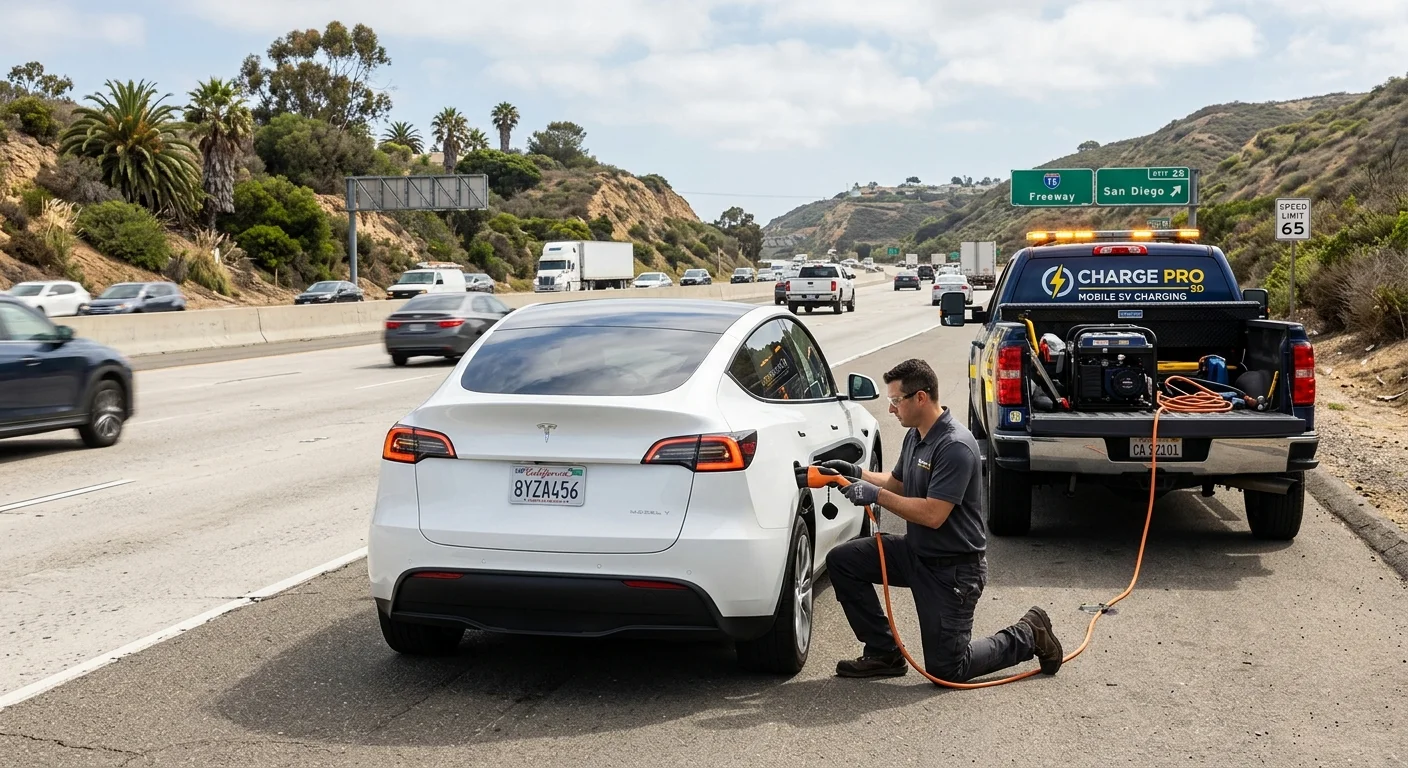
What those operators do is narrow and useful. They bring a 240-volt Level 2 source to the car. Teslas take a native NACS plug. Non-Tesla EVs use a CCS or J1772 adapter. Typical charging time adds 10 to 20 miles of range. That takes 15 to 30 minutes on the plug. That’s time on the plug, never an arrival claim. They can jump or replace a dead 12-volt on site. They handle Tesla and every major EV brand.
In a Brickell stack, that can wake a silent car. It can also put enough range on the pack to exit onto Brickell Avenue. You still have to clear the garage. Tell security you need a mobile rescue, not a wrecker, if that’s the job. A Level 2 van needs a legal place to stand. A tow staging bay is a different request.
For the Tesla-shaped ticket, start with Tesla roadside rescue. City context lives on the Miami EV charging hub.
If you’re on I-95 or a causeway instead
Not every dead Tesla here is under a tower. I-95 dumps into downtown. I-395 feeds South Beach. The Palmetto, SR-826, is the belt. If you’re on a shoulder, treat the lane first.
Florida Statute 316.194 says leave the vehicle off the main-traveled part where practicable. Leave room for passing traffic. Keep a clear view from 200 feet each way. 316.194(2) exempts a genuinely disabled vehicle that can’t practicably be moved.
Florida’s Road Ranger Service Patrol is the state’s free highway patrol for disabled vehicles. District 6 covers Miami-Dade. It patrols I-95, 95 Express, I-195, I-395, I-75, 75 Express, and SR-826. Dial *FHP, which is *347, from a mobile phone. Road Rangers jump-start vehicles and make minor repairs. They change flats. They tow a disabled vehicle from the travel lanes to the nearest safe location. All of that is free. No Road Ranger page we read mentions electric vehicles or EV charging. Don’t twist that into “they can’t help an EV.” A dead Tesla still needs a 12-volt jump or a move off the lane. Both of those they do. A Level 2 charge isn’t something they provide. That’s the job a mobile operator takes after you’re out of the travel lane.
Florida Highway Patrol takes disabled-motorist reports on the same *FHP short code. Florida 511 at FL511.com is FDOT’s official traffic feed, in English and Spanish.
If the original plan was Miami Beach or Key Biscayne, this isn’t a next-block problem. The way off is a bridge. Get the car awake and charged enough for the causeway before you join that traffic.
Private garages and a wrecker you didn’t order
A Brickell podium garage is private property. Florida Statute 715.07 sets the non-consent tow rules that matter here. A tow operator must stop and return the vehicle if you appear in time. That means before it’s fully removed. You then pay no more than half the posted tow rate. That’s a statute, not a price we can quote. Confirm the posted rate on the garage sign.
The property must carry a permanent, reflective, correctly sized tow-away zone sign at each access. It must be posted at least 24 hours ahead, with listed exceptions. Miami-Dade is a county of 500,000 or more. The towed vehicle must be stored within a 10-mile radius. It must be released within one hour of request.
Miami-Dade Code Section 30-476 caps maximum immobilization, nonconsent towing, and storage rates. The dollar schedule sits behind a page that didn’t load for this research. Don’t pay from a blog. Ask for the posted cap. If the garage is already calling a wrecker, get downstairs.
Pick the call from the symptom
Start with what the car is doing.
Dark screens, no handles, app silent: treat it as a 12-volt first. Use the mechanical release only if you know the one for your model. A jump on site is the usual fix. If it dies again after the jump, replacement is next, not another hope.
Car wakes, range is a sliver, you’re in the tower: you need energy. A Level 2 top-up is built for that. You’re not proving the neighborhood has no public plugs. You’re buying miles to reach the plug you already use.
Car is on an I-95, I-395, or Palmetto shoulder: hazards on. *FHP first if you’re in a lane. Then a mobile operator once the van has somewhere legal to stand.
Car sat at MIA: start with the 12-volt. A Heat game at Kaseya Center is the same drain. Long dwell kills accessories. The pack is the second guess.
Water is a stop. King tides run mainly September through November. If water reached the pack or the port, don’t request a charge. NHTSA warns residual salt in a flooded lithium battery can bridge and short. Fires can start days to weeks later. Don’t park a flood-exposed EV within 50 feet of a structure.
When the Brickell garage stays dark
If the Tesla is silent under a Miami tower, you want the right operator. The same is true if it’s awake with no miles to exit the stack. You want someone who can jump a 12-volt. Or they can put Level 2 on the port. Charge Pro MIA connects you with that independent pro. We serve every city in the county. We don’t perform the work. The operator quotes before any cable goes on.
Call (786) 963-2995 and we’ll connect you with a local operator.