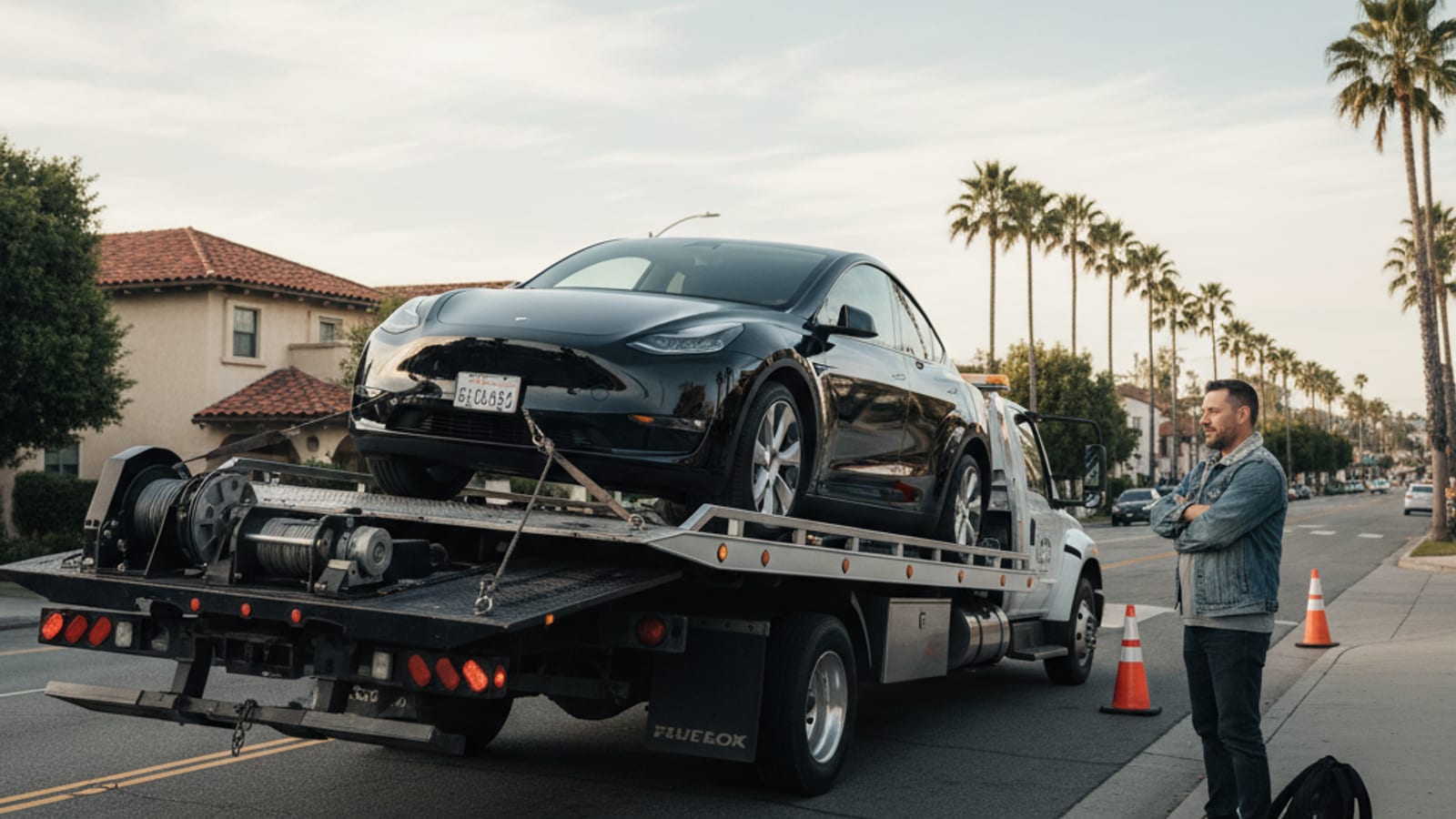
Tesla’s roadside card dispatches a contracted network, not Tesla’s own service vans. The services the card covers are real but limited. The services that fall outside the card are exactly the calls that hit South Florida EV drivers every week. Here is what the card covers and what to keep handy for the rest.
The short answer
Tesla roadside covers towing, lockout, flat-tire change with the spare, fuel delivery for a gas car, and winching. It does not dispatch a 240V truck to your location, a 12V jump to a tower garage, or a manual charge port release. For the calls the card does not cover, a local mobile operator is the path.
What the card sends
The card dispatches through a contracted network. In South Florida, the dispatched provider is usually a flatbed operator on contract with the network. The provider sends a truck based on the service:
- Tow: a flatbed truck to take the car to a Tesla service center or a contracted shop.
- Lockout: a service van with the tools to open the door without damage.
- Flat-tire change with the spare: a service van with a jack and the tools to swap the tire.
- Fuel delivery for a gas car: a service vehicle with a small amount of fuel.
- Winching: a truck with the rigging to pull the car out of a ditch or snow.
The card does not send a 240V Level 2 truck. It does not send a 12V jump pack. It does not send a charge port release tool.
Why the card misses the calls that come up most
The South Florida EV stranding pattern is different from the gas-car pattern. Most calls are:
- A dead 12V in a tower garage. The traction pack has range. A jump at the curb is the answer.
- A low pack with no home plug. A 240V top-up at the curb is the answer.
- A stuck cable at a public station. A manual release is the answer.
None of those fits the tow-to-a-shop model. They fit a mobile operator who comes to the car.
What the card does not cover
The card does not dispatch:
- A 240V Level 2 truck to your location. A mobile top-up at the curb is not part of the program.
- A 12V jump to a tower garage. The dispatched service may attempt a jump if the truck carries the right pack, but the program does not guarantee it.
- A manual charge port release. The card sends a tow if the cable cannot be released through the manual procedure.
- Off-hours mobile service. The contracted network may not have an EV-capable truck after hours.
When the card is enough
The card fits the calls that need a shop:
- A Tesla with no power after a collision on I-95.
- A Tesla that cannot unlock after a fender bender in a parking garage.
- A Tesla with a mechanical failure that needs a flatbed to a service center.
For those calls, the card covers the tow and the driver does not pay out of pocket.
When the card is not enough
The card does not fit the calls that need on-location help:
- A Tesla in a Brickell tower with a dead 12V. Use the local operator for a jump.
- A Tesla at 4% in Aventura with no home plug. Use the local operator for a 240V top-up.
- A Tesla with a stuck cable at a public station. Use the local operator for the manual release.
What a local mobile operator does
A mobile rescue operator working the South Florida metro brings:
- A 240V Level 2 source with a NACS connector.
- A 12V jump pack.
- A 12V replacement battery for common Tesla models.
- Tools for a stuck charge port.
The session typically adds 10 to 20 miles of range in 15 to 30 minutes of charging. That is charging time, not a promise about when someone arrives. The operator quotes you before starting and bills you directly.
How to set up the right backup
The cleanest setup is to treat Tesla’s included roadside as your tow coverage and keep a separate number for the on-location calls.
- Tesla roadside in the Tesla app and on a card in the glove box.
- Charge Pro MIA’s number in your phone for the on-location calls.
When the card covers the call, use the card. When it does not, use the local operator.
Common South Florida calls
- A Model Y in a Brickell tower for a long vacation. The 12V drains flat. Use the local operator.
- A Model 3 at MIA for ten days. Same drain. Use the local operator.
- A Model S in Fort Lauderdale Beach with a stuck cable. Use the local operator.
- A Model X with a mechanical failure on US-1. Use the Tesla card for a tow to a service center.
Frequently asked questions
Does Tesla roadside cover a 12V jump at my location?
The card dispatches a contracted service that can attempt a 12V jump. Whether the truck carries the right pack for an EV depends on the provider.
Does Tesla roadside cover a mobile EV charge?
No. The card dispatches a flatbed for tow calls and a service van for lockout and tire changes. It does not dispatch a 240V truck.
What does a local mobile charge cost?
The operator quotes you before starting. Charge Pro MIA does not set the rate.
When does a Tesla need a tow, not a charge?
If the dashboard shows a high-voltage fault, the car has visible damage, or it sat in floodwater, the next step is a flatbed to a service center.
Where does Tesla roadside tow a car in South Florida?
The destination is set by the contracted dispatcher. Most often it is the nearest Tesla service center in Miami or Fort Lauderdale.
When to call us
If your Tesla is low or dead anywhere in Miami-Dade or Broward, call us before you call for a tow. A mobile operator meets the car with a 240V Level 2 source and a 12V jump pack. They quote you before starting and bill you directly.
Call us at (786) 963-2995 to reach a local operator.