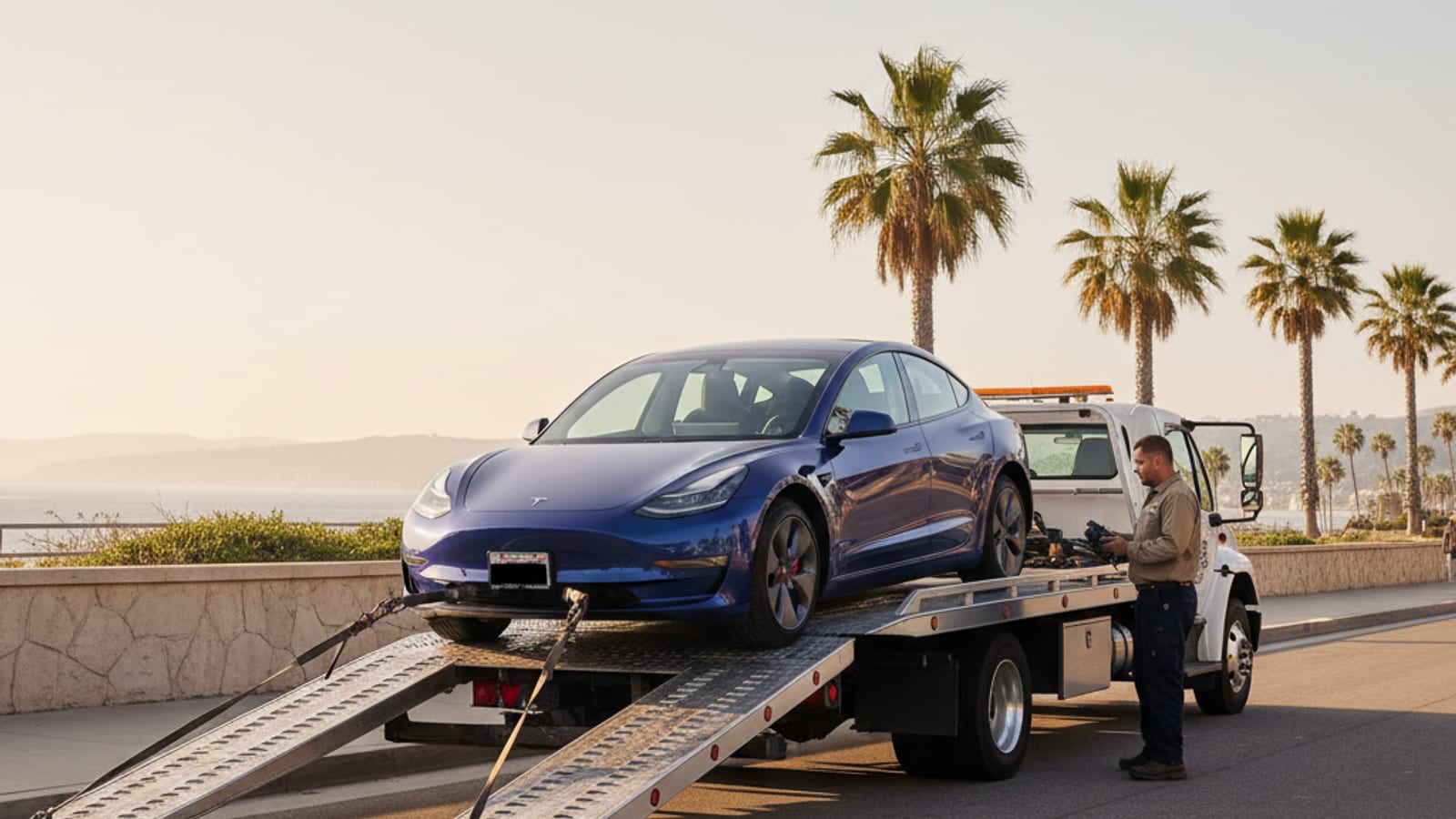
Uber’s roadside assistance program, sold to drivers through partnerships with motor clubs, is built around the gas-car model. A tow, a tire change with the spare, a lockout, a fuel delivery for a gas car. Not a 240V truck to your location. If you drive for Uber or Lyft on the Uber roadside program, here is what is covered and what is not.
The short answer
Uber’s roadside program covers a tow, a tire change with the spare, a lockout, a fuel delivery for a gas car, and a jump start. It does not cover a 240V mobile EV charge at your location. For an EV at 4% on a South Florida shoulder, the program does not bring a charge truck. A local mobile operator covers that.
What the Uber roadside program covers
The Uber roadside program is sold through partnerships with motor clubs. The exact coverage depends on the partner and the Uber driver’s plan, but the standard coverage includes:
- Towing to the nearest qualified shop, up to a per-disable limit.
- Tire change with the spare on the car.
- Lockout assistance.
- Fuel delivery for a gas car.
- Jump start for a 12V battery.
What the program does not cover:
- A 240V mobile EV charge at your location.
- An on-location 12V jump delivered to a Brickell tower or a MIA garage.
- A manual charge port release for a stuck cable.
Why the program misses the EV calls
The Uber roadside program is built around the gas-car mental model: the disabled car needs a tow to a shop. The EV stranding pattern in South Florida is different:
- A Tesla or other EV at 4% on a South Florida shoulder. The traction pack is low but the car is drivable. A 240V top-up at the curb is the clean answer.
- A Tesla with a dead 12V in a Brickell tower. The traction pack has range. A jump at the curb is the answer.
- A Tesla with a stuck cable at a public station. The manual release is the answer.
None of those fits the tow-to-a-shop model. They fit a mobile operator who comes to the car.
What Uber drivers experience in South Florida
The Uber driver population in South Florida skews toward late-model EVs, especially Tesla Model 3 and Model Y. The drivers who depend on the Uber roadside program are the ones who do not have a backup plan for an EV stranding.
The pattern that comes up:
- A Model Y at 4% on the MacArthur Causeway during a rideshare shift. The Uber roadside program dispatches a tow. The driver pays out of pocket for a tow to a charger.
- A Model 3 with a dead 12V at MIA after a long sit. The Uber roadside program dispatches a tow. The driver pays out of pocket for a tow to a service center.
- A Model Y with a stuck cable at a public station. The Uber roadside program may dispatch a tow. The driver pays out of pocket for a manual release.
A local mobile operator covers all three calls without a tow.
What a local mobile operator does
A mobile rescue operator working the South Florida metro brings:
- A 240V Level 2 source with NACS, CCS, and J1772 connectors.
- A 12V jump pack.
- A 12V replacement battery for common Tesla models.
- Tools for a stuck charge port.
The session typically adds 10 to 20 miles of range in 15 to 30 minutes of charging. That is charging time, not a promise about when someone arrives. The operator quotes you before starting and bills you directly.
For an Uber driver, the math is simple. A mobile charge costs less than a tow, gets you back on the road faster, and avoids the lost shift time of a tow to a charger.
How Uber drivers can set up a backup
The cleanest setup is to treat the Uber roadside program as your tow coverage and keep a separate number for the on-location calls.
- Uber roadside through the driver app.
- Charge Pro MIA’s number for the on-location calls that the Uber program does not cover.
Keep the local number in your phone. When the Uber program covers the call, use the Uber program. When it does not, use the local operator.
Common South Florida Uber driver calls
- A Model Y at 4% on the causeway during a shift. Use the local operator for a 240V top-up.
- A Model 3 with a dead 12V at MIA. Use the local operator for a 12V jump.
- A Model Y with a stuck cable at a public station. Use the local operator for the manual release.
- A Model 3 with a mechanical failure on I-95. Use the Uber program for a tow to a qualified shop.
Frequently asked questions
Does Uber roadside cover a mobile EV charge?
No. The program covers a tow, a tire change with the spare, a lockout, a fuel delivery for a gas car, and a jump start. It does not dispatch a 240V truck.
Does Uber roadside cover a 12V jump?
The program covers a jump start through the partner motor club. Whether the dispatched service carries the right pack for an EV depends on the provider. For a guaranteed on-location jump, the local operator is the path.
What does a local mobile charge cost?
The operator quotes you before starting. Charge Pro MIA does not set the rate.
When does an Uber driver’s EV need a tow, not a charge?
If the dashboard shows a high-voltage fault, the car has visible damage, or it sat in floodwater, the next step is a flatbed to a service center.
Where does Uber roadside tow a car in South Florida?
The destination is set by the partner motor club. Most often it is the nearest qualified shop.
When to call us
If your EV is low or dead anywhere in Miami-Dade or Broward, call us before you call for a tow. A mobile operator meets the car with a 240V Level 2 source and a 12V jump pack. They quote you before starting and bill you directly.
Call us at (786) 963-2995 to reach a local operator.