The Chevy Bolt won’t charge for reasons that are usually small. In older Miami-Dade housing, that small fault still strands you. Many Bolts here live on a shared public plug. There’s no wall unit in the driveway when the session fails.
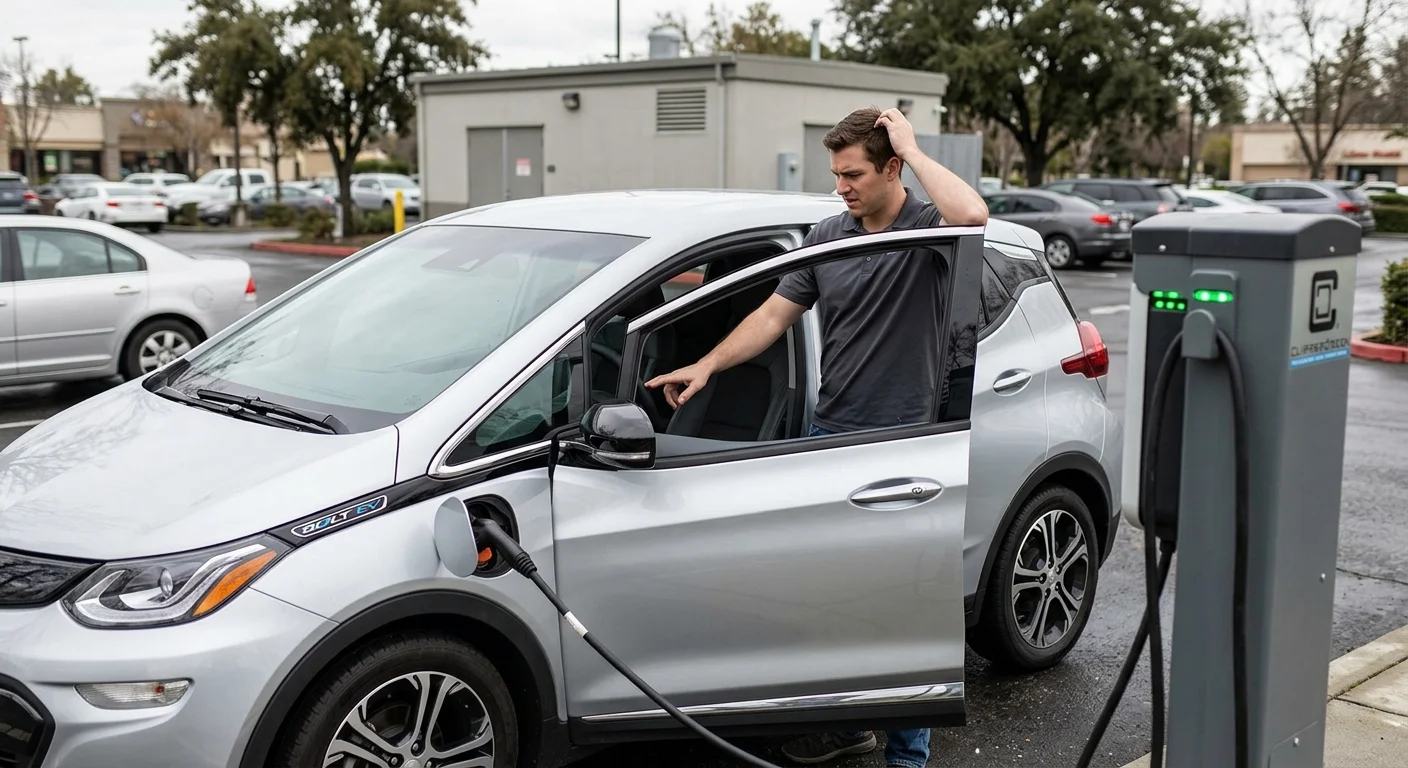
Older Miami-Dade housing turns a failed plug into a stranding
North Miami’s housing is 82.7% built before 1980. Miami Springs is 89.5% pre-1980. Hollywood, in Broward, is 74.7% pre-1980. Hialeah is 60.1% pre-1980 and 95.2% Hispanic or Latino. Those are the blocks where a home Level 2 often isn’t installable. Parking is a street space, a tight lot, or a condo stall with no circuit.
Doral is only 5.5% pre-1980. Parkland is 1.7%, and Weston is 7.0%. That newer stock is where a garage charger is common. A Bolt in Doral doesn’t live the same charging life as a Bolt in Hialeah. The Hialeah car depends on public posts, workplace pedestals, and FPL EVolution stalls. When one of those refuses the Bolt, you’re stuck unless help comes to the car.
Florida Power and Light serves essentially all of Miami-Dade and all of Broward. Homestead is the confirmed exception. Homestead Public Services Energy covers parts of that city. Other Homestead streets stay on FPL. Confirm your meter at homesteadfl.gov or at (305) 224-4800. No EV-specific program turned up on HPS Energy’s pages. That’s an observed absence, not proof that none exists.
FPL’s public charging brand is EVolution. EVolution Home is the residential Level 2 program. This page doesn’t print those dollar figures. Ask FPL for the current terms before you enroll.
The City of Miami is one of 34 municipalities in Miami-Dade County. The ACS count is 446,663. The 2024 estimate is 487,014. Hialeah holds 221,901. Kendall, Tamiami, and Westchester are census-designated places, not cities. Your Bolt still needs a plug that works.
Florida had about 450,400 registered EVs in 2025, per DOE AFDC registration data. Bolts use J1772 for AC and CCS for DC fast. A Tesla Supercharger stall doesn’t save a Bolt.
Check the session in front of you
Start with the stall you’re already touching. Watch the station screen and the Bolt’s charge lights together. Then move to the next handle on the same cabinet if there’s one. Cabinets fail one stall at a time. Your car isn’t the first suspect.
Seat the J1772 until it clicks. The Bolt’s port sits on the driver’s front fender. A handle that looks seated can still sit short. Don’t lean on it. Push until the latch takes.
If you’re on a house circuit, check the breaker and any GFCI. Afternoon thunderstorms here run roughly 2pm to 6pm. A wet outdoor outlet trips and looks like a dead car. Reset once. If it trips again, stop. That’s wiring, not a Bolt glitch.
Level 2 and DC fast are different systems. A failed pedestal doesn’t mean DC fast will fail too. If a working DC post accepts the Bolt, look at the onboard AC path next. If both refuse, stop hopping sites. The car, the 12-volt, or a setting is next.
Use the myChevrolet app as a second gauge
Open myChevrolet before you yank the handle a third time. Read the charging status, not the station map.
Scheduled charging is the quiet one. You set a departure time last week. The Bolt sits on a live plug and waits. Thirty seconds on the dash looks like a failure. The app shows a clock.
Charge limit is the other quiet one. If the slider matches the percent you already hold, the car is done on purpose.
Compare the app to the dash. If they disagree, screenshot both. They’re what you read to a tech later.
When range is already thin, you need the right apps in the right order. Which charging apps to open when your range is already thin is that list.
Port, latch, and water on coastal streets
Sometimes the pack is fine and the port isn’t. The handle goes in. Nothing starts. Or the handle won’t come back out.
King tides run mainly September through November. Each pulse lasts about three hours. They hit Miami Beach, Hollywood’s low coastal streets, and the Las Olas Isles in Fort Lauderdale. Standing water at bumper height can wet a low port. If that happened, stop forcing the latch.
Dry what you can see. Wait a few minutes. Try one gentle seat. For saltwater in the inlet, water in the charge port after a king tide is the local walkthrough.
A cracked, scorched, or melted connector isn’t a reset. Unplug if it will release. Don’t charge. That’s dealer work.
Heat, not hills, is what thinned your range
South Florida is flat. Miami-Dade’s highest natural point is the Atlantic Coastal Ridge at roughly 23 to 24 feet. Broward’s is Pine Island Ridge at about 29 feet. There’s no grade penalty on range in these two counties. What you lose is heat, air conditioning, and dwell.
NWS Miami 1991-2020 normals put the July and August average high at 91F. A normal year sees about 64 days at or above 90F. Recurrent Auto’s fleet study of about 30,000 EVs found about 5% range loss at 90F. At 100F, the same study found about 17 to 18% loss. Bringing a 95-degree cabin down can take 3 to 5 kW. Holding it cool takes about 1 kW. AAA’s 2019 SAE-standard test found about a 17% range drop at 95F with the AC on.
That’s why a public-plug Bolt arrives at the stall already thin. You spent the afternoon in traffic with the AC on. You needed this session. When it fails, North Miami often doesn’t have a home wall the way Weston might.
If the station says connected and the amps never come, stay with the car. The stall or the handshake is the problem.
A weak 12-volt can block charging
The Bolt still has a 12-volt battery under the hood, usually on the driver’s side. That small battery runs the computers. It closes the contactors high-voltage charging needs. A weak 12-volt can leave the dash half-alive and the port dead. It can also leave the car fully silent. The drive pack can still be full.
Heat is the local reason this happens so often. Battery University notes that every roughly 15F rise halves the life of a lead-acid battery. It ages about twice as fast at 93F versus 77F. At 111F it ages about four times as fast. The damage doesn’t reverse.
Airport parking is the classic trigger. You leave the Bolt for a week. You come back, and it won’t wake. At Miami International that includes the Dolphin Garage, the Flamingo Garage, the Ibis Garage, and Park 6 long-term. Motorist help through garage parking is (305) 876-7536. That number is parking help, not a mobile charger. The Ibis Garage page says ChargePoint EV ports sit across its levels. Those ports don’t help if the 12-volt won’t close the relays.
Don’t guess at clamp points if you’ve never jumped an EV. Treat a silent Bolt after a long sit as a 12-volt job first. What happens when an EV’s 12-volt battery dies in this climate walks that pattern. Chevy’s other electric crossover shows the same charge refusal: Chevy Equinox EV won’t charge.
One reset, then stop looping
If the plug is seated and the app isn’t delaying you, try one reset. Unplug. Power the Bolt all the way off. Open the driver’s door, close it, and wait a few minutes. Power it back on. Plug in once.
That can clear a stuck module. It isn’t a repair. If it works, move the car and get it scanned. If it fails twice, looping the same steps wastes the afternoon.
Don’t stand in a private garage cycling the handle while a tow crew hooks the car. Florida Statute 715.07 governs tows from private property. Miami-Dade and Broward both exceed 500,000 people. So the storage lot must sit within a 10-mile radius. The operator must release the car within one hour of request. If you show up before the car is fully removed, they have to stop and return it. You then pay no more than half the posted tow rate. This page doesn’t print that dollar amount. Miami-Dade’s cap is Code Section 30-476. Broward’s is Code Section 20-176.22. Read the posted sign. Confirm current figures with county consumer protection. This matters at Aventura Mall, Dadeland Mall, Dolphin Mall near Doral, and Brickell City Centre.
On a freeway, move off the travel lane first
If the Bolt died on a highway, get out of the travel lane if you can. Florida Statute 316.194 says a vehicle on a highway outside a municipality must sit off the main-traveled part where practicable. Leave room for passing traffic. Leave a clear view from 200 feet each way. 316.194(2) exempts a genuinely disabled vehicle that can’t practicably be moved.
Hazards on. Stay out of the travel lanes. Dial *FHP (*347) for Florida Highway Patrol and the Road Ranger Service Patrol. Road Rangers jump-start vehicles and make minor repairs. They change flats and provide gas, diesel, and water. They also tow a disabled vehicle from the travel lanes to the nearest safe location, free of charge. Their published materials don’t mention electric vehicles or EV charging. They can still jump a 12-volt. They can still move you off I-95, 95 Express, I-75, or SR-826, the Palmetto. FDOT District 6 covers those Miami-Dade roads. District 4 covers I-95 through Broward from the Miami-Dade line north.
Florida 511 at FL511.com is FDOT’s traffic system, in English and Spanish.
A Road Ranger move to a safe spot isn’t energy in the pack. If the Bolt is empty and the 12-volt is fine, you still need a charge at the car.
95 Express and 595 Express are FDOT. The former Miami-Dade Expressway roads now sit with the Greater Miami Expressway Agency, including SR-836, the Dolphin. All of them are all-electronic. SunPass or toll-by-plate. None takes cash. No facility published a disabled-vehicle rule unique to its express lanes. Road Rangers still work those corridors.
A mobile charge for a Bolt is J1772 at the car
Charge Pro MIA is a referral line. It matches stranded EV drivers with independent local operators. It performs no work. It owns no trucks. It employs no technicians. It sets no prices. It promises no arrival time. The operator quotes you before starting and bills you directly.
The operators we connect you with bring a 240-volt Level 2 source to the car. Their native plug is NACS. For a Bolt they use a J1772 or CCS adapter. Typical charging time, never travel time, adds about 10 to 20 miles of range in 15 to 30 minutes. That’s enough to leave a dead stall, a condo lot, or a shoulder and reach a working post. They can also jump or replace a dead 12-volt on site. They handle Tesla and every major EV brand, including Chevy.
That’s non-Tesla EV rescue and mobile EV charging. A flatbed is the right tool after a crash, or after flood water. It’s the slow tool for a charge handshake.
Hurricane season runs June 1 to November 30. FPL tells EV owners to keep the pack between 50 and 80% through the season. Unplug during the storm. Don’t charge or drive a flood-exposed EV until it’s inspected. NHTSA warns that residual salt in a flooded lithium battery can short days later. A flood-exposed EV shouldn’t sit within 50 feet of a structure. If your Bolt sat in storm water, don’t plug it in. Get it inspected.
A Bolt that won’t handshake in a Hialeah lot is the everyday version of this problem. EV roadside assistance in Hialeah when you live on public plugs is written for that pattern.
Shop work versus getting the car moving
If those checks still leave a charge refusal, the fault may be inside the Bolt. That can be the onboard charger, the port latch, or a high-voltage isolation fault. A mobile truck can still add enough range to roll to a Chevy store. It can’t rebuild an onboard charger in a parking space.
University of Miami’s main campus is in Coral Gables, not the City of Miami. The checklist doesn’t change. Port, app, 12-volt, one reset. Then a charge at the car, or a shop if the car itself is the fault.
If you’ve walked those steps, call (786) 963-2995. Say whether the Bolt is silent. Say whether it wakes but won’t charge. Say whether you’re on a shoulder or in a lot. The operator quotes before any work starts.