Your remaining range is already smaller than the number on the dash. Heat and air conditioning take a cut before you reach any pin. Open apps for EV charging while you can still change the plan. After zero, the map is only a picture.
Heat spends the miles your apps still count
South Florida is flat, so hills aren’t the range tax. Miami-Dade’s high point is the Atlantic Coastal Ridge at about 23 to 24 feet. Broward’s Pine Island Ridge is around 29 feet. Heat and the first blast of AC are what shrink a trip.
NWS Miami’s 1991-2020 normals put July and August highs near 91F. A normal year sees about 64 days at or above 90F. Recurrent Auto’s study of about 30,000 EVs finds about 5% range loss at 90F, and about 17 to 18% at 100F. Cooling a 95-degree cabin can take 3 to 5 kW at first.
A green pin from Coral Gables can look tight on the Palmetto later. The apps didn’t fail at math. Weather changed the budget you left with.
Status screens don’t inventory every stall
Apps for EV charging plot where hardware has been reported. They don’t sit in the stall with you. A listed site can show available while cables are occupied, erroring, or gated. A crowd note from last Tuesday is one session, not a live camera.
Florida had about 450,400 registered EVs in 2025, according to DOE AFDC registration data. It still explains crowded plugs at Aventura Mall, Dadeland, Sawgrass Mills, and Brickell City Centre.
FPL serves essentially all of Miami-Dade and all of Broward. FPL EVolution is FPL’s public charging brand. Check FPL’s own tools for FPL’s gear. Don’t expect that map to cover every other network on the block.
Let the car’s own app do the range math
Your maker’s app talks to the pack in your car. Most third-party maps skip that live state. On a thin-range day, that difference is the whole point. It can use your real charge, climate load, and current route.
We won’t name a maker app or freeze a feature list, because software moves. Your manual, the car’s screen, or the maker’s site is the current answer.
Treat the suggested stop as a draft, and confirm it before the last miles. A Supercharger, CCS cabinet, or Level 2 lot in the plan isn’t a stall you can see from here.
That check matters on long roads and on a beach errand. I-95, the Palmetto, the Dolphin, the Turnpike, and the Sawgrass all look clean on a phone. They’re all-electronic, with SunPass or toll-by-plate and no cash booths. Facility operators don’t publish a free charging stall as an express-lane perk. Road Rangers do patrol several of those corridors, which is separate from a plug.
If you stall on a highway outside a municipality, Florida Statute 316.194 says to leave the vehicle off the main-traveled part where practicable. 316.194(2) exempts a genuinely disabled vehicle that can’t practicably be moved. Get out of the travel lane first, then reopen the maps.
Then open the network that owns the hardware
The car’s app is your range math. The network app is closer to that network’s own live status, and it’s also blind to everyone else. One saved app is a habit. Two or three before a longer run is a real check.
A Tesla still needs a second look if the backup stop isn’t Tesla hardware. A CCS or J1772 car still needs to confirm the site will accept that plug. We’re not ranking network apps or describing current buttons. Coverage and reliability change, so the network’s own site is the source for what it does today.
For a government inventory view, the DOE Alternative Fuels Data Center station locator draws from reported infrastructure. It isn’t a live availability feed. Use it to see what’s been reported, not what’s free later.
Miami International’s Ibis Garage lists ChargePoint ports across its levels, and Park 6 lists EV charging on site. Don’t treat a garage listing as a guaranteed open cable after a flight.
Aggregators show more dots. They don’t prove a plug.
Aggregator maps mash networks into one view, and some add driver comments. That’s handy when you’re crossing mixed lots from Doral toward Aventura or Kendall. You see options a single-brand app would hide.
The honest limit is the same for every listing, because the app doesn’t own the equipment. Occupied, broken, valet-only, or flooded still renders as a pin. King tides run mainly September through November. They hit Miami Beach, Hollywood, and Fort Lauderdale’s Las Olas Isles. A low coastal stall can sit in water while the app still looks fine.
If the percentage is already sliding, stop installing another map. Read what to do when the pack is running low. Another icon isn’t a charge.
Local context still beats a national default zoom. Our South Florida charging hub is built around this metro, from the City of Miami to Miami Beach across the causeway.
Home plugs and tower decks aren’t the same backup
Newer inland housing often has a path to a wall connector. Doral’s stock is only 5.5% pre-1980, Weston about 7.0%, and Parkland about 1.7%. If you can still roll home, the public map matters less.
Older streets don’t give you that undo. North Miami is 82.7% pre-1980, Miami Springs 89.5%, Hollywood 74.7%, and Hialeah 60.1%. Many of those buildings never had a 240-volt run to a stall. When a listed public plug fails, you may not have a garage circuit waiting.
Tower and condo parking adds a gate the pin doesn’t show. You can be looking at a stall you can’t badge into. Miami Beach isn’t a neighborhood of Miami. It’s a separate city. Spending the last miles across a causeway for a nearby garage can leave you committed, so turn around while you still can.
A silent car after a week at MIA is often the 12-volt battery, not an empty pack. Systems keep sipping power in the Dolphin, Flamingo, Ibis, and Park 6 garages. Refreshing charging apps won’t wake a car that needs a 12V jump.
If you’re plugged in and nothing starts, that’s a hardware problem. Walk the steps for a public charger that isn’t working before you burn miles on the next listing.
Road Rangers move you. They don’t bring Level 2.
On I-95, I-195, I-395, I-75, 95 Express, or the Palmetto, FDOT’s Road Ranger Service Patrol is the free highway help. District 6 covers those Miami-Dade roads. District 4 covers Broward’s I-95 from the county line north, plus portions of I-595 and I-75. Dial *FHP (*347).
Road Rangers jump-start vehicles, make minor repairs, and change flats. They provide gas, diesel, and water. They also tow a disabled vehicle from the travel lanes to the nearest safe location. Their published material doesn’t mention EV charging. They can still clear a live lane or jump a 12V. They don’t roll up with a 240-volt Level 2 source. That’s what a mobile charging operator brings.
When you should stop refreshing and call
More apps won’t create a stall. If you can’t honestly spend remaining miles on any pin, park safe and switch jobs. You need energy at the car, not another map.
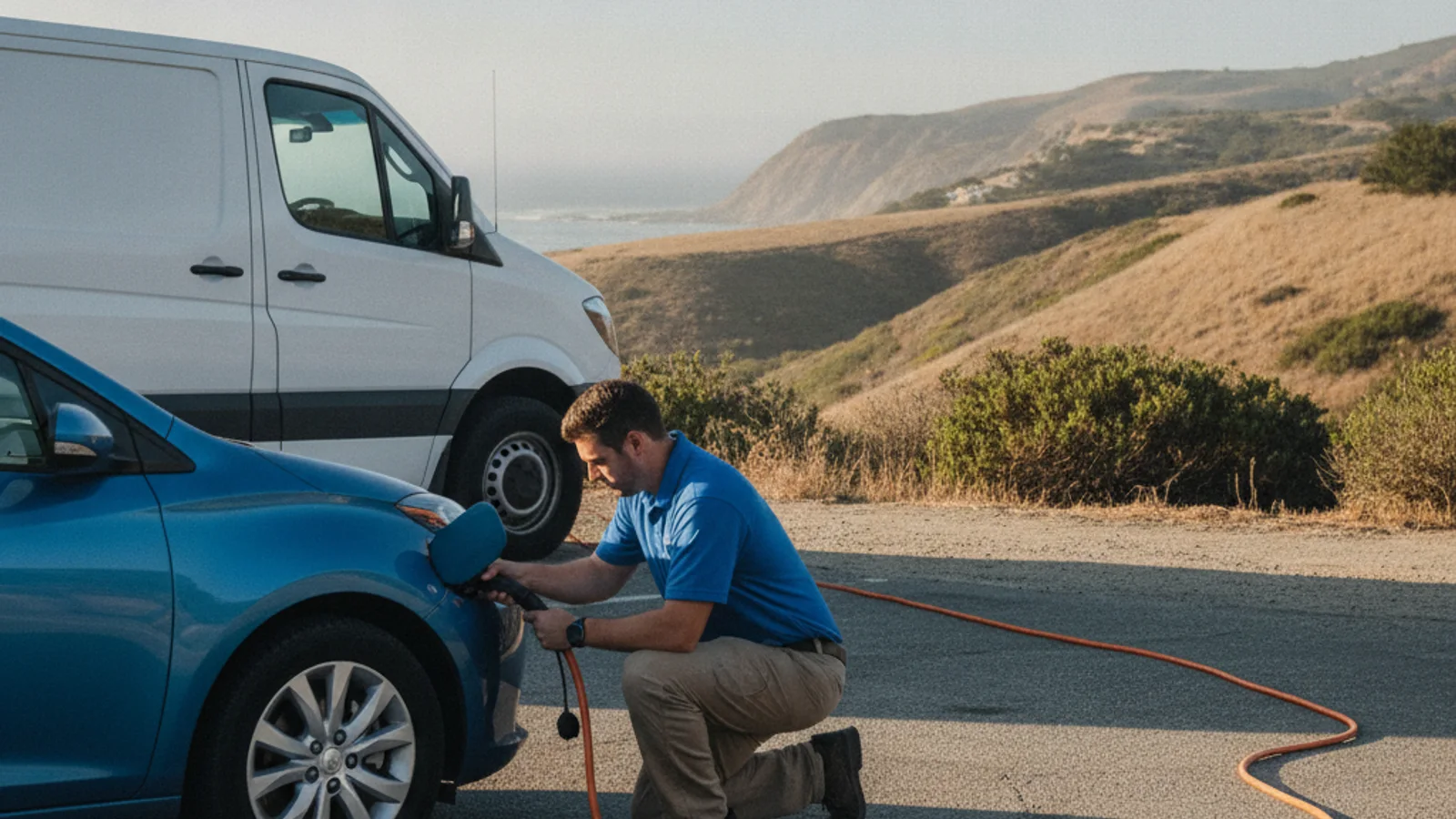
Independent operators we connect you with bring 240V Level 2 to a parked EV. They come with a native NACS plug for Teslas, plus CCS or J1772 adapters for other brands. They typically add 10 to 20 miles of range in 15 to 30 minutes of charging. That’s charging time, never an arrival time. They also jump or replace a dead 12V on site for Tesla and every major EV brand.
If the pack is already at zero, or the spot can’t take a charge, ask about out-of-charge recovery. The operator quotes you before starting and bills you directly. Charge Pro MIA doesn’t set prices, own trucks, or employ technicians. We’re a referral line. The pros we connect you with are licensed and insured.
If the battery is critical and the maps have already lied, call (786) 963-2995. We’ll connect you with a local rescue operator who can look at the car and the location. Don’t spend the last miles proving a pin wrong.