A Chevy Silverado EV that won’t start is usually a dead 12V battery, not an empty Ultium pack. The truck goes dark after sitting, often around the airport belt, while the main battery still holds range. Work-truck dwell is the usual trigger, not a failed drive motor.
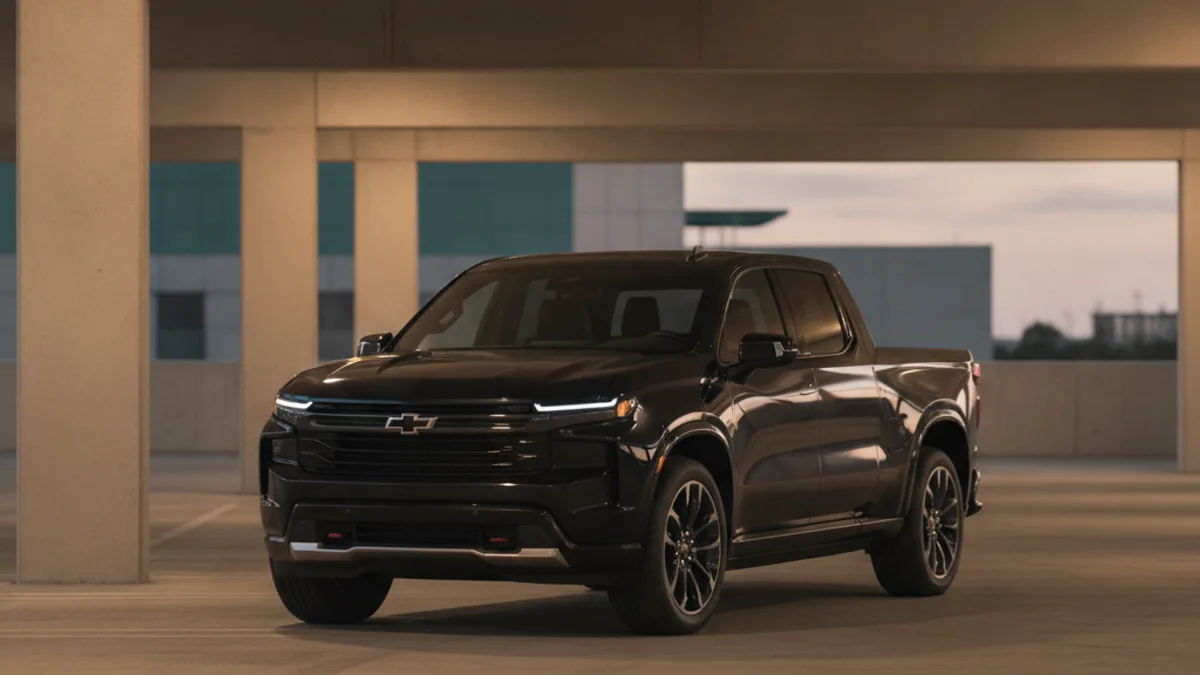
Contractors and freight crews leave these trucks in Doral lots and MIA garages for hours or days. Alarm modules, telematics, and eTrunk outlets keep drawing. The small battery gives up. The pack never had a chance to matter.
Chevy Silverado EV won’t start: start with the 12V
Treat a silent Silverado EV as a 12V problem until you prove it isn’t. That small battery powers the computers that wake the truck. It also closes the contactors that connect the Ultium pack. If voltage sags too far, that handshake never finishes. Dash stays black. Handles ignore the fob. You still had miles showing the last time it drove.
A DC-DC converter steps pack voltage down to about 12 to 14 volts. That’s how the 12V stays charged while the truck sits. When the converter lags, or the 12V is worn out, the trickle stops. You get a dark cabin and a truck that won’t respond. A jump can wake it. A 12V at the end of its life will strand you again within days.
Accessory load speeds that up. Lighting, a job box, or tools on the eTrunk outlets pull from the low-voltage side. Trailering keeps extra accessories alive the whole drive. A marginal 12V may survive a short errand. It often fails after a long sit with those loads still in the background.
Airport-belt dwell is how this truck actually dies
The Silverado EV is a work truck first. Around Miami International Airport, that means waiting. Crews park west of the terminals while a flight lands, a pallet clears, or a warehouse shift turns over. Doral EV rescue around the airport belt is built around that grid. Friday’s truck can be fully dark Monday, with plenty of pack left.
Long-term parking is the slower version of the same drain. MIA’s public options include the Dolphin Garage at the North Terminal, the Flamingo Garage at the Central Terminal, the Ibis Garage, the new Park 6 long-term garage, and the off-airport Park and Ride at 1350 NW 45 Ave. Come back from a week away and the cabin is dead. Systems kept the 12V busy the whole time. Heat made it worse.
The Ibis Garage holds ChargePoint EV ports across its levels, according to the airport. Park 6 opened in summer 2026 with charging on site. Those plugs can feed a pack that will accept a charge. They can’t boot a truck whose 12V already collapsed. The truck has to wake before it can take power. Garage motorist help is listed at (305) 876-7536. That’s the parking desk, not a mobile jump.
Miami Springs sits on that same MIA loop. A driveway that looks fine can still hide a truck that won’t unlock after airport parking. Miami Springs EV rescue when MIA parking kills the 12V is the local version of this call. The same 12V-after-parking pattern shows up on other EVs too. Our Tesla 12V failure after parking guide walks through why a car can look totally dead with a healthy pack.
Secondary fields see work trucks as well. Miami Executive, formerly Kendall-Tamiami, and Miami-Opa Locka Executive collect the same overnight dwell. The 12V doesn’t care which airport code is on the hangar.
Heat here ages a 12V faster than the odometer does
South Florida is flat. Range here isn’t a hill story. Miami-Dade’s highest natural point is the Atlantic Coastal Ridge, about 23 to 24 feet. Broward’s is Pine Island Ridge, about 29 feet. Heat, air conditioning, and dwell set the drain. Terrain doesn’t.
NWS Miami’s 1991-2020 normals put July and August average highs at 91F. A normal year has about 64 days at or above 90F. Battery University notes that every roughly 15F rise halves the life of a lead-acid battery. It ages about twice as fast at 93F, and about four times as fast at 111F, versus 77F. That damage doesn’t reverse.
A Silverado EV sitting in a Doral warehouse lot through a summer afternoon is already fighting heat soak. Cooling and always-on modules keep drawing. A weak 12V often fails at quitting time, not on the highway.
Pack range is a separate heat story. Recurrent Auto’s fleet study of about 30,000 EVs found about 5% range loss at 90F and about 17 to 18% at 100F. Cooling a hot cabin can take 3 to 5 kW at first, then about 1 kW to hold. AAA’s 2019 SAE test found about a 17% range drop at 95F with the AC on. Those numbers describe the Ultium pack under climate load. They’re not your dark-dash diagnosis. The dark dash is the 12V.
FPL serves essentially all of Miami-Dade and all of Broward. Homestead is the confirmed exception, with Homestead Public Services Energy on some city streets. Confirm that boundary with the city if you live there. It doesn’t change a 12V jump. It only names whose wires feed a home plug later.
What a dying 12V looks like in the cabin
Owners describe the same stack. Doors stop unlocking. Screens stay black. The truck refuses Drive even with a healthy range reading. The 12V feeds many modules at once. Low voltage doesn’t throw one clean code. It throws unrelated warnings together. That pile is the tell.
Don’t keep restarting to clear the lights. Restore 12V voltage with a jump or a charge. If the truck was just in for service, don’t pull terminals to force a reset. GM is specific that disconnecting the 12V at the wrong moment can turn a simple jump into a dealer visit. When you’re unsure, stop guessing and get a diagnosis.
The eTrunk lockout is the trap
GM put the 12V under the hood, inside the eTrunk, on the passenger side, under a plastic cover held by tabs. Simple with power. The eTrunk opens electrically by fob, dash button, or a fascia button. A dead 12V kills all three. You’re locked out of the compartment that holds the battery you need. Hummer EV owners hit the same frunk problem on the Ultium family.
How to pop the eTrunk with no power
GM built a mechanical release for this. Sit in the driver’s seat and reach under the dash, low and left. You’ll find a gray cable with a loop, where a hood release would sit on a gas truck. Pull it twice. The eTrunk unlatches with no electrical power.
It’s tucked up. Take a second to find the loop. Once the lid pops, lift the passenger-side cover. A flathead helps if the tabs are stiff. Go slow so you don’t crack the plastic.
Jumping the 12V on this truck
With the cover off, the terminals are right there. The negative is a 10mm bolt. The positive sits beside it. Connect a jump pack or donor positive clamp to positive first. Then put the negative clamp on the Silverado’s negative terminal, or on nearby unpainted metal. Wait a minute before you try to wake the truck.
If it stays dark, leave the pack connected a few minutes longer. A deeply discharged 12V sometimes needs a slow trickle before the handshake can finish. Don’t yank cables and immediately retry. For clamp order and safety notes, use our guide to jumping an EV without frying the 12V.
A jump that works once isn’t the end. If the truck dies again within days, the 12V can’t hold a charge. Replace it instead of jumping it again. Our EV 12V replacement guide covers the signs and what to do while you’re stranded.
Symptom to likely cause
| Symptom | Likely cause |
|---|---|
| Dash fully dark, doors ignore the fob | 12V fully discharged |
| eTrunk won’t open by fob or button | 12V too low for the electric latch |
| Unrelated warnings stack at once | Voltage sag confusing several modules |
| Won’t shift despite a healthy range reading | 12V can’t finish the Ultium handshake |
| No-starts return days after a jump | 12V has failed and needs replacement |
If the truck died on a road, not in a lot
Get off the travel lane when you can. Florida Statute 316.194 says a vehicle outside a municipality should sit off the main-traveled part where practicable. Leave room for passing traffic. Keep a clear view from 200 feet each way. 316.194(2) exempts a genuinely disabled vehicle that can’t practicably be moved.
Florida’s Road Ranger Service Patrol is FDOT’s free highway service. Crews jump-start vehicles, do minor repairs, change flats, and tow a disabled vehicle from the travel lanes to the nearest safe spot, free of charge. Dial *FHP (*347) from a mobile phone. District 6 covers Miami-Dade on I-95, 95 Express, I-195, I-395, I-75, 75 Express, and SR-826, the Palmetto. District 4 covers Broward’s I-95 from the Miami-Dade line north, plus portions of I-595 and I-75.
Road Ranger pages don’t mention electric vehicles or EV charging. A dead EV still needs a 12V jump or a tow to a safe spot. They do both. A Level 2 charge to the pack isn’t what they carry. Independent mobile operators fill that part.
Florida 511 at FL511.com is FDOT’s traffic feed in English and Spanish. Use it if you’re on the Turnpike, the Homestead Extension, the Sawgrass, or a Greater Miami Expressway Agency road. GMX now runs the former MDX corridors: SR-112, the Airport Expressway, SR-836, the Dolphin, SR-874, the Don Shula, SR-878, Snapper Creek, and SR-924, the Gratigny. Those roads are all-electronic. SunPass or toll-by-plate only. None takes cash. No facility publishes a disabled-vehicle tow unique to its express lanes. Road Rangers still patrol those corridors.
A wrecker from a private lot is a different statute. Florida Statute 715.07 covers non-consent tows. If you appear before the truck is fully removed, the operator must stop and return it on payment of no more than one-half the posted tow rate. In Miami-Dade and Broward, storage must sit within a 10-mile radius. Miami-Dade Code Section 30-476 and Broward Code Section 20-176.22 cap those non-consent rates. The dollar figures were not available on the county pages we checked. Confirm the posted schedule with the operator and county consumer protection before you pay. Towing a silent EV is also easy to get wrong. Read why towing a dead EV in South Florida gets messy before you wave a hook over.
Who actually shows up for a Silverado EV
Charge Pro MIA is a referral line. We match stranded EV drivers with independent local mobile rescue operators. We don’t perform the work, own trucks, or employ technicians. We don’t set prices or publish hours. The operator quotes you before starting and bills you directly. The pros we connect you with are licensed and insured.
For a dark Silverado EV, the usual on-site job is a 12V jump. Operators can also replace a failed 12V on site. If the pack is the real problem, they bring a 240V Level 2 source to the truck, with a CCS or J1772 adapter for non-Tesla EVs. That typically adds 10 to 20 miles of range in 15 to 30 minutes of charging. That’s charging time, never an arrival time.
The pros we connect you with handle Tesla and every major EV brand, including GM’s Ultium trucks. Non-Tesla EV rescue is the page for a Silverado EV. Don’t force the eTrunk if you can’t find the cable. Don’t keep jumping a battery that’s already failed twice.
If your Chevy Silverado EV won’t start after airport parking or a warehouse sit, call (786) 963-2995. We’ll connect you with an operator who can quote the job.
Why won’t my Chevy Silverado EV start if the range still looks fine?
Range comes from the Ultium pack. Startup comes from the 12V. If the 12V is dead, the truck can’t finish its wake sequence, no matter how many miles sit in the pack. A 12V jump is what usually brings it back.
Where is the 12V battery, and how do I open a dead eTrunk?
The 12V sits in the eTrunk, passenger side, under a plastic cover. If the electric release is dead, pull the gray loop under the dash on the driver’s side twice. That cable unlatches the eTrunk with no power.
Should I tow it, or jump it first?
Jump the 12V first if the truck is dark and the last range reading was healthy. A tow is for a truck you can’t make safe, or a pack that’s truly empty. Road Rangers can move you off a travel lane. A local operator handles the 12V jump or a Level 2 top-up once you’re in a safe spot.