You rolled out of Heron Bay with a full pack and a grocery list. University Drive in Coral Springs ate the afternoon. The climate control never took a break. Holmberg Road felt short on the way out. It felt longer on the way home. That’s the usual Parkland EV charging problem. The house almost always has a plug. The long loop is what still leaves you stuck.
This Parkland EV charging guide starts with that split, not with a station roster. We couldn’t confirm station-level inventory from the sources we checked. Parkland is a Broward city on the Palm Beach county line. Census ACS 2019-2023 counted 35,799 residents. The 2024 estimate is 39,700. Land area is 12.559 square miles. The ZIPs are 33067 and 33076. Florida Power and Light serves the city. Housing is new. Only 1.7 percent of homes were built before 1980. That share comes from Census table B25034, read 2026-09-18. It’s why a 240-volt circuit is common here. It’s also why calls from this city are usually road calls.
New northwest Broward homes, and why the plug is already there
Parkland isn’t an older coastal grid. Compare the pre-1980 housing share. North Miami is 82.7 percent. Miami Springs is 89.5 percent. Hollywood is 74.7 percent. Lauderhill is 67.3 percent. Those streets often can’t take a wall charger at all. Parkland is 1.7 percent. Weston is 7.0 percent. Doral is 5.5 percent. Newest stock changes the homework. You’re usually choosing where the plug goes. You’re not wondering if the panel can exist.
The map is gated master-plans more than walk-up blocks. Heron Bay. Cascata. Pine Trails. Parkland Golf and Country Club. Pine Trails Park is a landmark you can actually name. Equestrian and conservation land sits to the west. Coral Springs and Coconut Creek sit next door. Boca Raton sits north of the county line, in Palm Beach County. That county is outside this service area. Don’t treat the line as a suggestion.
Census ACS 2019-2023 also puts Parkland at the top of the Broward income list in this metro’s profiles. That’s context for housing and errand length. It’s not a quote for a rescue. Charge Pro MIA doesn’t set what you pay. The operator who takes the job quotes you before any work starts. The operator bills you directly.
We’re a referral line. We match stranded EV drivers with independent local mobile rescue operators. We don’t hold a trade license. We don’t own trucks. We don’t employ technicians. We don’t publish hours. The pros we connect you with are licensed and insured. They do the work. For the city page on this map, see Parkland EV charging.
Level 1 trickle versus a dryer-style 240-volt circuit
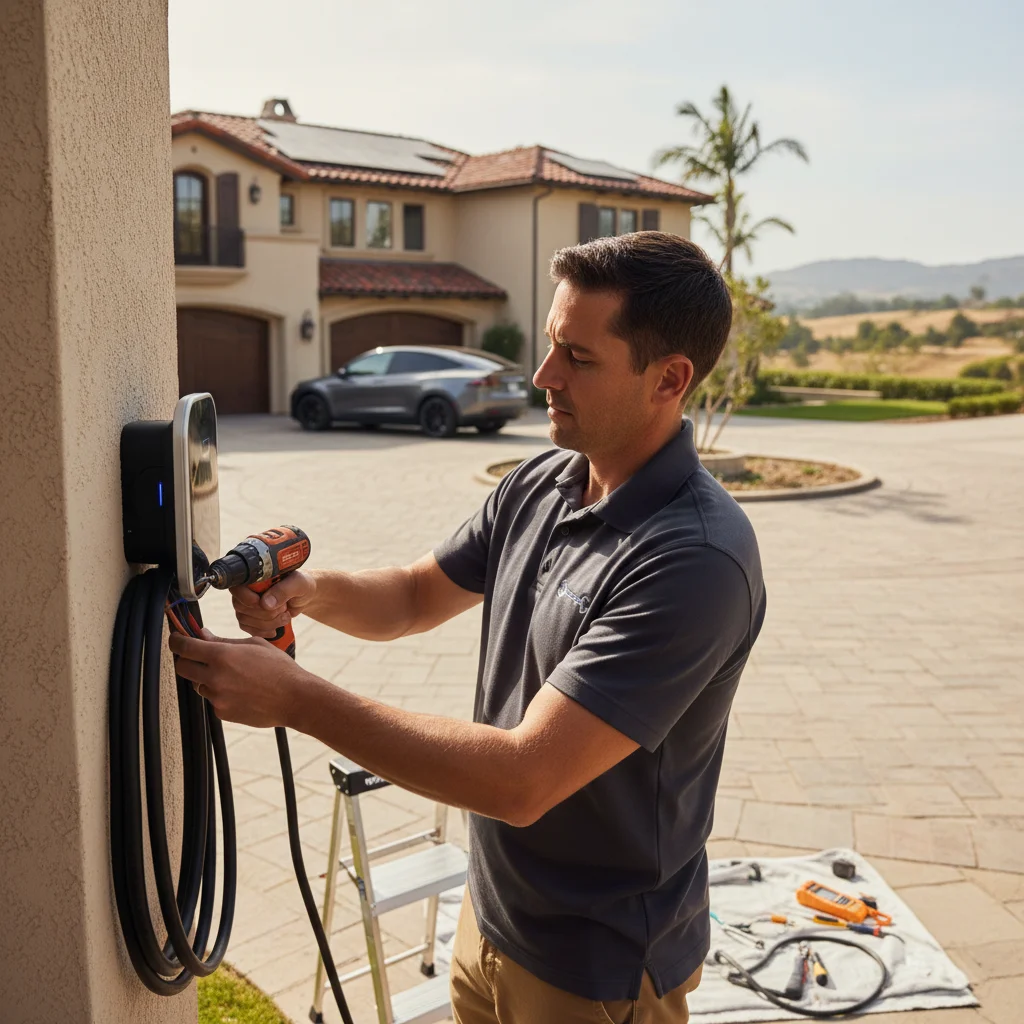
A new garage still has a regular wall outlet. Every EV includes a Level 1 cord for that outlet. Typical added range is about two to five miles per hour. That’s enough for a short hop on University Drive. It isn’t how you refill a large pack after a day of AC. A Level 2 unit needs a 240-volt circuit, the same idea as a dryer. Typical added range is about twenty to sixty miles per hour. Most packs finish overnight on that circuit.
Place the unit where you actually park. Garage, carport, or a detached bay: your electrician decides. Permits and panel work belong to that licensed electrician, not to us. If you want the home plug versus a truck that comes to you, read 240-volt charging: your home plug versus a mobile rescue. Night charging belongs at the house. Shoulder charging belongs to a mobile operator.
What FPL actually publishes, and what this page will not guess
FPL EVolution Home is the company’s residential Level 2 install-and-maintain program. We name the program. We don’t print its fees. Confirm current terms on FPL’s own page before you enroll. FPL also publishes a residential Time-of-Use rate for home charging. We name that too. We don’t print cents per kilowatt-hour. Those numbers go stale. Check FPL’s Time-of-Use page and schedule charging in the off-peak window your bill uses.
FPL EVolution is also FPL’s public charging brand. That’s a real program. It isn’t a Parkland site list. The DOE AFDC station API host didn’t resolve on 2026-09-18. Electrify America’s API returned 403. Tesla’s site blocks automated access. So we won’t name a plaza, a count, or a distance to a plug. A guessed station doesn’t help you when you’re already stopped. Use your car’s in-dash map while you’re still moving. Keep a charging app open before the dash is already thin.
Florida had about 450,400 registered EVs in 2025, per DOE AFDC vehicle-registration data. That’s state-level only. No county split showed up in what we could read. You’re not alone in Florida. That still doesn’t stock a post on Holmberg Road.
Heat, AC, and a county with almost no hill
Parkland is flat coastal ground. Range here isn’t about grade. Broward’s highest natural point is Pine Island Ridge, about 29 feet. Miami-Dade’s Atlantic Coastal Ridge is about 23 to 24 feet. There’s no mountain run between Heron Bay and Holmberg Road. What eats the pack is heat and air conditioning, plus time spent idling.
NWS Miami 1991-2020 normals put the July and August average high at 91F. A normal year sees about 64 days at or above 90F. Recurrent Auto studied about 30,000 EVs. It found about 5 percent range loss at 90F, and about 17 to 18 percent at 100F. Cooling a 95-degree cabin can take 3 to 5 kW at first. Holding that cabin cool is about 1 kW. The first minutes of AC draw the most power. AAA’s 2019 SAE-standard test found about a 17 percent range drop at 95F with the AC on. Don’t treat those as Tesla’s numbers. Tesla’s site wasn’t readable for this file.
Precondition the cabin while you’re still on the home plug. That spends house power, not pack power, on the first cool-down. Then the car holds the temperature on the road. Summer storms stack up from about 2 p.m. to 6 p.m. Low-lying streets flood on king tides and heavy rain. Plan the return before the sky opens if you can. Salt-laden humid air is also hard on the 12-volt battery. That failure looks like an empty pack. It usually isn’t.
Long drives: University Drive, Loxahatchee Road, and the Sawgrass
Home charging covers the night. The day still adds up. A loop that looks local on a map can include University Drive, Holmberg Road, Loxahatchee Road, and a Sawgrass Expressway run. The Sawgrass is SR-869. Florida’s Turnpike Enterprise operates it. It’s all-electronic. SunPass or toll-by-plate. None of these roads take cash. No facility we read publishes a disabled-vehicle free-tow rule unique to those express lanes. Don’t invent one.
If you stall on the Sawgrass, get off the travel lane first when you can. Florida Statute 316.194 says a vehicle outside a municipality must sit off the main-traveled part where practicable. Leave room for passing traffic. Leave a clear view from 200 feet each way. Statute 316.194(2) exempts a genuinely disabled vehicle that can’t practicably be moved. Statute 316.1945 covers places where stopping is prohibited. Read the statute. Don’t argue it from memory on the shoulder.
For the Sawgrass-specific steps, use Stranded on the Sawgrass Expressway: what to do next. If the errand died in the next city over, Coral Springs EV roadside help when the commute leaves you empty covers that grid.
Dial *FHP (*347) from the car. Florida Highway Patrol takes disabled-motorist reports on that short code. The Road Ranger Service Patrol is FDOT’s free highway service patrol. It jump-starts vehicles, makes minor repairs, and changes flats. It provides gas, diesel, and water. It tows a disabled vehicle from the travel lanes to the nearest safe location. All of that is free of charge. No Road Ranger page we read mentions electric vehicles or EV charging. A dead EV can still need a 12-volt jump. It can still need a tow off the travel lane. Rangers do those jobs. A Level 2 top-up isn’t something they provide. Rangers don’t bring that cable. A mobile operator does. District 4 covers Broward. It patrols the full I-95 corridor from the Miami-Dade line north, plus portions of I-595 and I-75 from the Miami-Dade line to mile marker 50. The Sawgrass is a Turnpike road. Don’t assume the same patrol script. Still start with *FHP. Florida 511 is FDOT’s traffic system, in English and Spanish.
Palm Beach County starts at the north line. Boca Raton isn’t ours. If your drive crosses that line, you’re outside this referral area. Turn around in Broward when the dash is already thin. Coconut Creek sits east of a lot of this grid. Coral Springs sits south. Those are still Broward. They are still in play.
The car that sat a week, then wouldn’t wake
A Parkland driveway can hide a different failure. You come back from a trip. The car is silent. Doors don’t release. The screen stays dark. Drivers often think the traction pack is empty. After a week in this heat, it’s often the 12-volt battery. Every EV still uses a small 12-volt battery to wake computers, locks, and contactors. The big pack can be fine. The car still looks dead.
Battery University’s heat rule is blunt. Every rise of about 15F halves the life of a lead-acid battery. It ages about twice as fast at 93F, and about four times as fast at 111F, versus 77F. Heat damage doesn’t reverse. South Florida’s sustained heat makes long parking famous for this. The same chemistry applies on a quiet street in Pine Trails. Salt-laden humid air is hard on that little battery. An EV that sat a week may not wake up.
Operators we connect you with can jump or replace a dead 12-volt on site. They handle Tesla and every major EV brand. For the longer explanation, read What happens when an EV’s 12-volt battery dies in this climate.
Gated entries, tow-away signs, and Broward’s written cap
Master-plan gates change the towing picture. Florida Statute 715.07 governs tows from private property. A tow operator must stop and return the vehicle if you appear before it’s fully removed, on payment of no more than one-half the posted tow rate. The property needs a permanent, reflective, correctly sized tow-away zone sign at each access, posted at least 24 hours ahead. Exceptions include a sign appurtenant to a single-family home, or personal notice. In a county of 500,000 or more, the vehicle must be stored within a 10-mile radius. Both Miami-Dade and Broward qualify. The operator must release it within one hour of request. The rate schedule must be filed with local law enforcement and posted at the storage site.
Non-consent tow rates are capped by county ordinance. Broward County Code Section 20-176.22 sets maximum nonconsent rates. The Board reviews them annually by CPI, with a 3 percent cap on that review. We don’t publish the dollar schedule. The county pages we needed for the numbers wouldn’t load, and a printed fee goes stale. Confirm the posted rate at the storage site. Miami-Dade’s parallel rule is Code Section 30-476, if the car crossed south. Don’t pay a mystery invoice without asking for the posted schedule.
If a wrecker is already on the latch at a gatehouse, say you’re present before the car is fully removed. That’s the statute’s window. After the car leaves the property, you’re in storage rules instead. Ask where it’s headed. Ask for the filed rate sheet. Heron Bay and Parkland Golf and Country Club are private. The shoulder of the Sawgrass is not. Know which one you’re on before you argue.
What a mobile operator brings when the pack is empty
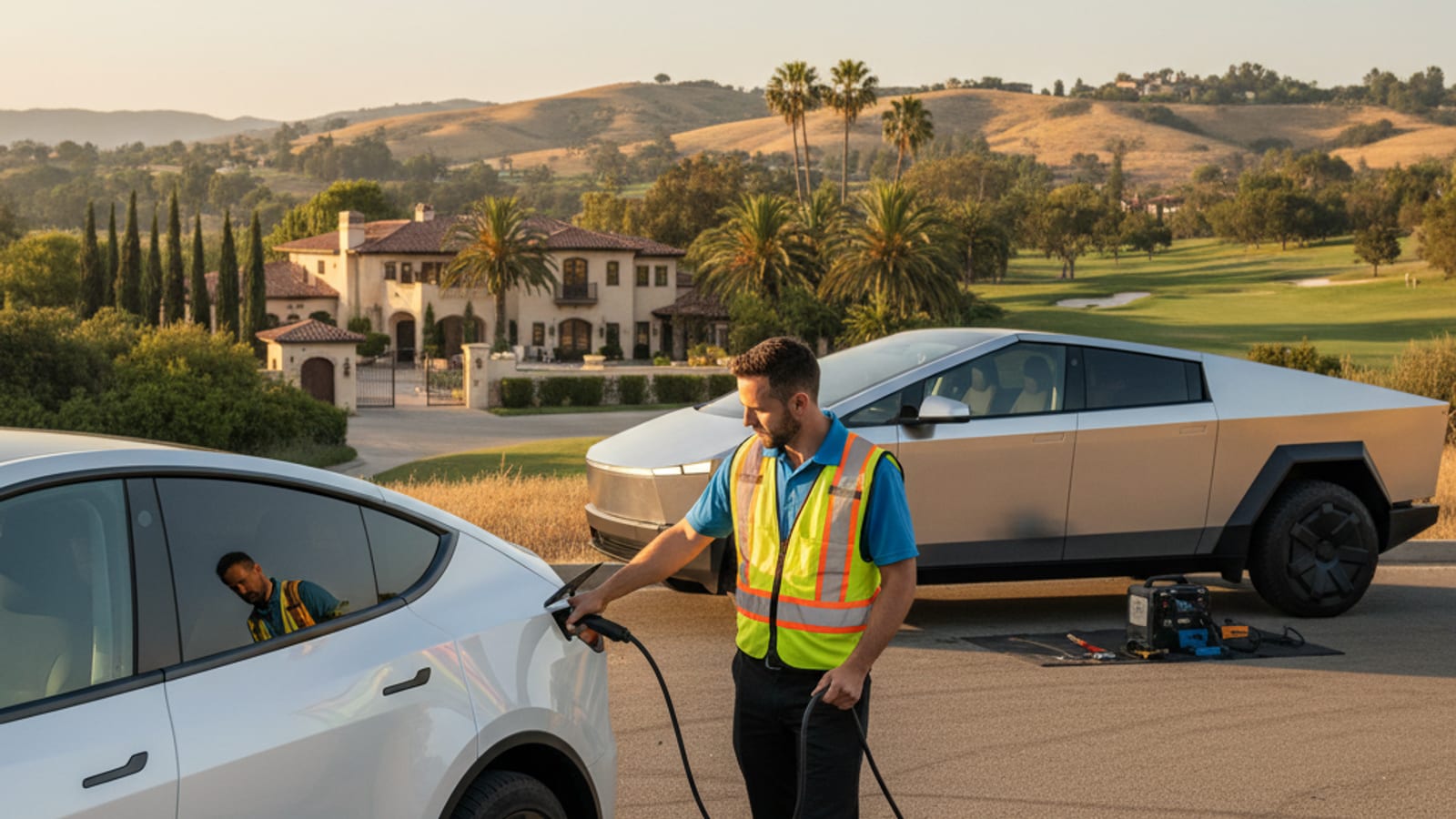
A club card often sends a hook. A flatbed then sits at a public post while you wait again. The operators in this network bring a 240-volt Level 2 source to the car instead. Native NACS for Tesla. A CCS or J1772 adapter for non-Tesla EVs. They typically add 10 to 20 miles of range in 15 to 30 minutes of charging. That’s charging time. It isn’t an arrival time. We don’t promise when someone reaches you. The operator quotes you before starting.
That 10 to 20 miles is usually enough to roll home to the Parkland plug, or to a public post your own map actually shows. Distance to the operator, time of day, and how much range you need are what move the quote. We don’t set that quote. See mobile EV charging and out-of-charge recovery for the service split.
They also jump or replace a dead 12-volt on site. If the pack is fine and the car is silent, say that on the call. You’ll skip a useless hunt for a DC post. Tesla, Rivian, Ford, Hyundai, Chevy, and the rest of the major badges are in play. The adapter on the truck matters more than the badge on your steering wheel.
Storm season, floodwater, and a pack you keep in the middle
Hurricane season runs June 1 through November 30. FPL tells EV owners to keep the pack between 50 and 80 percent through the season. Unplug during the storm. Don’t charge or drive a flood-exposed EV until it’s inspected. FPL also deploys mobile EV charging trailers before planned outages and during storms to aid evacuations. The Florida Division of Emergency Management has deployed temporary EV chargers along the I-75 evacuation corridor.
Parkland is inland northwest Broward, not a barrier island. Broward’s Plan A covers Category 1-2 east of the Intracoastal. Plan B covers Category 3 and higher east of US-1. Don’t put this city in those coastal boxes. Rain still floods low-lying streets here. NHTSA warns that residual salt in a flooded lithium battery can bridge and short. Fires can start days to weeks later. A flood-exposed EV shouldn’t sit within 50 feet of a structure. It shouldn’t be driven or charged until inspected. About 36 EVs flooded by Hurricane Ian in 2022 later caught fire. That’s an official warning, not a scare line.
If FPL posts a planned outage, treat the house circuit as temporary. Don’t assume the wall unit will finish a pack while crews are cutting feeders. The 50 to 80 percent window is for the season, not only for landfall night. West conservation land doesn’t change the humidity. It also doesn’t change the flood rule if standing water reached the floor pan.
A short plan before you leave Pine Trails or Cascata
Charge on the 240-volt circuit the night before a long errand. Precondition while you’re still plugged in. Watch the afternoon storm window. Leave margin for AC on University Drive and the Sawgrass. If the car sat through a trip, treat a no-wake as a 12-volt until proven otherwise. If you’re already on a highway shoulder, start with *FHP, then ask for a mobile charge if the pack is empty. Florida had about 450,400 registered EVs in 2025. The state’s adoption doesn’t stock your garage. Your plan does.
Keep tires at the door-sticker pressure. Soft tires waste range on a flat grid just like they do on a hill. Software updates often include battery logic. Install them before a long weekend, not after the car is already silent. Daily charging to a mid pack, and a full pack only before a long run, is what most makers still publish. None of that replaces a local operator when you’re already stopped.
Loxahatchee Road toward the western conservation land feels empty because the lots are large, not because we measured a plug map. We didn’t. Carry the charge you need for the return. Holmberg Road back toward Coral Springs is still Broward. University Drive is still the errand spine. The Sawgrass is still the fast way south and west. Each of those roads can strand you with a home charger waiting in the garage. That’s the Parkland pattern.
What should a Parkland owner plug into at home?
Most houses here can take a 240-volt Level 2 circuit. Only 1.7 percent of housing predates 1980. Ask a licensed electrician about your panel. Ask FPL about EVolution Home and Time-of-Use. Charge Pro MIA doesn’t install wall units.
Why did my range drop on a flat Parkland loop?
There’s no hill tax in this county. Heat and air conditioning are the tax. Recurrent Auto and AAA both tie large cuts to hot-cabin cooling. Precondition on the house plug. Don’t treat the dash estimate as a promise after a 91F afternoon.
What do I do if I run out on the Sawgrass Expressway?
Move off the travel lane when you can. Statute 316.194 is the rule. Dial *FHP (*347). Road Rangers can jump a 12-volt and tow you out of the lanes. They don’t bring a Level 2 charge. Call Charge Pro MIA for a referral to an operator who does.
Charge Pro MIA serves Parkland and the rest of South Florida as a matchmaker, not as a yard. If you need a mobile top-up or a 12-volt jump, call (786) 963-2995. The operator quotes you before any cable goes on the car.