Roadside assistance for an EV in South Florida is three separate layers. Florida traffic law decides where a disabled car may sit. FDOT’s Road Rangers can jump a 12V or move you off a travel lane. Independent operators can bring a 240V Level 2 charge to the bumper. A condo parking rule is none of those. Charge Pro MIA matches stranded drivers with local mobile rescue operators. We don’t perform the work. We don’t own trucks, a yard, or a fleet. The operator quotes you before any work starts, then bills you directly.
If you searched roadside assistance for EV coverage, start with that split. A membership card is one product, and a maker’s roadside plan is another. This line is a match with a local operator. Florida Statute 316.194 is something else again. Mixing them is how people wait in the wrong place.
Shoulder law comes before any rescue call
Florida Statute 316.194 covers stopping on a highway outside a municipality. Leave the car off the main-traveled part when you can. Leave room for passing traffic. Keep a clear view from 200 feet each way. Statute 316.194(2) exempts a genuinely disabled vehicle. That exemption holds when you can’t practicably move off the road. Statute 316.1945 lists other places where stopping is prohibited. Read both before you argue with a trooper.
Inside a city, local traffic rules still apply. The City of Miami is one of 34 municipalities in Miami-Dade County. Most of what people call Miami is unincorporated county or another city. Miami Beach is a separate city, and you reach it only by causeway. South Beach is a neighborhood of Miami Beach, not its own city. Hollywood sits in Broward County, not in Miami-Dade. A stall on I-95 in Fort Lauderdale is FDOT District 4. A stall on SR-826, the Palmetto, is District 6.
If the car still rolls, get off the travel lane first. Then stay in the vehicle with the belt on and the hazards lit. That sequence is safety, not a coverage promise. The freeway out-of-charge steps walk that same order.
What Road Rangers cover on Miami-Dade and Broward highways
The Road Ranger Service Patrol is Florida’s free highway service patrol, and FDOT runs it. Crews jump-start vehicles, make minor repairs, and change flat tires. They also provide gas, diesel, and water. They can tow a disabled vehicle off the travel lanes to the nearest safe location. That work is free of charge.
Dial *FHP (*347) from a mobile phone. Florida Highway Patrol takes disabled-motorist reports on the same short code. FDOT publishes a 15 to 30 minute window unless crews are held by an emergency. That figure is FDOT’s published window, not ours. We don’t publish an arrival time.
District 6 covers Miami-Dade. It patrols I-95, 95 Express, I-195, I-395, I-75, 75 Express, and SR-826. District 4 covers Broward. It patrols I-95 from the Miami-Dade line north. It covers parts of I-595 from I-75 to NW 136 Ave. It also covers I-595 from SR-7 to Port Everglades. It covers I-75 from the Miami-Dade line to mile marker 50.
Florida 511 at FL511.com is FDOT’s official traffic system in English and Spanish. Use it for closures and backups, not as a charging dispatcher.
Road Ranger materials we read on 18 September 2026 don’t mention electric vehicles or EV charging. Don’t read that silence as a refusal to help an EV. A dead EV still needs a 12V jump. It may still need a tow to a safe spot. Both of those are in the Road Ranger list. A 240V Level 2 charge isn’t. That last piece is what a mobile operator brings.
Florida’s Turnpike Enterprise operates the Turnpike, the Homestead Extension, and the Sawgrass Expressway. Road Rangers remain the highway answer on those corridors, including Alligator Alley. Naples sits at the far end of the Alley. That Gulf coast is outside this service area. Monroe County and the Keys are outside it too.
Private lots follow a different statute
Highway help stops at the off-ramp. A stall in a garage falls under Florida Statute 715.07. That’s towing from private property. Walk up before the car is fully removed, and the operator must stop and return it. You pay no more than half the posted tow rate. The property needs a permanent, reflective tow-away sign at each access. That sign must be posted at least 24 hours ahead. The exceptions are a lot tied to a single-family home, or personal notice given to you.
The towed vehicle must be stored within a 10-mile radius. That 10-mile rule applies in counties of 500,000 or more. Miami-Dade and Broward both qualify. The yard must release the car within one hour of request. The operator must file its rate schedule with local law enforcement. It must post that schedule at the storage site.
Non-consent tow rates are capped by county ordinance. Miami-Dade uses Code Section 30-476. Broward uses Code Section 20-176.22. We couldn’t load either county’s current dollar schedule on 18 September 2026. Don’t trust a number from memory. Confirm the posted cap with the county consumer office before you pay.
A Brickell garage, a Dadeland lot, and a Hialeah surface space all sit in that private-property world. Road Rangers don’t come into the garage, and Statute 316.194 doesn’t either.
Airports and cruise garages are 12V jobs more often than pack jobs
A week in long-term parking is a classic false empty. The high-voltage pack is usually fine. The 12V battery kept systems alive and then died. The car looks fully dead, and the doors may not wake. That’s a jump or an on-site 12V swap, not a flatbed by default.
Miami International lists several public garages. The Dolphin Garage serves the North Terminal. The Flamingo Garage serves the Central Terminal. The airport page says the Ibis Garage holds ChargePoint EV ports across its levels. Park 6 is the new long-term garage. It opened in summer 2026 and has EV charging on site. There’s an off-airport Park and Ride at 1350 NW 45 Ave. We’re not publishing parking rates. Those figures go stale. Use the airport parking page for the current amount.
PortMiami’s county parking page lists northside Garages A, AA, B, C, D, F, and G. It lists southside Garages J and K, plus surface Lot E. That page doesn’t list EV charging at those facilities. Port Everglades lists the Heron and Palm garages and surface lots. Its parking page also doesn’t list EV charging. An observed silence on a parking page isn’t a station inventory. If a post-cruise car won’t wake, treat it as a 12V first.
South Florida heat makes the 12V story worse. Battery University’s published rule is blunt. Every roughly 15F rise halves lead-acid life. Aging runs about twice as fast at 93F as at 77F. It runs about four times as fast at 111F. Heat damage doesn’t reverse. A car that sat at MIA or a cruise garage often needs a 12V before it needs range.
Condo plug rights: what the sources didn’t show
This is the piece most roadside pages skip. A wall plug at home isn’t roadside assistance. It still decides how often you need a rescue.
A statewide Florida right-to-charge statute for condos couldn’t be confirmed. That’s from the Florida Statutes pages we checked on 18 September 2026. No Miami-Dade or Broward ordinance number for a condo charging right turned up either. If your board says you can’t add a plug, start with the association declaration. Ask for the exact covenant in writing, then confirm the current rule with the board. If you need the legal text, read the Florida Statutes yourself. Don’t take a hallway rumor as law.
What we could confirm is housing age. North Miami is 82.7% pre-1980 stock, and Miami Springs is 89.5%. Hollywood is 74.7%, Lauderhill is 67.3%, and Hialeah is 60.1%. A Level 2 install often isn’t a simple panel job in that stock. Doral is 5.5% pre-1980, Parkland is 1.7%, and Weston is 7.0%. Newer houses still don’t create a parking-space right. They only change the wiring conversation.
Kendall, The Hammocks, Westchester, and Tamiami are census-designated places. They have no mayor and no city hall. Don’t call them cities when you describe the building. The plug fight still sits with the association or the landlord.
FPL serves essentially all of Miami-Dade and all of Broward. The confirmed exception is Homestead. Parts of Homestead sit on Homestead Public Services Energy, and other parts sit on FPL. Confirm the street on the city’s HPS Energy page. FPL publishes EVolution for public charging and EVolution Home for a residential Level 2. It also publishes a residential time-of-use rate. It publishes the EVolution Make-Ready Credit for multifamily wiring. We’re not publishing those program prices. Homestead’s HPS Energy pages showed no EV-specific program when we read them. That’s an observed absence, not proof that none exists.
None of those utility programs is a roadside dispatch. If the condo plug never got approved, you live on public stations and the occasional rescue. That’s a planning problem, not a coverage grant. The South Florida charging hub indexes the cities. It doesn’t sell you a parking right.
What a mobile operator covers at the bumper
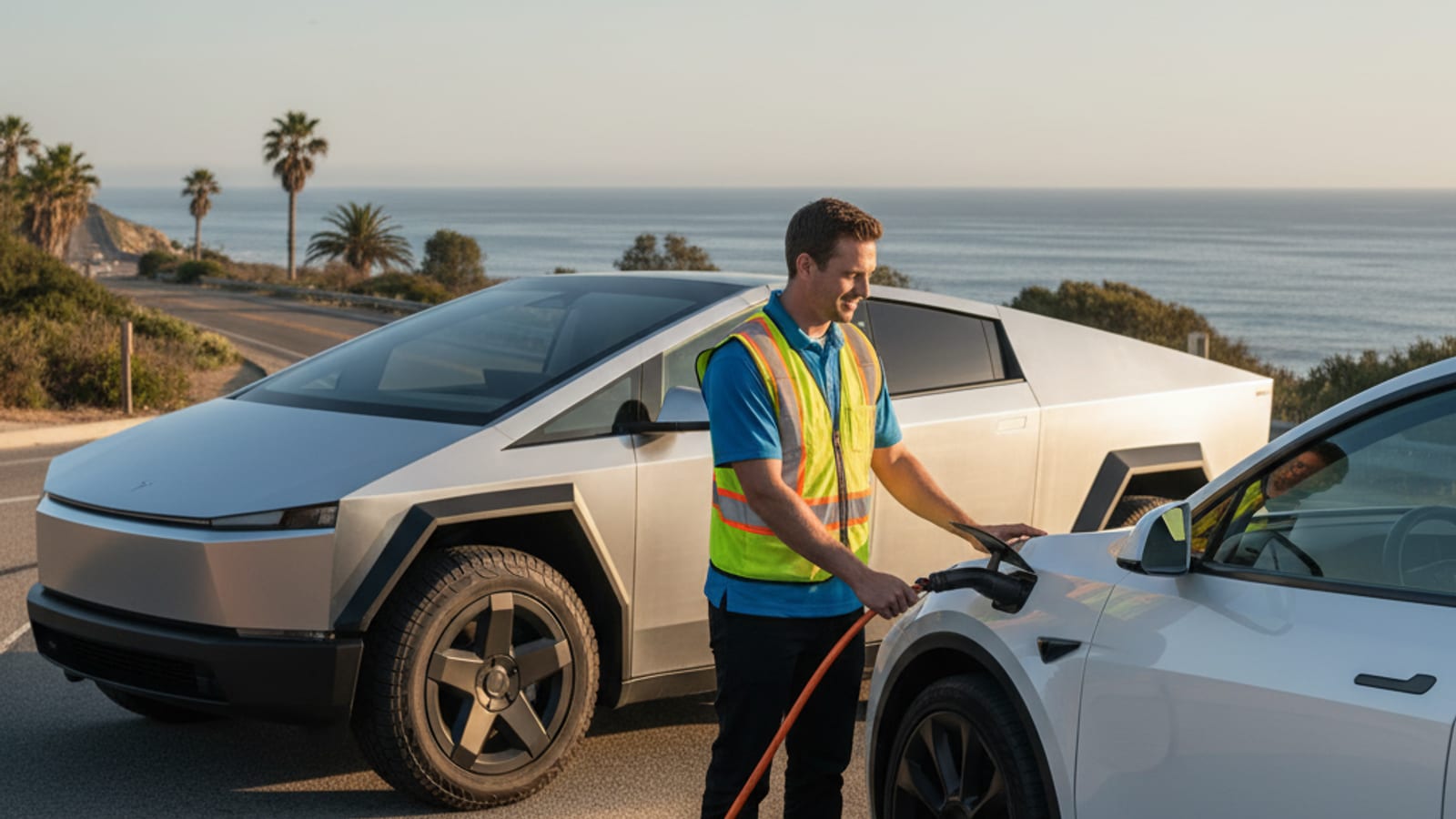
The operators we connect you with bring a 240V Level 2 source to the car. They use a native NACS plug. They carry a CCS or J1772 adapter for non-Tesla EVs. They handle Tesla and every major EV brand. A typical top-up adds about 10 to 20 miles of range. That’s 15 to 30 minutes of charging time. It’s not an arrival time.
They can also jump or replace a dead 12V on site. That’s the silent-car case after parking. It’s also the won’t-wake case in a tower garage. If the pack is empty, you want the Level 2 lead. If the dash is dark, you want the 12V first. Software glitches and a stuck charge port are different again. A restart can clear some software stalls. A port that won’t unlatch isn’t an empty pack. Sort the failure before you ask for a charge.
EV roadside assistance is the service overview. Mobile EV charging is the pack-empty path. Tesla 12V battery jump is the no-start path.
They don’t install a home charger, and they don’t argue with your condo board. They don’t patrol express lanes for FDOT. They quote before they start, then bill you directly.
A flat tire is still a tire. EVs are heavy, and many have no spare. Road Rangers change flats on the highway corridors they patrol. Off those corridors, you’re in ordinary tire help or a flatbed. Charge Pro MIA isn’t a tire shop and isn’t a tow company. If a wrecker is the honest next step, that’s a different call. Charge on site or tow is the fork.
Incorrect towing can damage an EV drivetrain. A flatbed is the usual safe method when the car must move unpowered. We don’t run that wrecker. We don’t hand you a branded tow partner as if we owned it.
What this referral line doesn’t cover
We don’t hold a trade licence, employ technicians, or promise a clock. We don’t publish business hours, and we don’t carry parts inventory. Florida’s recording law is all-party consent under Statute 934.03. Interception is lawful only when all parties have given prior consent. If a call is recorded, that’s why the notice exists.
We also don’t replace a maker’s own roadside plan. Read that plan on the maker’s site. Coverage years and exclusions change. We don’t replace AAA or an insurer’s card either. Compare those on their own pages. Our AAA or local Tesla rescue piece is a separate read.
FPL’s storm trailers aren’t this line either. FPL deploys mobile EV charging trailers before planned outages and during storms. That’s an FPL program. It isn’t a Charge Pro MIA dispatch.
Heat cuts range here. Grade doesn’t.
South Florida is flat. Miami-Dade’s highest natural point is the Atlantic Coastal Ridge, about 23 to 24 feet. Broward’s is Pine Island Ridge, about 29 feet. There’s no mountain climb eating range. Range here is heat, air conditioning, and dwell.
NWS Miami’s 1991-2020 normals put the July and August average high at 91F. A normal year sees about 64 days at or above 90F. Recurrent Auto studied about 30,000 EVs. That fleet work found about 5% range loss at 90F. It found about 17 to 18% at 100F. Cooling a 95-degree cabin can take 3 to 5 kW at first. Holding it cool takes about 1 kW. AAA’s 2019 SAE-standard test found about a 17% range drop at 95F with AC on. Don’t pin those numbers on Tesla. They’re fleet and lab figures.
Plan the buffer for AC, not for hills. That’s local, and it isn’t a map of public plugs.
Toll roads don’t publish an EV-only tow perk
FDOT owns 95 Express and 595 Express. The Greater Miami Expressway Agency took over the former MDX roads in 2023. Those roads are SR-112, SR-836 (the Dolphin), SR-874, SR-878, and SR-924. All of those facilities are all-electronic. They use SunPass or toll-by-plate. None takes cash.
No facility we read publishes a disabled-vehicle rule specific to its express lanes. None publishes a free-tow rule for those lanes either. Road Rangers do patrol those corridors. That’s the real highway answer. Don’t invent a free express-lane EV tow. We’re not publishing toll prices.
Deerfield Beach and Parkland sit on the Palm Beach line. This service area doesn’t continue into Boca Raton, Delray, Boynton, or West Palm. Keep the map honest when you describe where help can be matched.
If the car is already stopped
Get off the travel lane if the car still moves. Stay in the car on a high-speed shoulder. Then sort the failure. Dark dash and locked doors point at the 12V. A live car that won’t add miles points at the pack. A cable that won’t unlatch is a port problem.
For a highway stall, *347 reaches FHP and the Road Ranger path. For a garage stall, watch the tow signs and Statute 715.07. For an empty pack off those programs, call a mobile Level 2 operator.
Call (786) 963-2995 if you want Charge Pro MIA to match you with an operator. Tell them the city, the road, and whether the car will wake. That’s a referral. It isn’t a promise that someone is around the corner.
Frequently asked questions
Does a Road Ranger bring a Level 2 charge to an empty EV?
FDOT’s Road Ranger pages we read don’t mention EV charging. Crews still jump 12V batteries and tow disabled cars from travel lanes. A 240V rescue charge is a separate operator.
Does Florida law give condo owners a right to a wall plug?
A statewide condo charging-rights statute couldn’t be confirmed in the Florida Statutes we checked. Your association declaration still controls the space. Confirm the current text with the board before you buy hardware.
Who sets the price when I call this line?
Charge Pro MIA doesn’t set the price. The independent operator quotes you before starting. That operator bills you directly.