A Hyundai Kona Electric that won’t start in South Florida is usually a dead 12-volt battery. The traction pack can still hold plenty of charge. The computers just have no power to wake. That pattern shows up where older housing never got a home plug. The Kona then lives on public charge and sits between sessions.
Hyundai sells the Kona as gas, hybrid, and electric. This page is only for the electric one. If yours has a fuel door, stop here. That car wants a normal jump and a regular shop. The electric Kona fails in a quieter way.
This is the electric Kona, not the gas one
A gas Kona still acts like a small SUV when it dies. You get dash lights. You might hear a click. The electric model can go fully dark. No chime. No unlock. No “Ready” light. A lot of owners then assume the traction pack is empty. Often it isn’t.
Check the nose for a charge port, not a fuel filler. If you have a port, stay on this page. If you have a filler door, this fault tree isn’t yours.
Older housing, public plugs, and a 12V that sits
The Kona Electric doesn’t need hills to get in trouble. South Florida is flat. The highest natural point in Miami-Dade is the Atlantic Coastal Ridge, about 23 to 24 feet. In Broward it’s Pine Island Ridge, about 29 feet. Range here is heat, air conditioning, and dwell. It is never terrain.
Dwell is the local trap. Census ACS 2019-2023 figures show how old the housing is. North Miami is 82.7% pre-1980. Miami Springs is 89.5%. Hollywood is 74.7%. Lauderhill is 67.3%. Hialeah is 60.1%. A 1960s or 1970s house often has no 240-volt run to the driveway. The Kona then charges in public and sits in the yard or a street spot between sessions.
That sit is what flattens the 12V. The traction pack can still hold a healthy percentage. The little AGM under the hood is what went quiet. You may not even open the app if the 12V is gone.
Newer tracts look different. Doral is only 5.5% pre-1980. Parkland is 1.7%. Weston is 7.0%. Those lots more often have a path to a wall unit. FPL EVolution Home is the residential Level 2 program to ask about if you can put one in. Confirm current terms with FPL. FPL serves essentially all of Miami-Dade and all of Broward. Parts of Homestead use Homestead Public Services Energy instead. Confirm on the city’s HPS Energy page before you assume a program applies.
If you live in Hialeah without a home plug, the public-charge loop is the daily plan. See EV roadside assistance in Hialeah when you live on public plugs. Older North Miami streets follow the same sit-and-drain pattern. Read Older North Miami streets and a dead EV: what happens next.
Heat is what finishes a tired 12V
NWS Miami 1991-2020 normals put the July and August average high at 91F. A normal year has about 64 days at or above 90F. That’s the climate the AGM lives in, not a cold-weather freeze.
Battery University’s heat rule matches what owners feel here. Every roughly 15F, or 8C, rise in temperature halves the life of a lead-acid battery. It ages about twice as fast at 93F. It ages about four times as fast at 111F versus 77F. Heat damage cannot be reversed. A Kona that sat through a long, hot week can refuse to wake even if you left it charged.
The airport version of this story is the one people miss. You leave the Kona at Miami International in the Dolphin, Flamingo, or Ibis garage, or in the new Park 6 long-term garage. You fly. You come back to a brick. The traction pack didn’t empty. The 12V kept modules alive in the heat, then died. Ibis lists ChargePoint ports across its levels. Park 6 opened in summer 2026 with charging on site. A plug in the garage does not revive a 12V that already went flat.
PortMiami is a longer sit. Miami-Dade’s cruise parking pages do not list EV charging at any PortMiami facility. A week on a ship is enough time for a 12V to go flat in this climate.
Dark dash or empty pack
Call the right job. A jump will not fill an empty traction pack. A mobile charge will not wake a car with a dead 12V.
| What you see | 12V is dead | Traction pack is empty |
|---|---|---|
| Dash is fully dark | Yes | No. You’ll still get warnings |
| Fob won’t unlock | Yes | No |
| Cabin lights do nothing | Yes | No |
| ”Ready” never comes on | Yes | Yes |
| It rolled a few miles, then quit | No | Yes |
| You saw low-range warnings first | No | Yes |
| Charge port will take a cable | Often no. The door may not open | Yes |
Zero response on Start/Stop means 12V. Some lights and a stack of range warnings mean the main pack. For the wider picture, read what happens when an EV’s 12-volt battery dies in this climate.
Where the 12V sits, and how you get the hood open
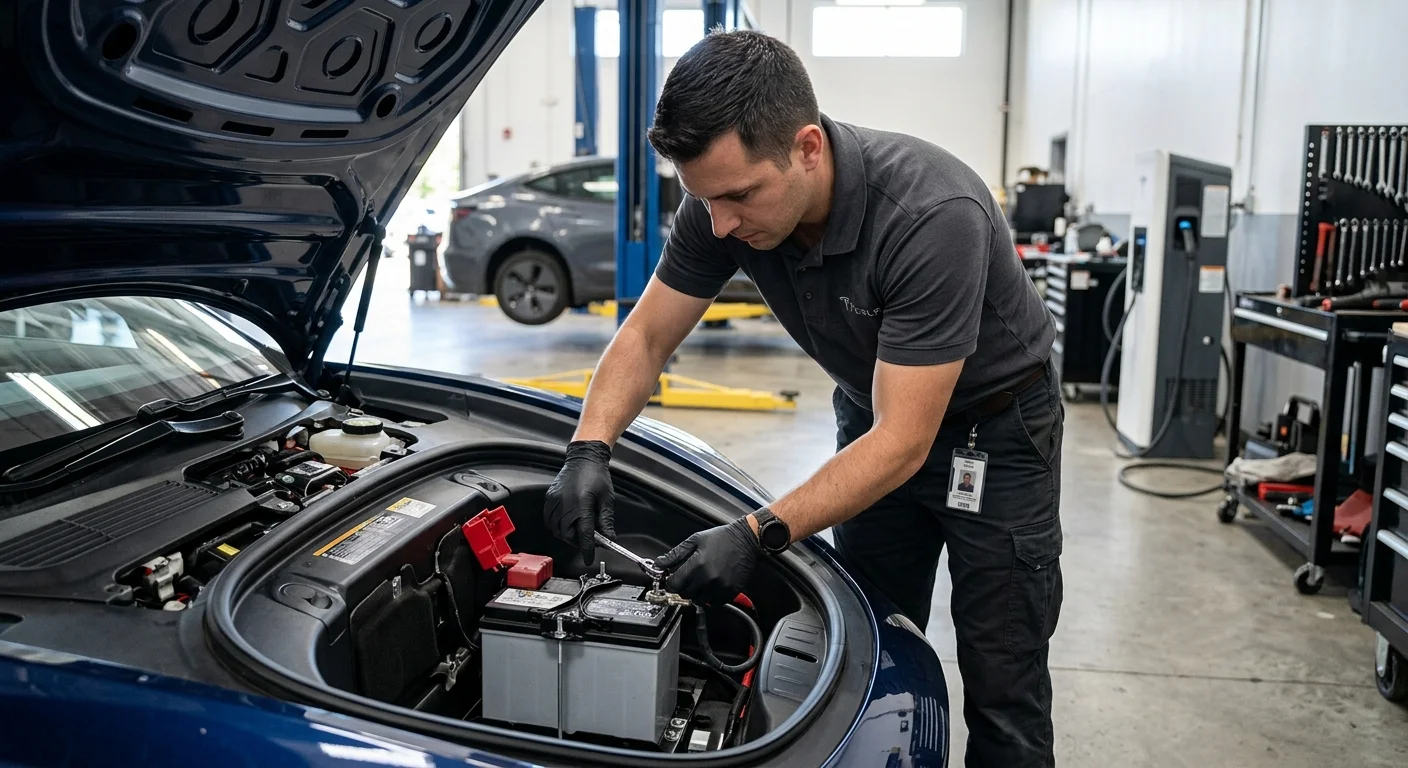
Many EVs hide the 12V in a frunk or under the cargo floor. The Kona Electric puts it in the under-hood bay, driver’s side, toward the rear of the compartment. It’s a standard 12V AGM in a plastic tray.
If the car still has enough 12V to pop the hood, use the interior release. If it’s fully dead, the latch may not fire. Check the owner’s manual for the emergency hood release. It’s usually a pull near the driver-side fender, reached through the grille opening. Don’t pry the panel.
Once the hood is up, look to the rear driver’s side. You’ll see the tray and a strap or bracket. The positive post has a red cap. The negative is bare or under a black cap. The bay is tight.
12V Battery Save only works if the screen still works
Hyundai added a 12V Battery Save function on the electric Kona from the 2019 model year. It tries to stop a full brick. It does not replace a battery that’s already failing.
On most trims the path is Settings, then Vehicle, then Charge Settings, then 12V Battery Save.
When it’s on, the car can pull a small amount from the high-voltage pack to top up the 12V. That’s a get-home net, not a forever fix. If you lean on it every week, the AGM is aging out.
If the dash is already dark, the menu isn’t there. You need an external jump first. After a jump on an older battery, turn the save function on for the drive to a Level 2 plug.
Jump the dedicated terminals
The Kona Electric uses dedicated jump points under the hood. Those are safer than clipping the battery posts themselves.
Use a portable jump pack, or cables from a gas car. Don’t use another EV as the donor. EVs aren’t built to source current that way.
Walk it in this order:
- Open the hood with the interior handle or the emergency pull.
- Pull the red cap off the positive terminal on the fuse box cover, driver’s side.
- Find a clean, unpainted metal ground on the chassis. A shock-tower bolt is a common pick. Skip the battery’s negative post if you can.
- Clamp positive to the Kona’s positive terminal, then to the pack or donor positive.
- Clamp negative to the pack or donor negative, then to the Kona’s chassis ground.
- Let current flow for a couple of minutes before you try Start.
- Press Start/Stop with your foot on the brake. The “Ready” light should come up.
If it wakes, drive to a Level 2 plug and leave it connected. The traction pack can trickle the 12V while the car is charging. If the 12V dies again within a day or two, the battery needs replacement. A jump is only a bridge. EV 12V replacement: signs, timing, and what to do stranded covers that next step. Safety notes that apply across brands sit in how to jump start an electric car without frying the 12V.
A tight garage stall is a bad place to run long cables. If you’re boxed in at Brickell City Centre, Dadeland Mall, or Aventura Mall, wait for an operator with a pack.
If you’re on a highway, leave the travel lane first
Florida Statute 316.194 says a vehicle on a highway outside a municipality must sit off the main-traveled part where practicable. Leave room for passing traffic. Leave a clear view from 200 feet each way. 316.194(2) exempts a genuinely disabled vehicle that can’t practicably be moved.
On I-95, I-195, I-395, I-75, or SR-826, the Palmetto, in Miami-Dade, FDOT’s Road Ranger Service Patrol is the free highway patrol. Dial *FHP (*347). Road Rangers jump-start vehicles, do minor repairs, change flats, and tow a disabled vehicle from the travel lanes to the nearest safe location. Their public material does not mention EV charging. A dead Kona can still need a 12V jump or a move off the lane. A Level 2 top-up is the separate job mobile EV charging covers.
District 4 covers the Broward I-95 run from the Miami-Dade line north, plus portions of I-595 and I-75.
If a wrecker is already hooking you in a private lot, Florida Statute 715.07 applies. The operator must stop and return the vehicle if you appear before it’s fully removed. You then pay no more than half the posted tow rate. Miami-Dade caps non-consent rates under Code Section 30-476. Broward uses Code Section 20-176.22. Confirm the current posted figure with the operator and the county. Don’t guess the rate.
When the pack is empty, a jump will not help
If the dash still lights and the car rolled until the range warnings stacked up, you’re not in 12V territory. You need energy in the traction pack.
Charge Pro MIA is a referral line. We match stranded EV drivers with independent local mobile rescue operators. We don’t own trucks. We don’t employ technicians. We don’t set prices. The operator quotes you before starting and bills you directly.
What those operators bring is a 240V Level 2 source to the car. Native NACS, or a CCS or J1772 adapter for non-Tesla EVs, including the Kona Electric. That typically adds 10 to 20 miles of range in 15 to 30 minutes of charging. That’s charging time, not a promise about when someone arrives. They can also jump or replace a dead 12V on site. Non-Tesla EV rescue is the path for the Kona.
If a jump attempt does nothing, the 12V may be too far gone to hold a charge. A blown fuse in the junction box is another common stop. A BMS communication fault is less common. That usually means a Hyundai dealer, not another jump. The operator who takes the job can tell you on site whether a tow is the honest next step.
Frequently asked questions
How do you jump a Hyundai Kona Electric?
Use a jump pack on the dedicated positive terminal under the fuse box cover, driver’s side. Ground to clean chassis metal, not the negative post if you can avoid it. Wait a couple of minutes, then press Start/Stop with your foot on the brake. Don’t use another EV as the donor. After it wakes, plug into Level 2 so the 12V can recharge from the main pack.
Why does a Kona Electric 12V die in South Florida?
The 12V keeps computers alive while the car sits. Older housing in North Miami, Miami Springs, Hollywood, Lauderhill, and Hialeah often has no home plug, so the Kona sits between public charges. Heat then ages the AGM. NWS Miami normals put summer highs at 91F. Battery University notes that each roughly 15F rise halves lead-acid life. The result is a dark car with a pack that still has range.
What does 12V Battery Save actually do?
It pulls a little current from the high-voltage pack to keep the 12V above a cutoff. Find it under Settings, Vehicle, Charge Settings on most electric Kona trims from 2019 on. If the screen is already dead, the function can’t run. You need a jump first. If you keep turning it on, replace the 12V. It’s a safety net, not a repair.
If the Kona is silent and you’re in South Florida, call Charge Pro MIA at (786) 963-2995. We’ll connect you with a local operator who can jump the 12V or bring a Level 2 charge. The operator quotes you before any work starts.