An Ioniq 5 charge port stuck at a beach-condo pedestal is a latch problem first. The CCS handle won’t leave after the session looks done. Miami Beach, Surfside, and Sunny Isles Beach put that stall in salt and heat. You may still need range to get off the island. Free the cable, then add a CCS-capable top-up so you can actually leave.
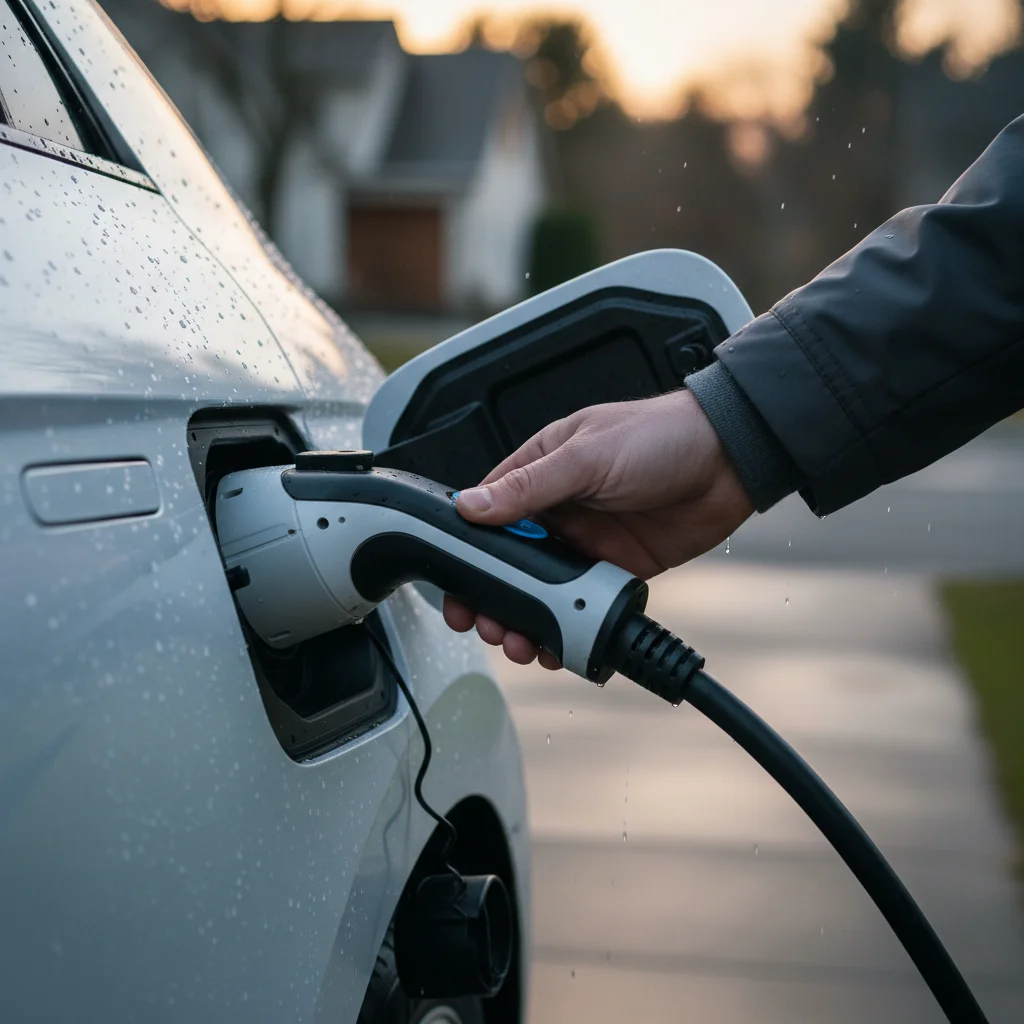
A condo stall is a different kind of stuck
A home driveway lets you wait out a glitch. A guest pedestal in a beach tower doesn’t. You’re occupying a marked EV stall in a private garage. Other residents need that post tonight. Florida Statute 715.07 governs towing from private property. The lot needs a proper tow-away sign at each access. That sign must be posted at least 24 hours ahead, with the usual exceptions. If a wrecker shows before the car is fully removed, the operator has to stop and return it. That return is on payment of no more than one-half the posted tow rate. Miami-Dade caps those nonconsent rates under Code Section 30-476. Broward does it under Code Section 20-176.22. We couldn’t load either county’s current dollar schedule. Confirm today’s posted figure on the sign. A car locked to a cabinet can’t leave that stall.
Many of these buildings never got a home Level 2. Hollywood’s housing stock is 74.7% pre-1980. North Miami is 82.7% pre-1980. A wall charger often isn’t practical there. Overnight charging moves to condo pedestals, workplace posts, and public cabinets. FPL EVolution is FPL’s public charging brand across almost all of Miami-Dade and Broward. More shared plugs mean more sessions that don’t close cleanly.
King tides add water to that hardware. They run mainly September through November. Each pulse lasts about three hours. They hit Miami Beach, Hollywood’s low streets, and the Las Olas Isles in Fort Lauderdale. If the port already holds standing water, stop commanding the latch. Read water in the charge port after a king tide. Don’t keep cycling a wet pin.
Heat finishes the 12-volt. NWS Miami’s 1991-2020 normals put the July and August average high at 91F. A normal year sees about 64 days at or above 90F. Every roughly 15F rise in temperature halves the life of a lead-acid 12-volt battery. It ages about twice as fast at 93F as it does at 77F. Heat damage can’t be reversed. The traction pack can still look fine. The latch still needs that small battery.
Three holders, not one frozen part
Treat the stuck handle as three locks, not one frozen part.
The charge door is motorized. It swings on command from the fob, the interior switch, or Bluelink. If the door won’t open, you’re not at the cable yet.
The connector lock is a separate actuator. A pin slides into a notch on the CCS handle when charging starts. Software is supposed to retract it when the session ends, or when you unlock the doors. A messy handshake with a public DC cabinet can skip that retract. So can a session that dies mid-cycle. The computer still thinks the plug has to stay put.
The station can keep its own lock. Your screen may say complete. The handle still won’t move. That’s the post, not Hyundai. Don’t yank it. You can bend pins or crack the housing.
A 2026 Ioniq 5 in the regular U.S. lineup has a built-in NACS port. Hyundai includes a CCS adapter for CCS DC fast charging. Confirm your year before you assume the handle. Earlier years used a CCS inlet.
See what to do when the charging cable won’t unlatch for the generic tree. This page stays on the Ioniq 5 cargo override and the coastal stall.
Work the car and the cabinet before the trunk
Leave the connector seated. A hard yank with the pin engaged can scar the inlet. It can also throw a fault on the cabinet.
Unlock the doors with the fob. Wait a few seconds. Lock them, wait, then unlock again. Give the car time to send the retract command. Don’t mash the fob. A burst of lock commands can freeze the same logic you’re trying to reset.
If Hyundai Bluelink is on your phone, end the session there. That remote stop is often the signal the latch was waiting for.
Walk to the charger screen next. Press stop if the unit still shows an active session. Some condo pedestals need a tap on the network app too. The car can be finished. The post isn’t.
Then use the button on the handle. Pull the connector straight back. Don’t twist it against the charge door.
If the car is dim, slow to boot, or silent, you’re not in a simple software loop. That’s the 12-volt path. Walk Hyundai Ioniq 5 won’t start: check the 12V before the pack before you start pulling cargo trim. We couldn’t confirm an Ioniq 5 jump-clamp map in this site’s claims file.
Ask the network to force-stop the stall
On a public cabinet, the unit is a second computer in the handshake. The support number printed on the station is the next tool. Read the station ID off the cabinet. Tell them the session won’t end and the connector won’t release.
They can often force-stop from their side. That remote command is what many Ioniq 5 lockups were waiting for. It’s also the step that protects the stall. If the cabinet is still talking to the car, a sudden unplug can fault the post. The next driver then inherits your error.
FPL EVolution cabinets, condo pedestals, and workplace posts all run their own software. The label on the unit is the authority. We couldn’t build a station-by-station inventory for this metro. The DOE AFDC host didn’t resolve when this research was pulled. Don’t hunt a second cabinet while you’re physically locked to the first.
After you’re free, report the stall to the network. Log it in whatever charging app you already use. We couldn’t confirm hold times from the network pages we could read. Stay with the car while you wait. Don’t leave a locked CCS handle in a tow-away garage.
The cargo override, after those steps
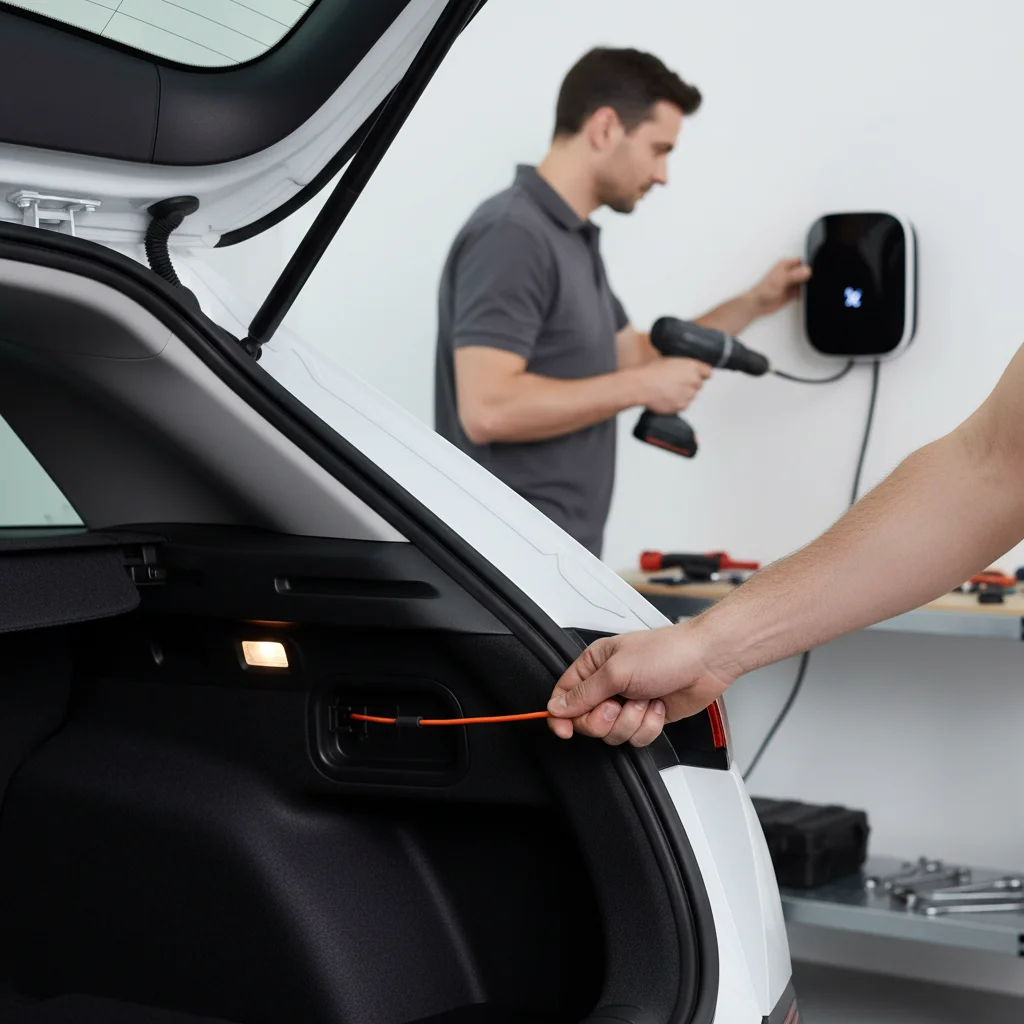
Hyundai hid a mechanical release in the cargo area for this stall. Use it after the software path when you’re on a live public unit. At a private Level 2 pedestal, you can go to the cargo cable sooner. You’re not taking a public DC stall down with a dirty unplug.
The car should be off, in park. Unlock it if you still can. Open the rear hatch.
Stand in the cargo opening and face the bumper. Look to the driver’s side wall. That’s the left side in a U.S. Ioniq 5. You’re hunting a small rectangular panel in the liner, roughly behind the tail lamp. Pop it with your fingers. A plastic trim tool is gentler than a house key if the cover is tight.
Inside is a short cable with a loop or a small handle. It may be black. Some years use an orange tab. That’s the charge-port release.
Pull it toward the center of the trunk, short and steady. Listen for a click or a clunk at the port. Then walk around and draw the handle straight out.
Snap the panel back in. Hyundai publishes manuals at owners.hyundaiusa.com, under manuals and warranties. Confirm the diagram for your year before you pry a second panel.
If the loop is stuck hard, stop. If you pull and hear nothing at the port, stop. Forcing it can snap the override or bend the actuator. If the hatch itself won’t open, you’re already past DIY. The release lives behind that liner.
Software hang, seized pin, or a dark 12V
A software hang is the usual public-plug story. The pin motor is fine. The retract command never arrived. Fob cycles, a Bluelink stop, and a network force-stop clear most of those.
A hardware bind feels different. Salt and grit can sit in the slot. The pin motor can seize. A damaged handle can keep the pin from clearing. The cargo cable will tell you. Firm resistance and a click usually mean the override reached the pin. A limp loop plus a frozen handle usually means hardware. Don’t keep pulling a limp cable. You’ll only add slack.
The latch also runs off the 12-volt system, not the traction pack. If that small battery is flat, the fob may do nothing. Interior buttons may do nothing. Bluelink may not reach a car that’s gone dark. The motorized door may sit wherever it last stopped. That’s not another software loop. It’s the same 12-volt failure that leaves an Ioniq 5 looking fully dead. A car that sat in long-term parking at Miami International can come back silent for the same reason. A stuck CCS handle on a dark car is a latch with no power.
After the cable is out, you still have to leave
Freeing the handle is only half the job at a barrier-island stall. Miami Beach is its own city, reached only by causeway. South Beach is a neighborhood of Miami Beach, not a separate city. Key Biscayne sits in Storm Surge Planning Zone A. If the pack is already thin, you still have to cross water to get home.
A 2026 Ioniq 5’s fastest advertised session is 10% to 80% in 20 minutes. That figure is on a 350-kW, 800-V DC charger, using the CCS adapter. Actual time varies with starting charge, output, battery temperature, and outside temperature. That’s a spec, not a promise at a condo pedestal.
If you can’t add range where you sit, you need a mobile top-up. Independent operators in the Charge Pro MIA network bring a 240-volt Level 2 source to the bumper. For a non-Tesla EV they use a native NACS plug, or a CCS or J1772 adapter. They typically add 10 to 20 miles of range in 15 to 30 minutes of charging time. That’s charging time, never an arrival time. They can also jump or replace a dead 12-volt battery on site. The non-Tesla EV rescue page is the match for an Ioniq 5. See mobile EV charging once the cable is free and you still can’t roll.
A thin pack on Miami Beach is a causeway problem. If you’re already empty on that island, read out of charge on Miami Beach with no building plug.
If you’re on a shoulder or in a marked tow-away
If you’re in a travel lane, get off it if you can. Florida Statute 316.194 says to leave the main-traveled part where practicable. Leave room for passing traffic and a clear view from 200 feet each way. A genuinely disabled vehicle that can’t practicably be moved is exempt under 316.194(2). Dial *FHP (*347) for Florida Highway Patrol and the Road Ranger Service Patrol. Road Rangers jump-start vehicles. They also tow a disabled car from the travel lanes to the nearest safe location, free of charge. FDOT District 6 covers Miami-Dade. District 4 covers Broward. Their published materials don’t mention EV charging. They can still jump a 12-volt. A Level 2 top-up isn’t their job. Don’t expect them to unlatch a CCS handle. Don’t skip them if you’re in a travel lane.
Private garages can still tow a car that’s stuck to a post. Confirm the lot’s posted rules before you walk away.
When you want a person at the bumper
Stop DIY when the cargo loop won’t click, feels like it will tear, or the hatch won’t open. Stop if the connector housing is cracked, the station won’t release, or the car is dark.
Charge Pro MIA is a referral line. It matches stranded EV drivers with independent local mobile rescue operators. It doesn’t hold a trade license. It doesn’t own trucks or equipment. It doesn’t employ technicians. It doesn’t set prices or promise an arrival time. It publishes no business hours. The operator quotes you before starting and bills you directly. The pros we connect you with are licensed and insured.
Ask the operator to confirm your year, port, and adapter before they start. A stuck pin, a dead 12-volt, and an empty pack are three different jobs.
Call (786) 963-2995 and we’ll connect you with a local operator.
Frequently asked questions
Why is my Ioniq 5 charge port stuck after the session ends?
The locking pin is still in the CCS handle. The car never sent the retract command, or the pin can’t move. Coastal salt and a tired 12-volt make that more likely here. Start with fob lock and unlock, a Bluelink stop, and the charger’s stop button. Then call the number on the cabinet with the station ID.
How do I free a stuck Ioniq 5 charging cable?
Work the car and the cabinet first. Then open the hatch. On the driver’s side of the cargo liner, pop the small panel behind the tail lamp. Pull the loop toward the middle of the trunk until you hear the port click. Draw the handle straight out. Confirm the diagram in that year’s Hyundai owner’s manual.
What if the 12-volt is dead and the latch won’t move?
The port lock is electronic. A flat 12-volt can freeze the fob, the door motor, and the pin together. Don’t keep yanking the cargo cable. An independent operator restores 12-volt power, then releases the connector. After that, they can add enough Level 2 range for you to leave.