A Kia EV6 that won’t charge is rarely a dead pack. In North Miami-Dade it’s usually a tower post that failed the CCS handshake. The 12V can also be too weak to wake the car. A charge schedule can hold the session too. Walk those checks before you call for a mobile rescue.
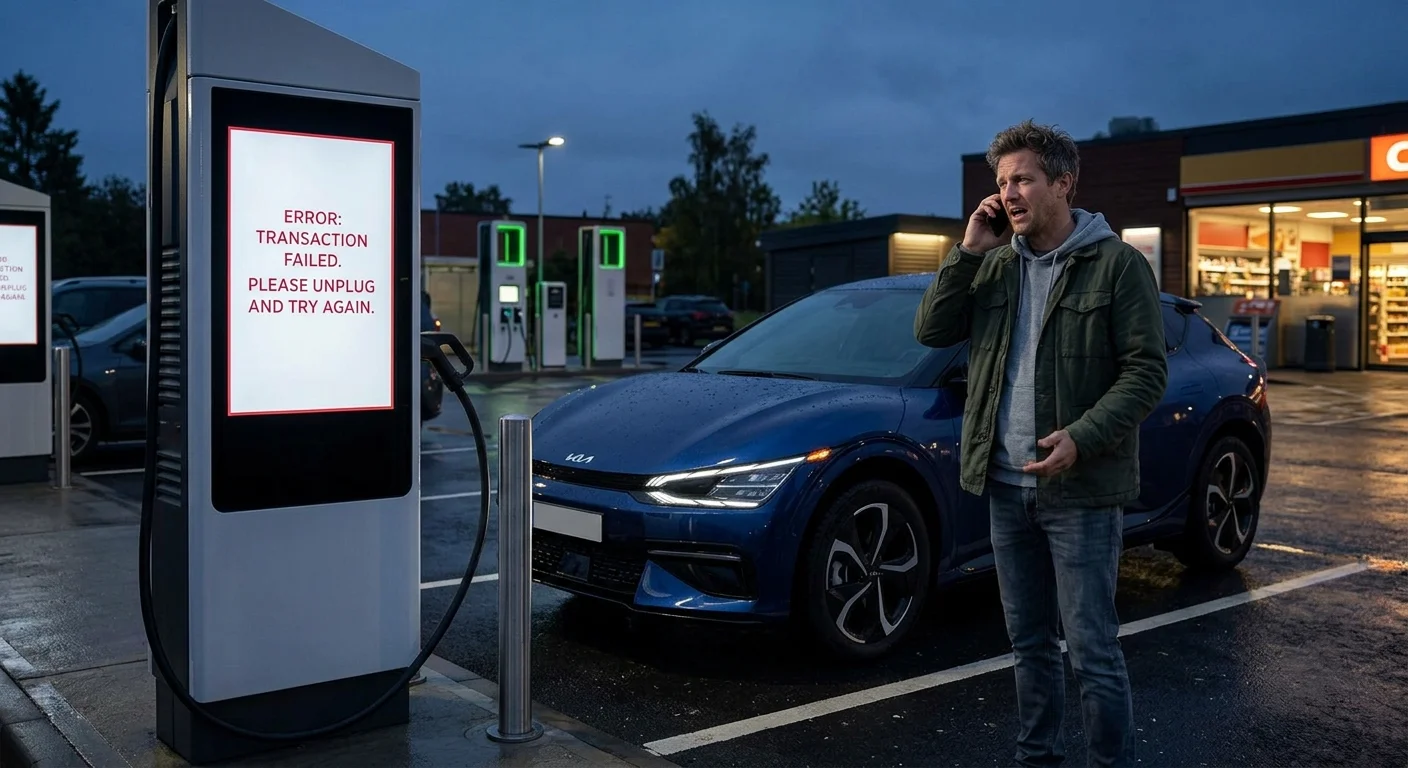
The EV6 needs a CCS handshake, not a guess
A U.S.-spec Kia EV6 charges on CCS. The post has to latch, talk to the car, then send power. Miss any of those three and the session never starts. The dash can still look normal, and the traction pack can still hold miles. Charging just doesn’t begin.
Push the handle in until it clicks and stays. Afternoon storms leave water in the port. King tides soak low coastal streets from September through November, about three hours at a time. Wet pins stop a session even when the post is healthy. Dry the port, then try that same handle one more time.
If the post screen is dark or throwing an error, move one stall over. Two dead handles at one bank point at the site, not the EV6. If both fail, switch networks in the Kia app. For the longer public-post checklist, start with public EV charger not working.
Tower parking is why this call keeps happening
Many EV6 owners here live in condos, not houses with a garage circuit. North Miami housing is 82.7% pre-1980. Golden Glades is 83.6%. Those buildings were not designed for a home Level 2. Daily charging happens on a shared post in the deck.
Shared posts fail in boring ways. A handle gets left half-seated. The payment app times out. A prior session never ends. Closed-garage heat makes the electronics cranky. NWS Miami normals put the July and August average high at 91F. A normal year sees about 64 days at or above 90F. The post derates, the EV6 waits, and you assume the car is broken.
FPL serves essentially all of Miami-Dade, including North Miami, North Miami Beach, and Aventura. Homestead’s municipal utility is the confirmed exception, and that isn’t this corridor. FPL EVolution is the utility’s public charging brand. That name doesn’t mean the stall in your building is up tonight. Check the stall in the app before you sit through a dead session.
Inland new construction is a different life. Doral housing is only 5.5% pre-1980. Those owners often plug in at home. Coastal north county is tower decks, visitor stalls, and a post you don’t control. When that post fails, you need CCS brought to the bumper.
The same pattern shows up around Aventura Mall and the older streets in North Miami. It shows up in North Miami Beach tower garages after a beach day. The cable is in, the percent never moves, and the driver is already late.
Kill the schedule before you blame the hardware
Open the Kia app and the car’s charge menu. An 80% limit looks like a failure when you wanted a full pack. A scheduled start looks like a dead post until the clock hits. Scheduled charging is smart at a house. It’s a trap on a public stall you only have for an hour.
Turn the schedule off and raise the limit if you actually need the miles. Start the session from the car, not only the phone. If the app says waiting and the post says connected, the handshake never finished. Unplug, wait a minute, and retry.
A home Level 2 fails simpler. The breaker tripped, so check the panel and reset it once. If it trips again, stop. That’s an electrician, not a roadside call. FPL EVolution Home is the utility’s residential Level 2 install-and-maintain program. Use that name when you’re shopping later. It doesn’t help you in a deck tonight.
FPL also publishes a residential time-of-use rate for home charging. Don’t assume your public post follows that clock. Public stalls bill through their own apps.
Heat cuts range, and it kills the 12V
South Florida is flat. Miami-Dade’s Atlantic Coastal Ridge tops out around 23 to 24 feet. Broward’s Pine Island Ridge is about 29 feet. Range here is heat, air conditioning, and time sitting. It’s never a hill.
Recurrent Auto studied about 30,000 EVs in heat. They found about 5% range loss at 90F. At 100F the loss was about 17 to 18%. Bringing a 95-degree cabin down can take 3 to 5 kW at first. Holding it cool takes about 1 kW. AAA’s 2019 SAE test found about a 17% drop at 95F with the AC on. An EV6 running from Miami Gardens toward the beach spends early miles on cooling.
The 12V is the failure people miss. Every roughly 15F rise in temperature halves lead-acid life. It ages about twice as fast at 93F versus 77F. At 111F it ages about four times as fast. Heat damage doesn’t reverse, and a weak 12V won’t wake the charge computer. Every CCS post then looks dead even though the pack is still fine.
Watch for slow screens, hesitant locks, and a cable the car never notices. If the EV6 won’t see any post, stop hopping stalls. Treat it as a 12V problem. Read what happens when an EV 12V battery dies for that split.
A 12V jump is the test. Use a pack meant for modern electronics. Clamp only where the EV6 manual shows. Don’t guess under the plastic covers. If the car wakes and then takes a charge, the 12V was the block. Replace it soon, because another afternoon in a hot deck will drop it again.
Reset the electronics only if you can do it safely
A frozen module can block a good post. A 12V disconnect reset is the usual owner fix. Park, set the brake, and shut the car fully down. Find the 12V in the manual. On the EV6 it may not sit where a gas battery sits.
Loosen the negative clamp first and wait five to ten minutes so modules drain. Reconnect negative last, snug it, then try a charge. If the stall is tight and you’re not sure, skip this. A mobile operator can run the same check on site.
Don’t reset with a public cable locked in the port. Release the handle first. If the latch won’t let go, stop pulling. That’s a port-latch fault, not a charge-session fault.
Dashboard lamps mean stop swapping posts
A Check EV System lamp, a charging-fault line, or a 12V warning changes the job. Photograph the exact text so the owner’s manual can map those phrases. A parts counter can pull generic OBD-II codes. Charging-control codes often need Kia’s tool.
Clearing a code without a fix brings it back. If the lamp stays after a reset and a second post, you’re past the DIY list. High-voltage diagnosis belongs at a dealer. Getting there is a range problem. A mobile CCS top-up is how you make those miles without a flatbed.
Mobile CCS is the backup when the tower post fails
Charge Pro MIA is a referral line. We match stranded drivers with independent local operators. We don’t own trucks, employ technicians, or set prices. The operator quotes you before work starts and bills you directly.
Operators bring a 240V Level 2 source to the EV6. For a Kia they use a CCS adapter. Typical charging adds about 10 to 20 miles of range. That takes 15 to 30 minutes of plug time. That number is charging time. It’s not an arrival time. It’s enough to leave the deck and reach a working post or a home circuit.
That’s the backup when a North Miami-Dade tower plug fails. You don’t need a wrecker for a car that simply won’t handshake. You need CCS at the bumper. See non-Tesla EV rescue and mobile EV charging for what the operator carries.
After a long sit, the order is often a 12V jump, then a short CCS session. Mall decks and weekend parking cook the 12V. The EV6 looks fully dead. The pack usually isn’t. A tow is for a car that can’t roll, or a pack that’s truly empty on a shoulder.
Private-property tows have their own rules. Florida Statute 715.07 covers private-property tows. The operator must stop and return the car if you appear before it’s fully removed. You pay no more than half the posted rate in that case. The lot needs a proper tow-away sign. Miami-Dade Code Section 30-476 caps nonconsent rates. Don’t argue price from memory. Ask for the posted schedule. The faster fix is a charge that lets you drive out before a hook shows up.
A stall on I-95 or the Palmetto is a different job
Florida Statute 316.194 says leave the main-traveled part when you can. A genuinely disabled vehicle is exempt if it can’t be moved. Put the hazards on and stay out of the travel lane.
Dial *FHP (*347) for Florida Highway Patrol and the Road Ranger Service Patrol. Road Rangers jump-start vehicles, handle minor repairs, and change tires. They also tow a disabled car from the travel lanes to the nearest safe spot, free of charge. FDOT District 6 covers Miami-Dade on I-95 and 95 Express. It also covers I-195, I-395, I-75, 75 Express, and SR-826, the Palmetto. Published Road Ranger material doesn’t mention EV charging. A 12V jump or a lane-clearing tow is still useful. A Level 2 CCS charge is what a local operator brings after you’re out of the travel lane.
Florida 511 at FL511.com has corridor status in English and Spanish. GMX roads and the Turnpike are SunPass or toll-by-plate. It only means you shouldn’t hunt a booth while the car is dying.
Work this list, then call
Reseat the CCS handle and dry the port. Kill the charge schedule and retry from the car. Try a second post, then a second network. Watch for 12V symptoms and jump if the car won’t wake. Reset the 12V only if you can do it safely. If the EV6 still won’t charge, ask for a mobile CCS top-up.
If two posts and a reset already failed, stop sitting in a hot cabin. Call (786) 963-2995. We connect you with a local operator. That operator can quote a CCS top-up or a 12V jump on site. You hear the quote before anything starts, then you decide.