A Mercedes EQE won’t start after airport-belt parking for one main reason. The 12-volt battery died in the heat. The drive pack never got a chance to work.
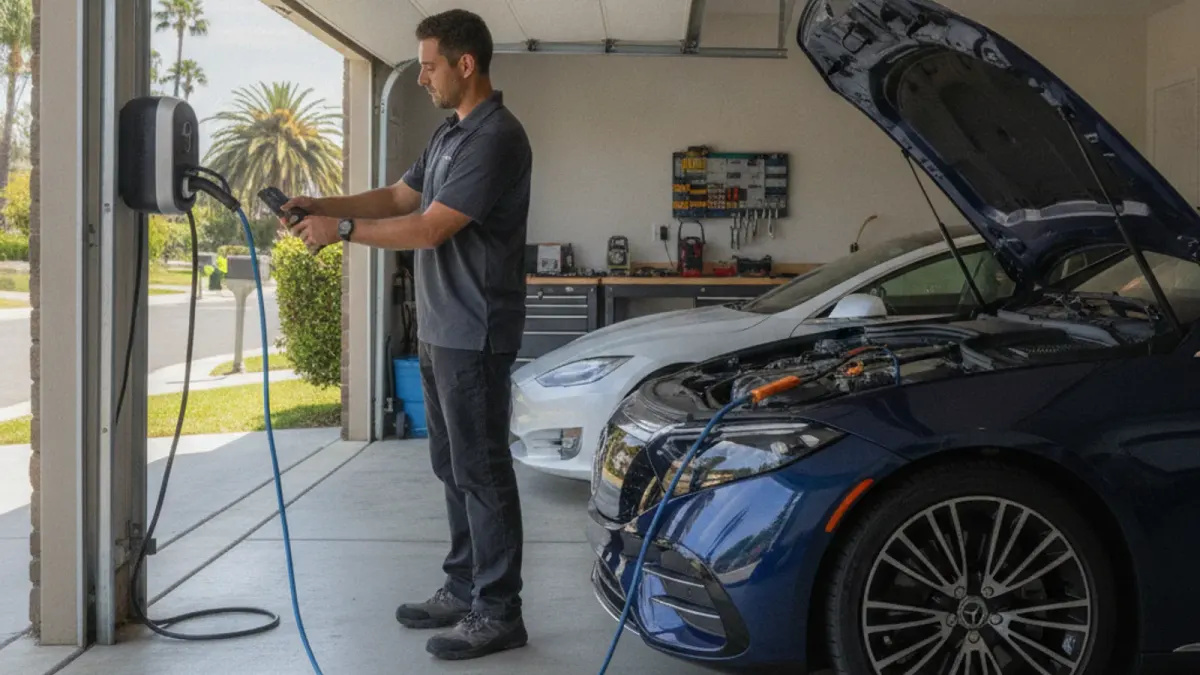
Airport parking is what kills this 12V
You land at Miami International and walk back to the car. That’s the Dolphin Garage at the North Terminal, the Flamingo Garage at the Central Terminal, Ibis Garage, the new Park 6 long-term garage, or the off-airport Park and Ride economy lot. The EQE is silent: flush handles, a black MBUX, and no Ready mode.
That’s not an empty pack. A week in long-term parking drains the small battery that wakes the computers. The high-voltage pack can still read 80% or better. It just never gets the signal to connect.
Ibis lists ChargePoint ports across its levels. Park 6 opened in summer 2026 with charging on site. Many drivers still leave the car unplugged in Dolphin, Flamingo, or the economy lot. An unplugged EQE doesn’t sit fully asleep. Modules keep a light load on the 12V the whole time.
Heat makes that load expensive. NWS Miami normals put the July and August average high at 91F. A normal year here sees about 64 days at or above 90F. Battery University’s lead-acid rule is simple. Every roughly 15F rise in temperature halves life. A 12V ages about twice as fast at 93F as it does at 77F. At 111F it ages about four times as fast. Heat damage doesn’t reverse.
Cruise parking writes the same story. PortMiami’s northside garages are A, AA, B, C, D, F, and G. Southside is J and K, plus surface Lot E. Those are long sits in the same climate. You come off a ship. The Mercedes looks dead. Check the 12V before you call a flatbed.
Smaller fields do it too. Miami Executive, still called Kendall-Tamiami by a lot of locals, sees the same parked drain. So does Miami-Opa Locka Executive. Fort Lauderdale-Hollywood International is the other big fly-out. Confirm that airport’s garage map on its own site. The 12V failure mode doesn’t change with the terminal.
The airport belt around MIA is where the car sits longest in heat. Doral warehouse lots. Miami Springs streets beside the terminals. Overnight garage stays before a dawn flight. Miami Springs housing stock is old. About 89.5% of it predates 1980, so a home Level 2 plug is often missing. Doral’s stock is much newer, with only about 5.5% pre-1980. A work trip still leaves an EQE sitting hot and idle.
Tesla drivers hit this after the same parking. The car looks totally dead, and the small battery is the one that quit. The Tesla 12V failure after parking guide is that version. The EQE fails for the same reason. Mercedes put the parts in different places.
The pack drives and the 12V wakes the car
The EQE uses a 12V AGM lead-acid battery, separate from the drive pack. That 12V powers the flush handles, MBUX, ambient lighting, and driver-assistance sensors. It also powers the control units that close the high-voltage contactors. When voltage falls too far, those units never finish their handshake. The motors never get permission. The pack sits full and unused.
Parasitic drain is the usual path. The connectivity gateway stays partly awake. So do radar and camera units, the over-the-air update system, and MBUX electronics. Mercedes flagged elevated self-discharge on early EVA2 cars and pushed software to quiet those modules. Even updated cars sag after two weeks without a drive. Airport parking is that sit, plus heat.
The EQE shares the EVA2 low-voltage layout with the EQS. The jump is the same family of fix. If you already know the sedan, use the Mercedes EQS 12V battery guide as the sibling walkthrough. The EQE SUV uses the same underhood studs. The EQA and EQB sit on a different platform. Their 12V placement isn’t the same. A dark screen and a no-start still point at 12V first.
Range here is heat, air conditioning, and dwell. It isn’t hills. South Florida is flat. Miami-Dade’s Atlantic Coastal Ridge tops out around 23 to 24 feet. Broward’s Pine Island Ridge is about 29 feet. An EQE that won’t crank after MIA parking didn’t burn the pack on a grade. It cooked a small battery while it sat.
Recurrent Auto’s fleet study of about 30,000 EVs found about 5% range loss at 90F. The same study found about 17 to 18% at 100F. AAA’s 2019 SAE-standard test found about a 17% range drop at 95F with the AC on. Those figures matter on a drive. They aren’t why the car is dark in Park 6. The 12V failed in the heat. The pack never entered the conversation.
For the broader split between a dead 12V and a dead pack, read what happens when an EV 12V battery dies.
What a dying EQE 12V looks like
The car doesn’t fail in one look. How far the 12V has dropped changes the scene.
Fully dark, handles stuck flush, fob dead: the 12V is flat. You need a jump first, not a charge truck.
The screen starts to boot, then freezes or dies before Ready. The 12V had just enough current to begin. It didn’t have enough to finish the handshake.
A “12V vehicle electrical system” warning, or a battery lamp, then a black display. Voltage fell under what the control units will accept.
The car unlocks, then won’t leave Park, or never enters drive. Low-voltage modules can’t bridge to the high-voltage pack.
None of those mean the expensive drive battery failed. All of them mean the small battery can’t deliver voltage.
Get in, open the hood, jump the studs
Owners look under the hood for a battery that isn’t there. On the EQE, the 12V lives in the rear, under a trunk floor panel. Replacement means pulling the cargo liner and load floor. That’s shop work. It isn’t garage-aisle work. The powered tailgate may already be dead, so the rear pack is even less useful while you’re stuck.
Mercedes put dedicated jump terminals in the engine bay for this failure. You jump there. You leave the rear battery alone.
Doors first. If the handles won’t power out, slide the mechanical key blade out of the fob. Unlock the driver’s door by hand. The interior hood release near the driver’s door sill is a mechanical cable. It still works with the 12V dead. Pull it. Open the hood.
On the driver’s side of the bay you’ll see a black plastic fuse and relay box. Lift the cover. Under a red protective cap there’s a marked positive terminal stud. That’s jump positive. For negative, use an unpainted metal bolt or bracket on the chassis, or a strut-tower ground. Don’t run the negative lead back to the trunk battery.
Connect in the usual order. Positive to the EQE stud, then positive to the donor or jump pack. Negative to the donor, then negative to the EQE chassis ground. Wait two full minutes so the low-voltage side can recover. Then try to start. MBUX should run its boot. The car should reach Ready.
The safe jump-start walkthrough covers that order for any EV. The EQE trap is the split: rear battery for replacement, underhood studs for a jump.
If you aren’t set up to do this in a garage aisle, stop. Charge Pro MIA is a referral line. It matches stranded drivers with independent local operators. Those operators jump or replace a dead 12V on site. They can also bring a 240V Level 2 source if the pack is actually empty, with a native NACS plug and CCS or J1772 adapters for non-Tesla EVs. They quote before they start, and they bill you directly. The line doesn’t own trucks, set prices, or promise when someone arrives.
Non-Tesla EV rescue is the service page for Mercedes, including the EQE, EQS, and the rest of the EQ lineup.
If it starts, then dies again
Once you’re moving, the DC-DC converter feeds the 12V from the main pack. A healthy battery takes that charge and holds it. An old or internally failed one doesn’t. You get out of the garage. A few days later the EQE is dark again.
If a 12V fault stays on after a jump, treat it as a failed battery. Replacement is still the rear disassembly job. The new unit usually needs registration with a diagnostic tool. Get the car mobile first. Then book the shop. The EV 12V replacement guide covers the signs and the stranded-to-shop path.
Have it load-tested once the car has some years on it. Heat here makes last winter’s “it was fine” a weak plan. FPL serves essentially all of Miami-Dade and Broward. Homestead is the exception, with Homestead Public Services Energy on some streets and FPL on others. FPL EVolution Home is the residential Level 2 program if you want the car plugged in more of the year. Confirm current terms with FPL. Don’t treat a program name as a price. A car that sits unplugged in Miami Springs or a Doral garage is the one this page is about.
Shoulders, expressways, and a wrecker you may not need
Some EQE stalls start on a shoulder, not in Park 6. SR-112, the Airport Expressway, feeds MIA. SR-836, the Dolphin, is the east-west run toward the terminals. Both are Greater Miami Expressway Agency roads. They’re all-electronic: SunPass or toll-by-plate, no cash.
If the car dies on a highway outside a municipality, Florida Statute 316.194 says to leave it off the main-traveled part where you can. Leave room for passing traffic. Keep a clear view from 200 feet each way. A genuinely disabled vehicle that can’t practicably be moved is exempt.
Dial *FHP (*347) for Florida Highway Patrol and the Road Ranger Service Patrol. Road Rangers jump-start vehicles, do minor repairs, change flats, and tow a disabled vehicle from the travel lanes to the nearest safe spot, free of charge. District 6 covers Miami-Dade. It patrols I-95, 95 Express, I-195, I-395, I-75, 75 Express, and SR-826, the Palmetto. Their materials don’t mention EV charging. A 12V jump is still a jump. A travel-lane tow is still a tow. They don’t bring a Level 2 charge. That’s the job a mobile operator takes if the pack is empty. Florida 511 at FL511.com is the state’s traffic feed in English and Spanish.
Skip the flatbed as the first idea. Private-property tows from a garage or lot fall under Florida Statute 715.07. The wrecker must stop and return the car if you appear before it’s fully removed, on payment of no more than half the posted tow rate. Storage in our counties must be within a 10-mile radius, and release within one hour of request. Miami-Dade Code Section 30-476 and Broward Code Section 20-176.22 cap non-consent rates. Confirm the posted schedule with the operator and county consumer protection. Don’t guess a dollar figure from memory.
A 12V jump in the aisle is faster than all of that.
Airport-belt cities, and the call that actually fits
The pattern is parking, heat, and a 12V that quit. It shows up in Doral warehouse parks and overnight in Miami Springs beside the terminals. Coral Gables garage streets, Brickell towers, and beach-town trips add more dwell. The fix doesn’t change with the zip code. Check the 12V first. Confirm the pack state second. Call for a charge only if the pack is actually empty.
Operators in this network handle Tesla and every major EV brand. For Mercedes, that means CCS or J1772 as needed if a top-up is the real job. A typical Level 2 roadside session adds about 10 to 20 miles of range in 15 to 30 minutes of charging. That’s charging time, not a promise of when someone arrives. For an EQE that’s merely silent with a full pack, you want the 12V jump, not the plug.
If you need the line, call (786) 963-2995. Tell them you have a Mercedes EQE that won’t start after sitting, and whether the screen is fully dark. The operator quotes before starting.
Frequently asked questions
How do you jump start a Mercedes EQE?
Use the underhood jump stud, not the rear battery. Positive is the red-capped terminal inside the driver’s-side fuse box. Negative is a chassis ground in the bay. Wait two minutes after the cables are on, then start. The real 12V is under the trunk floor and isn’t a parking-lot jump point.
Where is the Mercedes EQE 12V battery?
It sits in the rear cargo area, under a trunk floor panel. Jump terminals are in the engine bay. That split is why owners stall in a garage with the hood open, staring at a fuse box, while the battery they’d replace is under the luggage.
Why won’t my EQE start if the main battery is charged?
The pack moves the car. The 12V wakes the computers that let the pack connect. When the 12V is dead, handles, MBUX, and contactors stay offline. Jump the 12V. The pack was never the problem.