Your Mercedes EQS 12V battery dead isn’t a pack failure. The Hyperscreen stays black and the doors ignore the fob. Ready mode never lands, even with a healthy high-voltage reading. The small 12-volt battery is what failed. It has to wake every module that talks to the drivetrain. You don’t need a flatbed to a dealer. A jump at the underhood posts is the first move. A 12-volt swap in that same garage beats a shop wrecker.
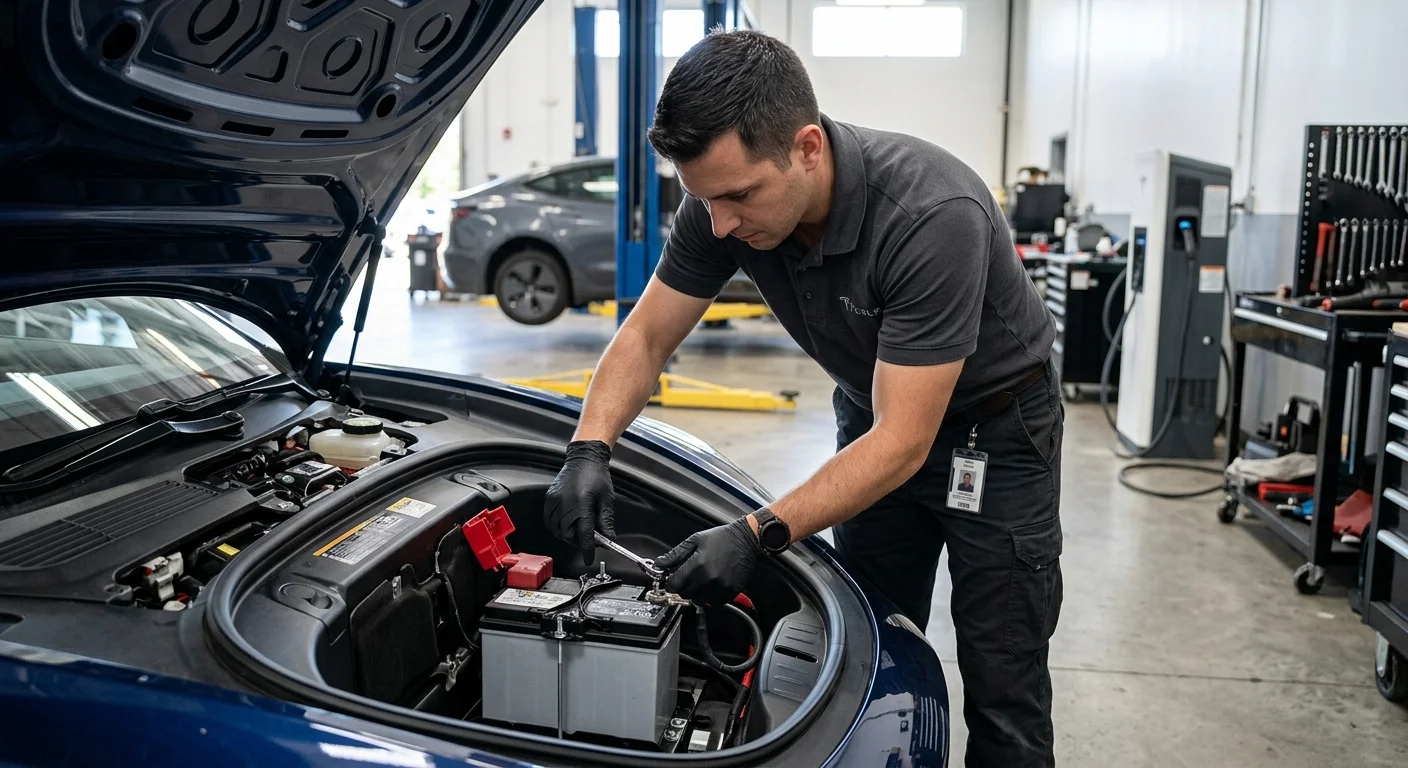
The EQS hides that 12-volt pack in the trunk. You jump it from the front bay. That layout is why a wrecker is the wrong first call. You need cables on the dedicated studs, a short wait, and a reboot. If the cell is already cooked, the car still doesn’t need a hook. It needs a replacement where it already sits.
This page is written for the EQS sedan. The EQE shares the same 12-volt weakness with a different bay layout. If that’s the car in the stall, use the Mercedes EQE 12V guide. The EQB and EQA sit on another platform. Don’t treat those jump points as the same.
What a dead EQS 12-volt looks like
Three patterns keep showing up, and all three are the 12-volt system. Complete silence is the first. No interior lights, a dead fob, and handles that stay flush. A partial boot is the second. The display lights, then freezes on “vehicle being prepared, please wait.” The third is a brief Hyperscreen wake. It flashes a 12-volt warning and goes dark before Ready. Each pattern is the same voltage drop. Control units can’t finish their startup handshake. The traction battery is still in the floor. The car can’t close the contactors until the low-voltage network is alive. Power-extending handles, digital mirrors, and the Hyperscreen all run on that 12-volt net. Kill the small battery and the big one might as well be a brick. That’s what happens when an EV’s 12-volt battery dies in this climate.
Why the heat here finishes a weak 12-volt
The EQS uses an AGM lead-acid 12-volt battery. Typical capacity sits around 90 to 95 Ah, depending on year and spec. It feeds always-on modules. Radar, the connectivity gateway, MBUX ambience, and over-the-air update hardware poll overnight. Parasitic draw is the design problem. Mercedes flagged elevated self-discharge on early EQS builds for 2022 and 2023 model years. Dealers pushed software to quiet background modules. Patched cars still drain if they sit two weeks without a drive. A parked EQS in a Brickell or Coral Gables garage does that often.
NWS Miami normals put July and August average highs at 91F. A normal year sees about 64 days at or above 90F. Battery University’s lead-acid rule is blunt. Every 15F rise halves battery life. Aging runs about twice as fast at 93F versus 77F. It runs about four times as fast at 111F. Heat damage doesn’t reverse. South Florida is flat. Miami-Dade’s Atlantic Coastal Ridge tops out around 23 to 24 feet. Broward’s Pine Island Ridge is about 29 feet. Range here is heat, air conditioning, and dwell, never grade. Cabin pre-conditioning in a hot garage plus standby electronics is how you come back to a dark screen. A week in long-term parking makes it worse. The 12-volt pack keeps systems alive while you’re gone. The traction battery isn’t empty when you return. The small battery is. That’s the airport and cruise pattern, and it’s a jump, not a wrecker.
Trunk battery versus the front jump posts
The 12-volt battery lives in the cargo area. It sits under the load floor on the driver’s side. You can’t reach it from the front bay. A true swap means pulling the trunk liner and the floor board. That’s a workshop sequence, or a mobile tech with a scanner. It isn’t a passerby’s job in a public garage. You don’t jump at the battery itself. Mercedes put dedicated jump terminals under the hood for this stall.
Find the interior hood release by the driver’s sill. If the doors won’t wake, slide the mechanical key out of the fob. Open the driver’s door by hand. The hood cable still works with no 12-volt power. Open the hood and look driver’s side front. You’ll see a black fuse and relay box. Lift that cover. A red-capped positive stud is the jump post. It’s marked once the lid is up. For negative, use unpainted chassis metal. A bolt or bracket near a strut tower is the usual ground. Don’t run the negative clamp to the trunk battery. Use chassis ground.
Clip in standard order. Positive to the EQS stud, then to the donor source. Negative to the donor, then to EQS chassis ground. Wait two full minutes, then request a start. The Hyperscreen should boot and the car should reach Ready. If you want the general EV sequence, read how to jump start an electric car without frying the 12V.
Do this in the garage, in this order
You’re in a stall, not on a shoulder. Work this list before anyone calls a wrecker.
- See if the doors answer the fob. If they don’t, use the mechanical key.
- Look for any 12-volt sign: a dome lamp, hazards, a faint screen glow. Nothing means you need a jump.
- Pull the hood. The interior release is mechanical.
- Open the fuse-box cover on the driver’s side and find the red cap.
- Connect a jump pack or a donor vehicle to the stud and to chassis ground.
- Wait two minutes, then start.
- If a 12-volt fault stays on after the jump, the battery is done. Plan a replacement in that same garage, not a tow across town.
Don’t keep cycling the start button. Don’t jump from a random underhood bolt that isn’t the stud. Don’t tear into the trunk liner unless a tech is doing the swap. Once Ready is up, drive. The DC-DC converter should refill the 12-volt from the main pack while you move. If the battery is sulfated or internally open, it won’t hold. You’ll be dark again in a day or two. That’s the signal to replace, not to jump a third time. The EV 12V replacement guide covers signs, timing, and what to do when you’re already stranded.
Where this stalls in Miami-Dade and Broward
The failure follows sitting and heat, not a hunt for a public plug.
Miami International Airport is the long-sit version. Cars rest in the Dolphin Garage at the North Terminal, the Flamingo Garage at the Central Terminal, the Ibis Garage, and the new Park 6 long-term garage. Ibis holds ChargePoint ports across its levels. A week of modules staying alive still drains the 12-volt. You can come back to a charged main pack and a car that won’t wake. Tesla 12V failure after parking walks the same physics. The EQS version uses different posts and the same small battery.
Cruise parking does the same week-long drain. PortMiami uses northside garages A through G and southside J and K, plus surface Lot E. Port Everglades in Fort Lauderdale uses the Heron and Palm garages. You leave for a week at sea and return to a silent sedan in a hot structure. Jump it in that garage.
Condo and office parking is the weekday version. Brickell City Centre, Aventura Mall, and Dadeland Mall in Kendall all produce a stall after a long sit. Coral Gables is another. University of Miami’s main campus is there, not in the City of Miami. For that street grid, see EV roadside assistance in Coral Gables. Pinecrest, Palmetto Bay, Weston, and Parkland have the same garage-and-errand pattern. Miami Beach and Sunny Isles Beach add tower parking and causeway exits. If the car won’t wake after the causeway, it’s still a 12-volt job.
Miami Springs is 89.5 percent pre-1980 stock and sits next to MIA. Home plugs are often not installable in that older housing. FPL serves essentially all of Miami-Dade and Broward. Homestead Public Services Energy covers some Homestead streets.
On a limited-access road, get off the travel lane first. Florida Statute 316.194 says a vehicle belongs off the main-traveled part when practicable. A truly disabled car that can’t move is exempt. Dial *FHP (*347) for Florida Highway Patrol and the Road Ranger Service Patrol. Road Rangers jump-start vehicles and tow a disabled car from the travel lanes to the nearest safe spot, free. District 6 covers Miami-Dade on I-95 and the Palmetto. District 4 covers Broward’s I-95 from the county line north. Their published material doesn’t mention EV charging. They can still jump a 12-volt or move you off the lanes. Independent operators bring the Level 2 top-up.
Jump, replace on site, or tow
A dark EQS looks like a wrecker candidate. A jump at the underhood studs is the first move. Two minutes of recovery often brings Ready back.
If the battery won’t hold, replace it where the car already is. The trunk pack has to come out from under the load floor. The new AGM unit usually needs registration on the battery management system with a compatible diagnostic tool. Mercedes dealers and independent EV shops do that work. Some mobile techs do it in the same stall. A flatbed doesn’t fix the 12-volt. It only relocates a car you can wake in place.
Towing a dead EV gets messy in this metro. Private-property tows in Florida follow Statute 715.07. If you appear before the car is fully removed, the operator has to stop and return it. You pay no more than half the posted rate. Non-consent rates are capped by Miami-Dade Code Section 30-476 and Broward Code Section 20-176.22. Don’t let a garage tow you because a Hyperscreen is dark.
Charge Pro MIA is a referral line. It matches stranded EV drivers with independent local mobile rescue operators. Those operators bring a 240V Level 2 source for an empty pack. They also jump or replace a dead 12-volt on site. They handle Tesla and every major EV brand, including the EQS. A Level 2 session typically adds 10 to 20 miles of range in 15 to 30 minutes of charging. That’s charging time, never an arrival time. For this sedan the first question is still the 12-volt. Non-Tesla EV rescue is the matching service page. The operator quotes you before work starts and bills you directly.
After Ready comes back
Drive enough for the DC-DC converter to work, then get the 12-volt load-tested. A jump after a hot week at MIA is already a wear warning. Watch for a repeat black screen after a short sit. That isn’t a fluke. That’s a cell that can’t hold. Book the replacement before the next garage stall, and keep the mechanical key where you can find it. A charged main battery and a dark Hyperscreen is 12-volt. An awake screen and a zero-range warning is a charge problem.
Frequently asked questions
How do you jump a Mercedes EQS in a parking garage?
Use the underhood jump stud, not the trunk battery. The positive post sits under a red cap in the driver’s-side fuse box. Negative goes to chassis ground. Wait two minutes after the clamps are on, then start. The cargo-area battery stays covered. That’s how you wake the car without a wrecker.
What does “vehicle being prepared, please wait” mean on an EQS?
The control units started a boot and couldn’t finish the handshake. Voltage on the 12-volt network is almost always the reason. The message isn’t a traction-pack failure. Jump the front terminals. The loop usually clears once voltage is back.
Should you flatbed an EQS with a dead 12V to a shop?
Not as the first move. Jump it where it sits. If the battery is finished, replace it in that garage. The trunk pack needs liner work and a registration scan, which a shop or a mobile tech can do. A flatbed is for a car you can’t wake, or a car that’s blocking a travel lane.
A Mercedes EQS 12V battery dead in South Florida is a garage problem, not a dealer-wrecker problem. Call Charge Pro MIA at (786) 963-2995. An independent operator can quote a jump, or a 12-volt path, before anyone hooks the car.