I-595 is Broward’s east-west belt toward Fort Lauderdale-Hollywood International and Port Everglades. If your EV stops on it, skip the charger hunt. Get the car out of the travel lane. Tell a local operator if the pack is empty or the 12-volt is dead.
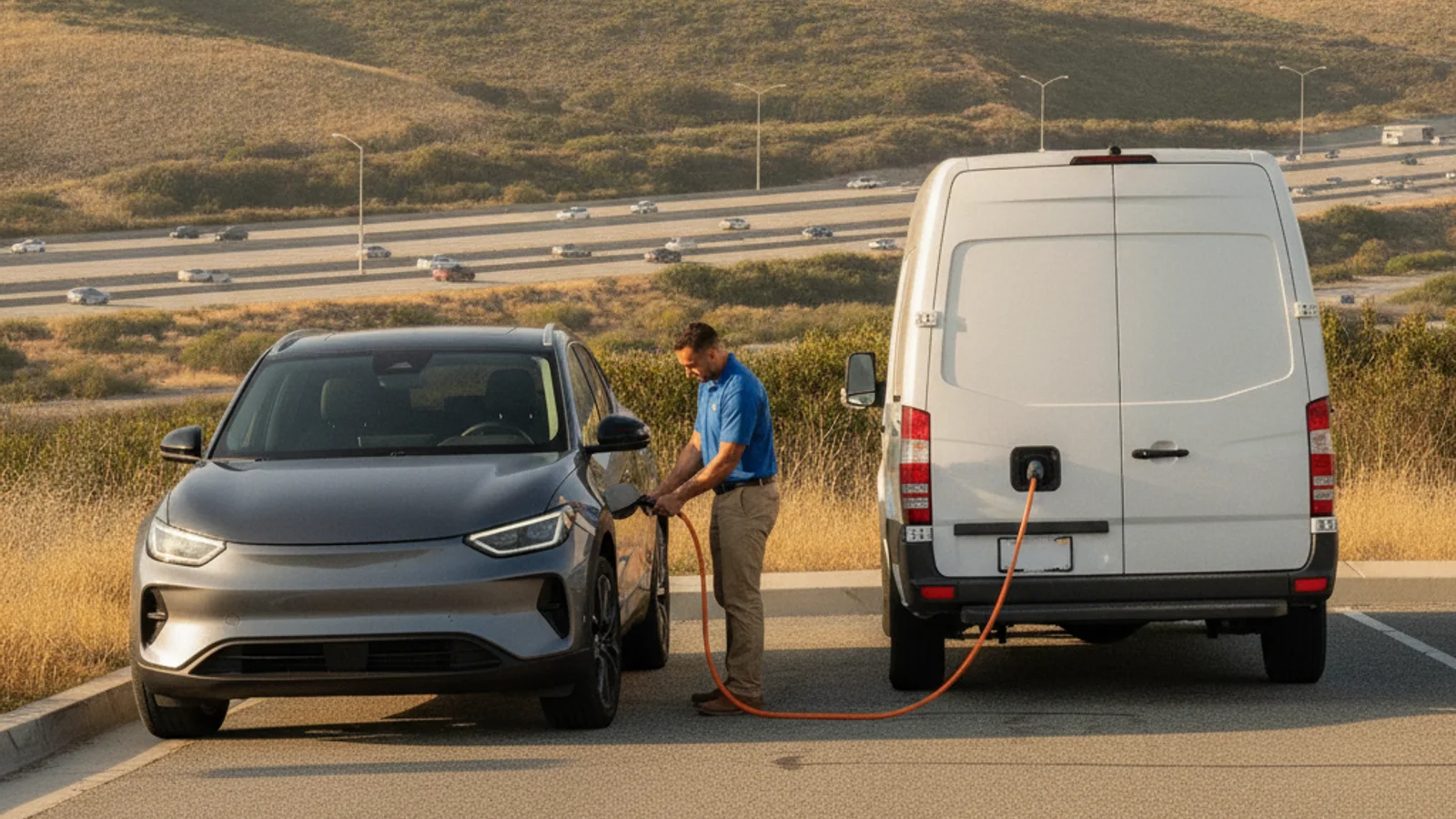
Get out of the travel lane first
Florida Statute 316.194 is the rule on this corridor. Outside a municipality, leave the vehicle off the main-traveled part where you can. Leave room for other cars to pass you. Keep a clear view of the car from 200 feet each way.
Statute 316.194(2) covers a genuinely disabled vehicle that can’t move. If the EV can’t practicably be moved off the road, that exemption applies. You still switch the hazard lights on from the cabin. You still get as far right as the pavement allows.
A live lane with no usable shoulder is a safety problem. It isn’t a charging problem until you’re out of traffic. Dial *FHP (*347) and report a disabled motorist to Florida Highway Patrol. FDOT’s Road Ranger Service Patrol can jump a 12-volt battery. They can change a flat tire on site. They can tow a disabled vehicle off the travel lanes. That tow to a safe spot is free of charge.
They don’t bring a 240-volt Level 2 source. That’s a different truck from a Road Ranger van. Don’t write off Road Rangers for an EV, though. A dead 12-volt still needs a jump on site. A car in a travel lane still needs a shove to a safe pad. Both of those are in their published list.
Florida 511 at FL511.com is FDOT’s traffic feed. Check it after you’re out of the lane. Our EV roadside assistance page starts that match. Use it once the car sits where a truck can work.
Name the stretch, not just I-595
Westbound I-595 points at I-75 and the inland Broward grid. That’s Weston, Sunrise, Davie, and Plantation on the surface streets. Eastbound points at Fort Lauderdale, Dania Beach, the airport approach, and Port Everglades.
An operator can’t plan a shoulder stop from “I’m on 595.” Give your direction of travel and the last interchange you passed. I-75, NW 136 Avenue, and SR-7 are published landmarks on this belt. The port ramps sit at the other end. If you just left airport parking or a cruise garage, say so. That detail changes the likely fault for the operator.
595 Express is a separate roadway from the general lanes. FDOT owns 595 Express and maintains those lanes. Like the rest of this system, it’s all-electronic. You pay with SunPass or toll-by-plate. There’s no cash booth on this corridor. No toll facility here publishes a disabled-vehicle rule for the express lanes. There’s also no published free-tow rule that is specific to 595 Express. Don’t wait on a policy that isn’t written. If you’re stopped in an express lane, treat it as live traffic. Call *FHP first and stay in the car if you can.
Road Rangers in FDOT District 4 patrol parts of I-595. The published stretches run from I-75 to NW 136 Avenue. They also cover the stretch from SR-7 to Port Everglades. That’s published coverage of those segments, nothing more. It isn’t a promise that a charging truck is already on the way.
If you rolled off toward the port, start with Dania Beach EV rescue. That page covers streets at the airport edge. If you dropped into city streets, use the Fort Lauderdale EV charging guide.
Heat spent the miles, not a hill
South Florida is flat. Broward’s high point, Pine Island Ridge, sits around 29 feet. There’s no grade penalty on I-595 at all. Range can fall apart between the I-75 end and the port. That’s heat, air conditioning, and time in traffic.
NWS Miami normals put the July and August average high at 91F. A normal year sees about 64 days at or above 90F. Recurrent Auto’s fleet study of about 30,000 EVs is the range figure to cite. It finds about 5% range loss at 90F. It finds about 17 to 18% at 100F. AAA’s 2019 SAE-standard test found about a 17% range drop at 95F.
It can take 3 to 5 kW to cool a 95-degree cabin. It takes about 1 kW to hold it there. The first minutes of AC are the expensive ones. A trip that should have been enough can still die on this belt.
Empty pack, or a 12-volt that sat in parking
“My EV died on I-595” is two jobs. One job is a traction battery at zero. The other is a 12-volt battery that won’t wake the car.
A zero-range warning and a “pull over safely” message usually mean an empty pack. A silent cabin and dead locks usually mean the 12-volt. An app that can’t find the vehicle points the same way. Read the screen word for word if there’s a screen. Don’t turn that screen into your own diagnosis.
This mix-up is common after a flight or a cruise. A car that sat in long-term parking often looks totally dead. The 12-volt often drained keeping systems alive in the heat. The main pack can still have range left. Port Everglades cruise parking uses the Heron and Palm garages plus surface lots. Airport parking after a trip follows the same pattern. You come back and the car won’t wake. It feels like the main pack is empty.
South Florida heat makes that 12-volt drain worse. Every roughly 15F rise in temperature halves the life of a lead-acid battery. It ages about twice as fast at 93F versus 77F. It ages about four times as fast at 111F. Heat damage on that battery doesn’t reverse later.
Don’t pop service panels from a generic article. Access points and approved jump procedures vary by make and model year. Use the owner’s manual or the manufacturer’s app. Tell the operator what still works: lights, locks, the charge-port release, the app. That’s enough for them to pick a Level 2 top-up or a 12-volt jump.
Independent operators in this referral network typically add 10 to 20 miles of range. That takes 15 to 30 minutes of charging on site. That’s time on the plug, not a clock on arrival. They bring a 240-volt Level 2 source with a native NACS plug. They carry CCS or J1772 adapters for non-Tesla EVs. They also jump or replace a dead 12-volt on site. Tesla and every major EV brand are in that mix.
What the operator needs before they take the call
Charge Pro MIA matches stranded drivers with independent local operators. The operator quotes you before any work starts. They bill you directly once you accept the quote. They can’t accept a shoulder call on a guess.
They need the vehicle on the record first. Give make, model, year, and the connector. A Tesla uses a native NACS plug. Most other EVs use CCS or J1772. The operator confirms compatibility before they commit to the trip. Start that match on our mobile EV charging page.
They also need a clear read on the site. Say whether you’re on a shoulder, a gore, or an off-ramp. Say if you’re in a garage or a cruise lot. Tell them whether another vehicle can stand beside you. Say whether you’re in general-purpose lanes or 595 Express. A locked garage with no code is the same as no access.
They need an honest symptom, not a theory. “I don’t know, here’s the screen” is usable. A guess stated as fact isn’t useful. If you’re weighing a charge against a hook, start here. When you need a charge, not a tow walks through that choice.
When a mobile charge is the wrong tool
Some I-595 stops aren’t charging stops at all. A car that won’t begin charging on a compatible plug may have a deeper fault. Mobile equipment can’t always clear that on the shoulder. A car sitting in an express lane with no safe pad isn’t a charging site. A garage stall the truck can’t reach is the same problem.
In those cases the operator may recommend transport instead. That’s a different tool, not a lesser one. Out-of-charge recovery is the path when the car has to leave the shoulder.
Don’t force a Level 2 session onto a car that’s refusing the plug. Don’t drift back onto I-595 to hunt a public station you haven’t confirmed. Florida Statute 316.1945 lists places you can’t stop. If a Road Ranger already moved you to a turnout, stay there. For freeway law, read what Florida law says when your EV dies on the freeway.
Call when the car is already stopped
Call when you’re stopped on I-595 and the car won’t move. Call if the pack looks empty or the 12-volt won’t wake. Call (786) 963-2995 for a match with an independent EV rescue operator. They quote the work, bill you, and decide if the shoulder is workable.