A stall on Hollywood’s low coastal streets leaves you with no dry place to wait. Water can cover the curb. A1A stays tight. A dead EV in a travel lane is a hazard, not a pause. Get your hazards on. Stay in the car if the pavement is still dry. Call for an operator who can charge you on dry ground. Or have the car moved before the next tide push. Charge Pro MIA matches stranded drivers with independent local operators. The brand doesn’t own trucks and doesn’t do the work.
Hollywood is flat, wet, and hard on a waiting car
This is Hollywood, Florida, in Broward County. It’s not the California city with the same name. There’s no hill tax on range. Broward’s highest natural ground, Pine Island Ridge, is only about 29 feet. Hollywood’s beach blocks sit far lower than that. Range here is heat, air conditioning, and time parked with systems awake. NWS Miami’s 1991-2020 normals put the July and August average high at 91F. Recurrent Auto’s study of about 30,000 EVs found about 5% range loss at 90F. AAA’s 2019 SAE-standard test found about a 17% range drop at 95F with the AC on.
Florida Power and Light serves Hollywood. Older housing makes a home plug less likely. About 74.7% of Hollywood’s housing was built before 1980. Many beach and downtown drivers rely on a public port. When that plan fails, they stall on the same low streets that flood.
Where the low streets actually pin you
Hollywood Beach sits on a barrier strip. You reach it on the Hollywood Boulevard causeway or the Sheridan Street causeway. A1A runs the ocean side. The Hollywood Beach Broadwalk sits between the sand and those blocks. Downtown Hollywood and Young Circle sit west of the Intracoastal. Emerald Hills, Hollywood Hills, and Driftwood sit farther inland on slightly higher ground.
The stall that goes bad is usually east. A1A, the Broadwalk-side streets, and the two causeways have little extra pavement. A dead car there can sit in a travel lane or a flooded curb. Hallandale Beach and Dania Beach share that thin coastal edge. Inland Pembroke Pines and Miramar don’t.
King tides run mainly September through November. Broward’s resilience pages name Hollywood among the low coastal streets that take sunny-day flooding. Each event lasts about three hours. Afternoon storms from about 2pm to 6pm can refill the same blocks. If your car dies in that window, you don’t have a dry shoulder.
Broward’s hurricane plans draw the same line. Plan A, for Category 1 and 2, covers land east of the Intracoastal. Plan B, for Category 3 and above, covers land east of US-1, Federal Highway. That’s the strip with the least room to sit. If a storm is coming, FPL tells EV owners to keep the pack between 50 and 80%. Unplug during the storm. Skip any charge on a car that took floodwater.
For a Hollywood stall that isn’t about tidewater, see EV roadside assistance in Hollywood when the public plug fails. This page is about the wet, low blocks.
Floodwater changes the next call
Saltwater and a live EV don’t mix. NHTSA warns that leftover salt in a flooded lithium battery can bridge and short. Fires can start days or weeks later. After Hurricane Ian in 2022, about 36 flooded EVs later caught fire. The agency says a flood-exposed EV shouldn’t park within 50 feet of a structure. It shouldn’t be driven or charged until it’s inspected.
FPL repeats that inspection rule in its EV storm guidance. If the car sat in tidewater, don’t plug a Level 2 cable into a wet port. Read what to do when water sits in the charge port before you try a public plug later.
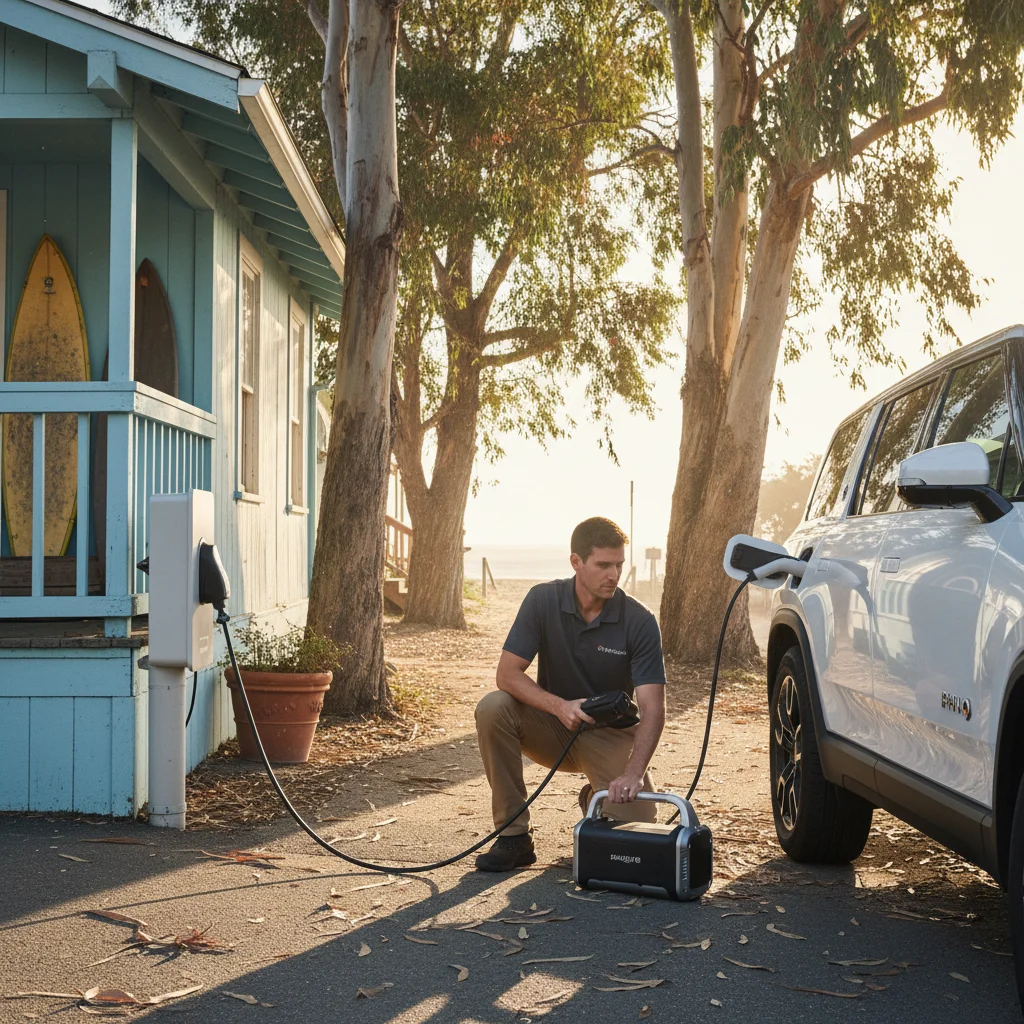
A dry stall is a different job. The operator you’re matched with can bring a 240V Level 2 source to the car. Native NACS on Tesla. CCS or J1772 adapters for other brands. Typical charging time, not travel time, is 15 to 30 minutes. That usually adds about 10 to 20 miles of range. The operator quotes you before any cable goes in, then bills you directly.
If the 12-volt battery is the dead part, the pack can still hold energy. Salt air and heat chew through a 12V. Battery University notes that every rise of about 15F halves lead-acid life. A car that sat a week at the Seminole Hard Rock Hotel & Casino Hollywood may not wake. The Guitar Hotel garage does the same thing. That’s a jump or an on-site 12V swap, not a flatbed by default.
What the law and Road Rangers actually cover
Florida Statute 316.194 says a vehicle on a highway outside a municipality should sit off the main-traveled part when that’s practicable. Leave room for passing traffic and a clear view from 200 feet each way. 316.194(2) exempts a genuinely disabled vehicle that can’t be moved.
Inside Hollywood, you’re in a municipality. The practical rule is still the same. Get out of the travel lane if you can. Don’t sit in standing water if you can still roll. Hazards on. Seatbelt on if you stay in the car.
If you die on I-95 through Hollywood, that’s FDOT first. District 4 Road Rangers patrol I-95 from the Miami-Dade line north. They jump-start vehicles, change flats, and tow a disabled car off the travel lanes, free of charge. Dial *FHP, which is *347, from your phone.
Road Ranger pages don’t mention EV charging. They still jump a 12V and they still clear a lane. A Level 2 charge is the part a local operator handles. Don’t wait on the interstate for a friend. For the freeway version, read your EV died on the freeway: what Florida law says to do.
Private lots have their own clock. Florida Statute 715.07 governs non-consent tows. If you appear before the car is fully removed, you can stop the tow by paying no more than half the posted rate. In a county over 500,000 people, the yard must sit within 10 miles. Broward qualifies. Broward Code Section 20-176.22 sets maximum nonconsent rates. Confirm the current posted figure with the operator and with Broward Consumer Protection.
US-1, SR-7 (US-441), and Hollywood Boulevard are the inland exits if you can still roll. Don’t aim for a public charger you haven’t confirmed. Roll toward dry pavement and a legal stall first.
A mobile charge, a 12V jump, or a wrecker
Three different failures look like one dead car. An empty traction pack needs energy. A mobile Level 2 charge is built for that. See out-of-charge recovery and mobile EV charging. The pro plugs in where you sit, if the ground is dry and legal.
A silent car after a long sit is often the 12V. Lights, locks, and computers die first. An on-site jump or 12V replacement is the usual fix. Tesla and every major EV brand carry a low-voltage battery. Heat and salt make Hollywood hard on that small battery.
A car in water, or a car that can’t legally stay, needs a flatbed. EVs should ride on a flatbed so the motors don’t drag. For the choice in plain terms, read charge on site or tow: how to choose when you’re stranded.
Don’t treat a wrecker as a charger. The truck moves you. It doesn’t fill the pack unless you’ve also booked a charge. Don’t treat Road Rangers as a Level 2 source either. They can clear I-95. They don’t publish an EV charge.
Charge Pro MIA is a referral line. It holds no licence, owns no equipment, and sets no price. The independent operator quotes you, then bills you. The pros we connect you with are licensed and insured.
What to do on the Broadwalk side, in order
Hazards on as soon as the car starts to sag. Coast right, or onto a side street, while you still have motion. Stay out of standing water if you can still roll. Stay in the car with the belt on if traffic is close and the cabin is dry. If water is at the sills, get yourself to dry ground. Don’t plug in a wet port. Don’t accept a charge on a flood-exposed car until it’s inspected. Call *347 if you’re in an I-95 travel lane. Call for a local mobile rescue if you’re on a dry city street. Tell the operator your cross street, whether water is present, and whether the car is silent or just empty.
A night at the Seminole Hard Rock or the Guitar Hotel is a common silent-car story. Hours in a garage drain the 12V. That’s not an empty pack. Say so when you call, so the operator brings jump gear, not only a charge cable.
If you still have a mile or two, leave the barrier island on the Hollywood or Sheridan causeway. Don’t sit in a flooded A1A block. Inland Hollywood, Young Circle, and the US-1 side give you more pavement. They also sit closer to the rest of the Hollywood charging and rescue page.
When to call Charge Pro MIA
Call when the car is dry and you need someone to come to you. That means an empty pack or a dead 12V. Call from Hollywood Boulevard, A1A, a causeway, or a Hard Rock garage aisle if you can’t wake the car. Don’t ask the brand to perform the work. Ask to be matched with an operator.
The number is (786) 963-2995. The operator quotes you before starting. You pay that operator. Nobody on that line can promise when a truck will appear. What they can do is match you with a local pro. That pro may bring a 240V source and a NACS plug, plus CCS or J1772 adapters, or 12V jump gear. Tesla and every major EV brand are in scope.
If floodwater already reached the battery tray, say that first. The right next step may be a flatbed to dry ground and an inspection, not a charge. That’s the Hollywood coastal version of this problem. The street is low. The water is real. Sitting there isn’t a plan.