Tesla roadside assistance is a factory dispatch program. It isn’t a local truck based in Miami-Dade or Broward. Whether a contractor actually comes out depends on the Tesla app. It also depends on your car’s terms and the kind of stall you have. Our approved sources couldn’t confirm continuous hours. Don’t treat an old search result as proof that a Tesla-branded crew is rolling.
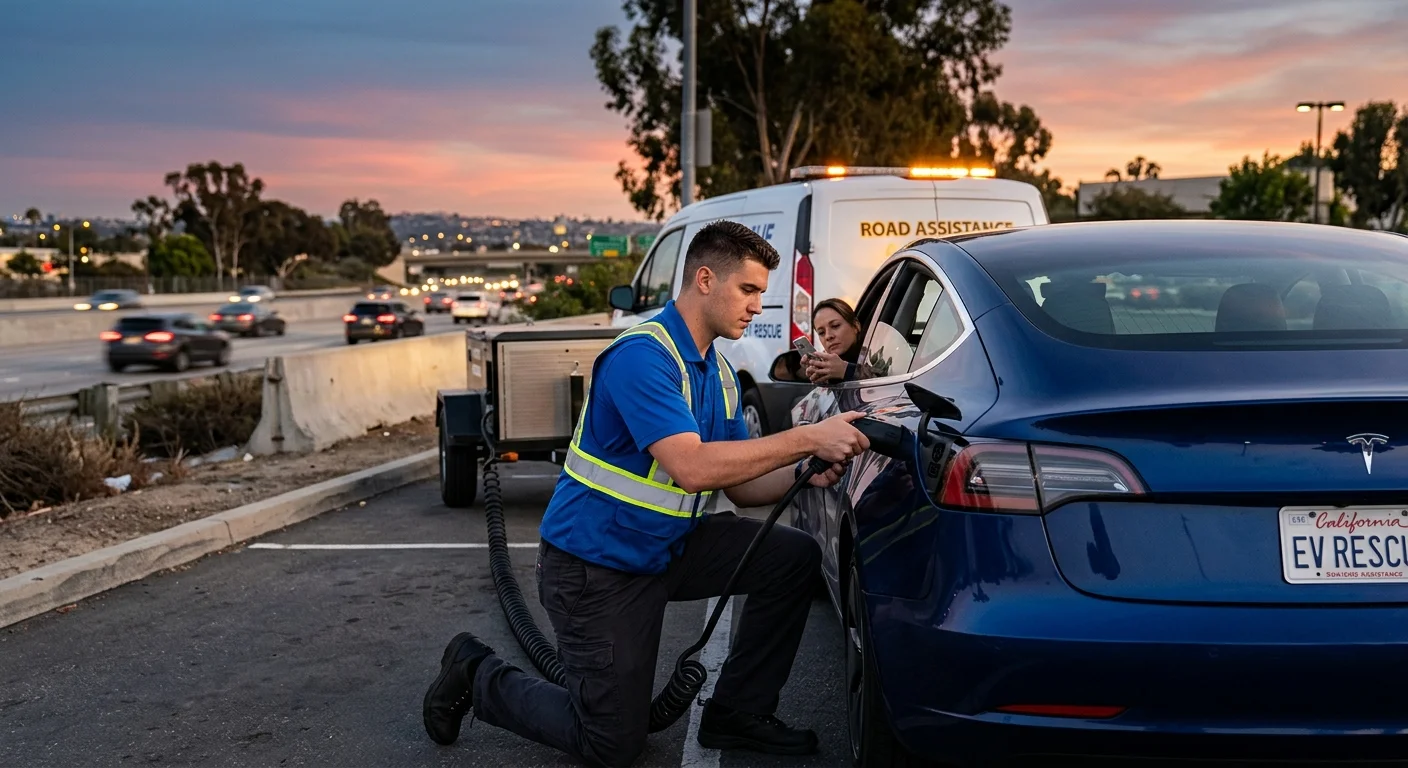
Factory dispatch isn’t a South Florida crew
Tapping Roadside in the Tesla app asks Tesla’s program to send a contractor. That contractor isn’t Charge Pro MIA. It isn’t a branded depot sitting in the City of Miami either. Tesla’s current in-app terms for your VIN are the coverage text that matters. We couldn’t confirm a dedicated South Florida Tesla crew. We also couldn’t confirm a published hour window. We couldn’t confirm a promise that every request gets a truck.
A request button isn’t a confirmed dispatch. Who shows up, what they can do, and who pays are separate questions. Read every condition on the screen before you submit. If the option doesn’t appear, use Tesla’s current support materials. Skip numbers copied from old directories.
Our guide to the Tesla roadside phone versus the app covers what to prepare. It doesn’t promise which path answers first.
What “come out” means on this map
A stall in the City of Miami isn’t the same as a stall in Broward. Neither matches a stop on a causeway. Miami Beach is its own city, reached only by causeway. Kendall is a census-designated place, not a city with a hall. Name the real place and the real road. Say whether you’re in a lane, a shoulder, a garage, or a lot.
A Model Y that won’t wake in the Ibis Garage is often a drained 12-volt. That’s a common stall after a trip at Miami International Airport. Park 6, the newer long-term garage, is another common sit. The main pack can still hold energy while the 12-volt dies keeping systems alive. Almost nobody in that moment knows the difference.
A Model 3 on the Palmetto Expressway can sit with an empty high-voltage pack. It needs a charge or a tow, not a jump. The same holds on the Dolphin Expressway, the Homestead Extension, or I-95 through Fort Lauderdale. A silent car on a causeway to Miami Beach is a traffic problem first.
Tesla’s program may send towing or tire help when your screen terms allow it. We couldn’t confirm a complete, current list of covered problems. Don’t assume a depleted traction pack is treated like a dead 12-volt. Don’t tell a dispatcher the car “just needs a jump” unless that’s already confirmed.
What Tesla roadside will still send helps you sort those categories. Heat also makes 12-volt failures more common here than people expect. NWS Miami 1991-2020 normals put the July and August average high at 91F. A typical year sees about 64 days at or above 90F. Battery University notes that every roughly 15F rise halves lead-acid life. A pack ages about twice as fast at 93F as at 77F. That’s why Teslas left after a cruise or a flight so often look totally dead.
Use the Tesla app, then describe the pin
Open the Tesla app tied to the stranded vehicle. Find the current Roadside or support area. If a request path appears, follow the on-screen steps. Save screenshots of the terms, any confirmation, and the provider name shown.
Give a location a contractor can find. “On I-95” isn’t enough. Say northbound or southbound, the nearest exit, and the shoulder side. Note whether you’re in a travel lane. On GMX roads such as SR-112, SR-836, SR-874, SR-878, or SR-924, add the ramp or plaza you just passed. Those roads are all-electronic, using SunPass or toll-by-plate. A garage at Brickell City Centre needs a building name and a level. So does a condo stack in Sunny Isles Beach. A map pin alone isn’t enough there.
Describe the car in plain words. Screens on or dark. Able to shift or not. The exact warning text, if any. Visible tire damage, smoke, heat, or a blocked lane. Don’t open electrical covers next to moving traffic.
If the request stalls or vanishes, go back to Tesla’s current support channel. Don’t keep retrying an unsourced number. For Miami-specific stall patterns, read Tesla roadside help in Miami.
Get out of the travel lane first
Treat a live-lane stall as an emergency, not a coverage debate. If the Tesla is blocking traffic or someone is in danger, call 911. Follow the responders on scene.
Florida Statute 316.194 covers a vehicle on a highway outside a municipality. Sit off the main-traveled part when that’s practicable. Leave room for passing traffic and a clear view from 200 feet each way. 316.194(2) exempts a genuinely disabled vehicle that cannot practicably be moved. That exemption isn’t permission to stay in a live lane. Get clear if you can.
The Road Ranger Service Patrol is FDOT’s free highway service for disabled vehicles. Dial *FHP (*347) from your phone. District 6 covers Miami-Dade on I-95, 95 Express, I-195, I-395, I-75, 75 Express, and SR-826. District 4 covers Broward’s I-95 from the Miami-Dade line north, plus portions of I-595 and I-75. Rangers jump-start vehicles, change flats, and do minor repairs. They also tow a disabled car from the travel lanes to the nearest safe spot. Their published materials don’t mention electric vehicles or EV charging. A 12-volt jump or a move off the travel lane is still in their toolkit. A Level 2 top-up isn’t what they bring.
Florida 511 at FL511.com is FDOT’s official traffic feed, in English and Spanish. Check it if you need to know whether the corridor is already jammed.
Use the hazards if they work. Speak the exit, direction, mile marker, and shoulder side. A map pin helps. It doesn’t replace a spoken description.
Once you’re out of the travel lane, match the help to the failure. A tow, a 12-volt jump, and a mobile charge are different jobs. Our freeway out-of-charge checklist covers that sequence. It doesn’t ask you to do electrical work on the shoulder.
A local operator quotes before starting
Factory dispatch is one path. It isn’t the only one. If the app has no suitable option, the terms may skip your problem. You may also want a provider who states a price before rolling. An independent mobile operator is that other route.
Charge Pro MIA is a referral line for South Florida. We match stranded EV drivers with licensed, independent local mobile rescue operators. We don’t perform the work, own trucks, or employ technicians. We don’t set prices or hold a trade license. The operator quotes you before starting and bills you directly.
Tell the operator the Tesla model and what the screens show. Say whether the pack looks empty, and give the exact pin. Name the site if it helps. That can be airport parking or a surface lot at Hard Rock Stadium in Miami Gardens. It can be campus streets near the University of Miami in Coral Gables. It can be FIU’s Modesto Maidique Campus in the Sweetwater and Tamiami area. The operator decides whether the job matches the truck.
Operators typically bring a 240-volt Level 2 source to the car. Tesla gets a native NACS plug. Other EVs use a CCS or J1772 adapter. That session usually adds about 10 to 20 miles of range. The plug time is 15 to 30 minutes. That figure is plug time, never an arrival window. They can also jump or replace a dead 12-volt battery on site. They handle Tesla and every major EV brand.
Ask who is coming and what the quote covers. Confirm whether the plan is a charge, a 12-volt service, or a tow. Keep the operator’s own record of the agreement.
If you want that path, start with Tesla roadside rescue. For the split between factory inclusion and a hired operator, read when Tesla roadside is included.
When this number is the next step
Call when your Tesla is stranded in Miami-Dade or Broward and you want a connection to a local mobile rescue operator. We don’t promise that an operator is free. We don’t quote an arrival window. The operator confirms the service and the terms with you.
Call (786) 963-2995 and we’ll connect you with an independent local operator.