Two Teslas in the same Doral lot still leave you stranded. A Model 3 can’t pour pack energy into a Model Y. Most EVs on South Florida roads can’t charge another EV. A few trucks and a handful of crossovers can export power. That’s a hardware exception, not a rescue plan. When you’re empty on the Palmetto, you need 240V brought to the car.
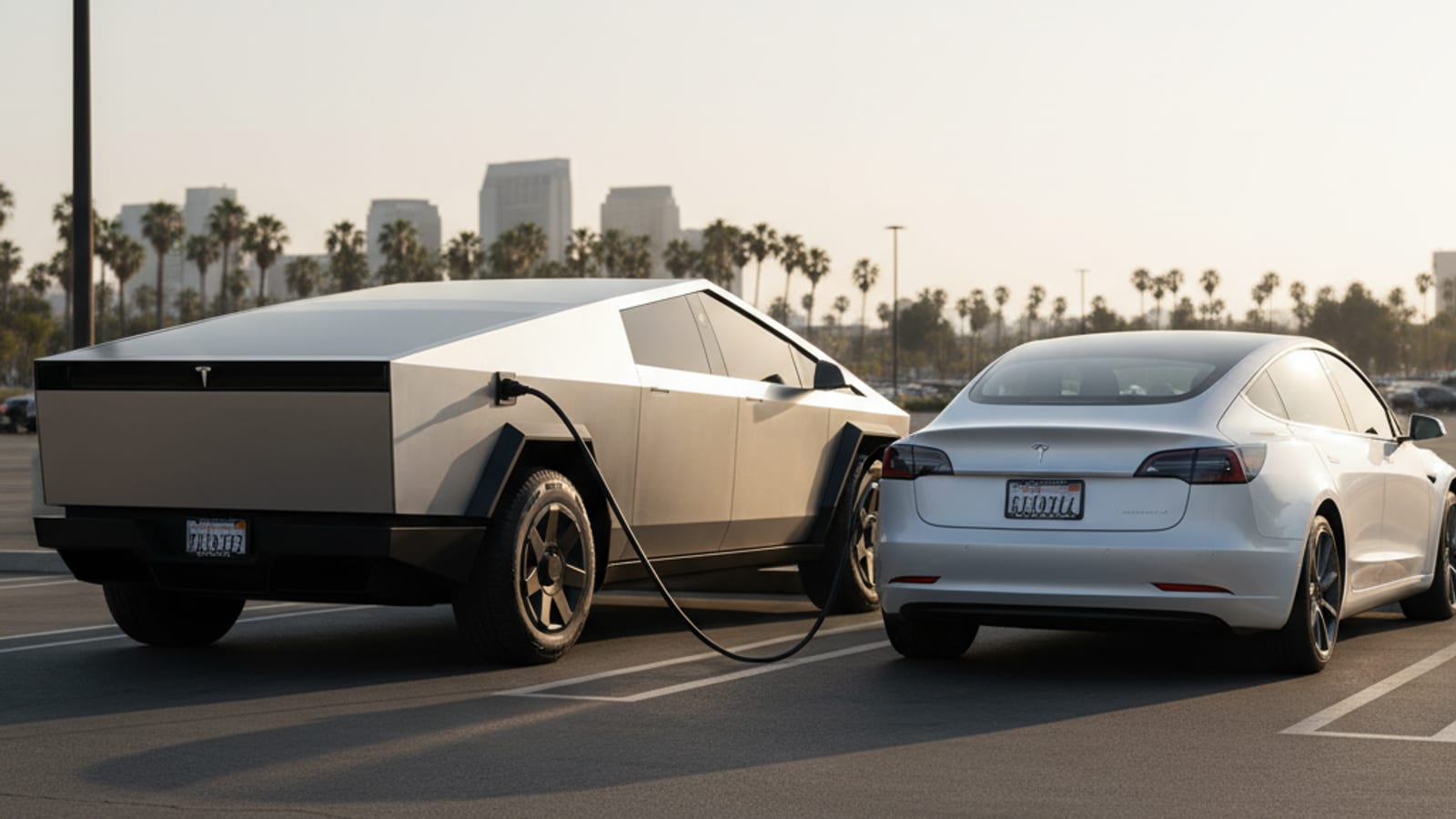
Most cars here can’t share a pack
One EV can charge another only with real export hardware and the right cable. Regular Teslas don’t have that. Neither do most commuter EVs that fill Coral Gables streets and Brickell garages. An F-150 Lightning can export, and so can a Cybertruck. Some Hyundai and Kia models can trickle power through a V2L adapter. That’s not how a dead car on I-95 gets moving.
Charge Pro MIA is a referral line. We match you with independent local mobile rescue operators. Those operators bring a 240V Level 2 source to the car. They use a native NACS plug on Teslas. Non-Tesla EVs get a CCS or J1772 adapter. Charging time is typically 15 to 30 minutes. That usually adds about 10 to 20 miles of range. That’s charging time, never an arrival time. The operator quotes you before starting and bills you directly.
Heat makes the myth tempting
South Florida is flat, so range here isn’t a hill problem. Miami-Dade’s Atlantic Coastal Ridge sits around 23 to 24 feet. Broward’s Pine Island Ridge is about 29 feet. What eats miles is heat, air conditioning, and dwell.
NWS Miami normals put July and August average highs at 91F. A normal year sees about 64 days at or above 90F. Recurrent Auto studied about 30,000 EVs. That fleet work found about 5% range loss at 90F. Loss rose to about 17 to 18% at 100F. AAA’s 2019 SAE-standard test found about a 17% drop at 95F with AC on.
A full Tesla next to you looks useful after Hard Rock Stadium lets out. The plug between two passenger Teslas isn’t.
Florida had about 450,400 registered EVs in 2025, per DOE AFDC registration data. Plenty of those cars live in older housing. North Miami is 82.7% pre-1980 stock, and Hialeah is 60.1%. A home Level 2 install often isn’t practical there. Doral, Parkland, and Weston sit on much newer stock. The roadside question still hits both groups.
Sharing power isn’t a 12V jump
Every traction pack holds a lot of energy. Moving some of it into a second car isn’t a 12V jump. You need an inverter that can send power out. You need an outlet or adapter that exposes it. You need a cable the stranded car will accept. Most EVs convert AC to DC to fill the pack. They don’t reverse that path to a bumper socket.
The 12V pigtail at a Tesla tow hook is a wake-up tool. See Can a Tesla jump-start another car: the 12V truth for that path. That can wake computers and unlock latches. It won’t refill a traction pack.
Trucks, V2L adapters, and 120V camp plugs
A small set of EVs can export. Cybertruck Pro Power puts 240V in the bed and 120V in the frunk. The bed outlet is a NEMA 14-50, rated up to 9.6 kW. It can feed a portable Level 2 unit when the cable is right.
Ford’s F-150 Lightning uses Pro Power Onboard. Standard output is 2.4 kW, and the extended setup reaches 9.6 kW. Details sit in Can an F-150 Lightning charge another EV on the roadside.
Ioniq 5, EV6, and EV9 can use a V2L adapter on the charge port. Published output is about 3.6 kW. That’s a slow trickle for a stranded driver. Chevrolet’s Silverado EV advertises power takeoff around 10.2 kW. Rivian R1T and R1S bed outlets are 120V, around 1.4 kW.
Passenger Tesla Model 3, Y, S, and X don’t export. Tesla has shown bidirectional charging in lab clips. Export still isn’t a feature on those four.
The cars stacked at Aventura Mall and Dadeland mostly can’t share a pack.
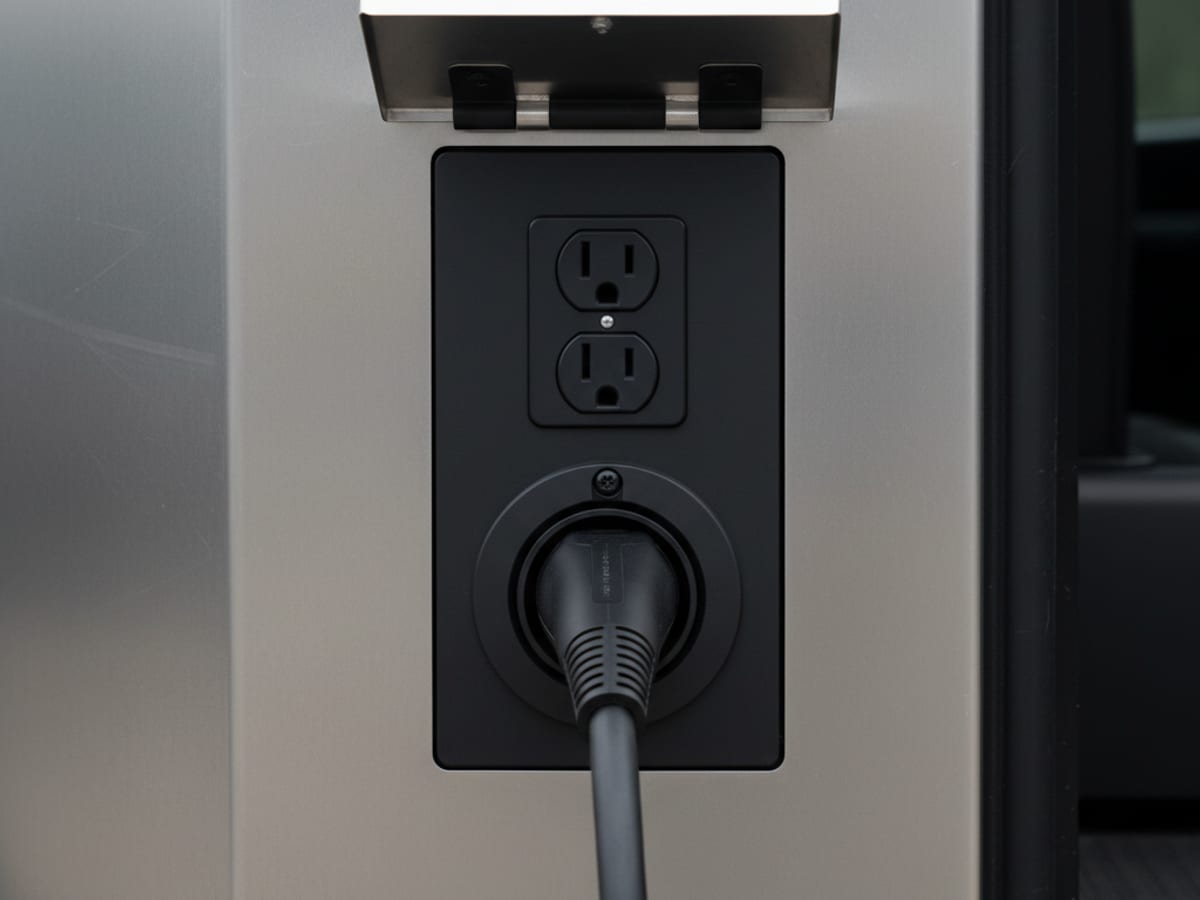
A second Tesla doesn’t help on the causeway
Miami Beach is a separate city from Miami. You reach it on a causeway. Key Biscayne is the same shape: one way in, one way out. An empty pack there doesn’t turn the next Model Y into a charger. There’s no Tesla-to-Tesla cable for those cars.
Hard Rock Stadium in Miami Gardens spills traffic after Dolphins games and F1. University of Miami traffic is in Coral Gables, not the City of Miami. Those lots fill with passenger EVs that can’t export.
What drivers here actually need: 240V on a truck
Mobile rescue in this metro isn’t car-to-car. Independent operators roll up with a 240V Level 2 source. The stranded car’s onboard charger does the conversion. They plug native NACS into Teslas, or CCS or J1772 adapters into other brands. Typical add is 10 to 20 miles in 15 to 30 minutes of charging. That’s a bridge toward a working public plug, not a full pack.
FPL serves essentially all of Miami-Dade and all of Broward. FPL EVolution is the utility’s public charging brand. None of that puts a plug on your bumper once you’re already stopped.
A Supercharger, or any DC fast stall, is a different class of power. A 9.6 kW outlet isn’t that. Operators add enough miles to leave the shoulder. See How a mobile EV charging truck gets you enough range to move. What’s actually on a mobile EV rescue truck in South Florida covers the kit. Service pages for the same job are mobile EV charging and out-of-charge recovery.
Shoulder law, Road Rangers, and the airport 12V
If you’re stopped on a highway outside a municipality, Florida Statute 316.194 applies. Get off the main-traveled part where you can. A genuinely disabled vehicle that can’t move is exempt. District 6 Road Rangers cover Miami-Dade routes including I-95, I-75, and the Palmetto.
Road Rangers jump-start vehicles, change flats, and handle minor repairs. They also tow a disabled car from the travel lanes, free of charge. Dial *FHP, which is *347. Their published materials don’t mention EV charging. They can still jump a 12V or move you off a lane. They don’t bring a Level 2 EV charge.
Don’t treat a silent car as an empty pack. After a cruise week at PortMiami, the 12V often died keeping modules alive. The same pattern shows up in MIA’s Flamingo Garage and Ibis Garage. Battery University notes that roughly every 15F rise halves lead-acid life. A jump or an on-site 12V swap wakes the car. See Tesla 12V failure after parking: why the car looks totally dead.
Don’t improvise a dryer-cord hookup
A NEMA 14-50 on a truck bed is still live 240V. Grounding, cable rating, and the EVSE in the middle all matter. A household dryer cord plus a portable charger isn’t a trained setup. An operator with the right lead quotes you before they start. Charge Pro MIA doesn’t set the price, own the truck, or do the work.
The exception isn’t a plan
If a second EV is already there, check whether it actually exports 240V. A Lightning or Cybertruck can transfer power when the owner knows the outlets. Treat Ioniq 5 V2L as a trickle, not a rescue clock. Otherwise call for a mobile 240V charge. If the car is fully dark, confirm the 12V first.
Empty-pack stops on the Homestead Extension, Tamiami Trail, or Alligator Alley still start with the travel lane. Florida 511 at FL511.com is FDOT’s traffic feed in English and Spanish. Charge Pro MIA matches stranded EV drivers with independent local operators across South Florida. Tesla, and every major EV brand. If you need that match, call (786) 963-2995. The operator quotes you before they start.