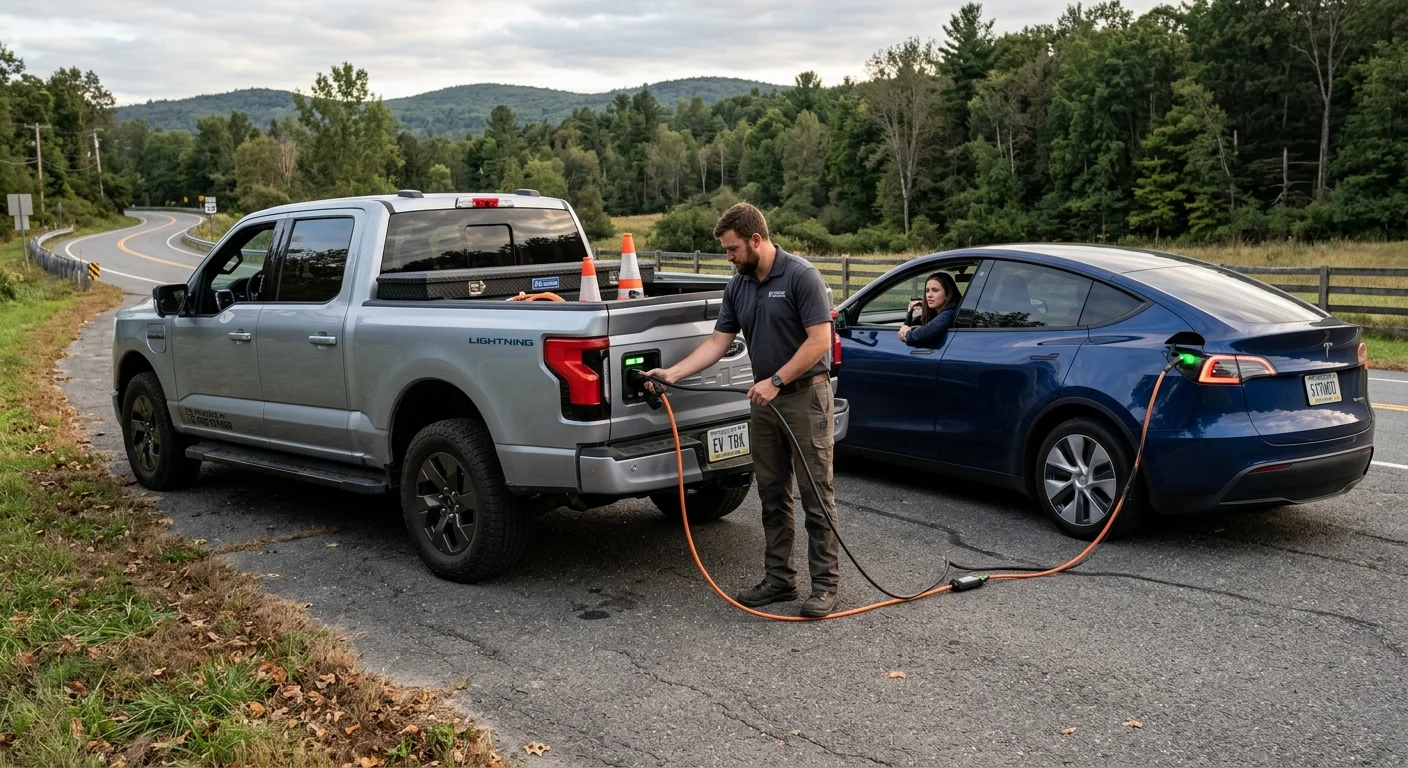
A Ford F-150 Lightning can charge another EV. Pro Power Onboard has to be on that truck first. You also need a portable Level 2 unit for the 240-volt outlet. This is AC power from bed outlets, not a DC fast-charge session. On I-95, that wait leaves two EVs on the shoulder.
What Ford actually put in the truck
Pro Power Onboard is Ford’s factory inverter and outlet package. It feeds tools, a campsite, or a house during an outage. Outlets sit in the bed and the cabin. They put out household-style AC, including 120-volt and 240-volt receptacles on equipped trucks.
The kilowatt rating changes by trim and model year. This page won’t publish a kilowatt figure for your truck. Open that year’s Lightning owner’s manual and read the Pro Power section. The window sticker on your truck is the other check. If Ford’s book doesn’t list charging another EV, don’t assume it’s allowed.
The energy leaves through those AC outlets, not the Lightning’s DC charge port. That’s why a random extension cord isn’t the plan. You need a portable EVSE that plugs into the 240-volt receptacle. It has to handshake with the other car. For how long the truck itself takes to fill, see How long a Ford F-150 Lightning takes to charge.
The adapters that make or break it
A Lightning with empty outlets still can’t help a stranded EV. You need a portable Level 2 charger that matches the plug on that 240-volt outlet. Match the amperage printed on the receptacle too. Then you need the connector the receiving car actually uses.
DOE lists J1772 and J3400, also called NACS, for AC Level 2. Many non-Tesla EVs still take J1772 on AC. Teslas use the NACS inlet for AC Level 2. CCS in DOE material is DC fast-charging hardware. Don’t treat a CCS adapter as an AC fix. Confirm the inlet on the car in front of you.
The same limits show up in Can one EV charge another, or is that a myth. The Lightning can do it only with the right EVSE. Skip damaged cables and household adapters that weren’t built for EV loads. If you don’t already carry that kit, you just have a pickup.
Speed, heat, and what the miles are worth here
DOE’s Alternative Fuels Data Center puts Level 1 near 120 volts. It adds about 5 miles of range per hour. Level 2 is 240-volt AC, not that 120-volt trickle. Residential Level 2 often sits near 7.2 kW. DOE cites about 25 miles of range per hour at that level. Actual speed still depends on the car’s onboard charger. It also depends on the pack’s state and the equipment.
A Lightning on Pro Power stays in that AC family on the 240-volt outlet. It isn’t a public DC stall, and it won’t act like one. Your exact kilowatts are whatever Ford built into that trim. Confirm them in the book before you promise anyone a fill. Then expect a session measured in a long stretch of sitting, not a few minutes.
South Florida doesn’t steal range with hills anywhere in these two counties. Miami-Dade’s highest natural point is the Atlantic Coastal Ridge at about 23 to 24 feet. Broward’s Pine Island Ridge is about 29 feet. Range here is heat, air conditioning, and time in traffic. NWS Miami 1991-2020 normals put July and August average highs at 91F. A normal year sees about 64 days at or above 90F.
Recurrent Auto studied about 30,000 EVs and found about 5% range loss at 90F. At 100F it was about 17 to 18%. AAA’s 2019 SAE-standard test found about a 17% drop at 95F with AC on. A small AC top-off buys fewer real miles here than a cool chart suggests. See EV charging levels when you’re already stranded for Level 1, Level 2, and DC.
When two EVs on a shoulder is a bad plan
Florida Statute 316.194 says to leave a disabled vehicle off the main-traveled part. Leave room for passing traffic, and a clear view from 200 feet each way. 316.194(2) exempts a genuinely disabled vehicle that can’t be moved off the road. Keep hazards on, and stay out of the travel lane.
I-95 through Fort Lauderdale is a bad place to run a long AC session. The Palmetto Expressway, SR-826, is the same kind of stop. The Dolphin Expressway is SR-836, now under the Greater Miami Expressway Agency. Florida’s Turnpike Enterprise runs the Turnpike, the Homestead Extension, and the Sawgrass Expressway. None of that makes a dual-EV sit safer.
Miami Beach is a separate city from Miami, reached only by causeway. Key Biscayne is the same kind of trap. Two cars occupying a shoulder on a causeway block more than a driveway ever would. West of the suburbs, I-75 toward Alligator Alley thins out past Weston and Sunrise. The Homestead entrance road into Everglades National Park is a dead-end. Don’t turn a Lightning into a generator on those alignments.
If you’re in a travel lane, call 911 when the scene is dangerous. Dial *FHP (*347) for Florida Highway Patrol and the Road Ranger Service Patrol. Rangers jump-start vehicles, change flats, and do minor repairs. They also tow a disabled vehicle off the travel lanes, free of charge. District 6 covers Miami-Dade on I-95, I-195, I-395, I-75, and the Palmetto. District 4 covers Broward’s I-95 from the Miami-Dade line north. Their public pages don’t mention EV charging. They can still jump a 12-volt or move you off a lane. They don’t bring a Level 2 source. For I-95 steps, see I-95 through Fort Lauderdale left you empty: what now.
When using the Lightning still makes sense
A driveway in Weston, Parkland, or Doral is a different scene. Those west-side places have much newer housing stock. Doral is only 5.5% pre-1980, Parkland 1.7%, and Weston 7.0%. A Lightning owner there often already has a portable Level 2 unit in the cab. A neighbor who came up short overnight can take a slow AC feed there.
Hialeah, North Miami, and Hollywood skew older. North Miami is 82.7% pre-1980, Hollywood 74.7%, and Hialeah 60.1%. Home 240-volt circuits are harder to add there. That doesn’t make the Lightning a highway charger. It means the truck helps more in a lot you already control.
Keep it off the travel lane and off a causeway. Don’t drain your own pack if you still need to get home. Ford didn’t design Pro Power as a daily station for other people’s cars. Confirm remaining range on the Lightning before you share any of it.
What a mobile Level 2 operator brings
The honest split isn’t that a referral truck is a DC stall. Independent operators we connect you with also bring 240-volt Level 2. They show up with their own source, not your Lightning’s inverter. They carry a native NACS plug for Teslas. Non-Tesla EVs get a CCS or J1772 adapter. Typical charging adds 10 to 20 miles in 15 to 30 minutes of charging. That’s charging time, never an arrival time.
You don’t sit there hoping you packed the right EVSE. You don’t empty your own truck to float someone else. The operator quotes before starting and bills you directly. Charge Pro MIA is a referral line. We don’t own trucks, employ technicians, or set prices. We don’t hold a trade license. The pros we connect you with are licensed and insured. They handle Tesla and every major EV brand. They can also jump or replace a dead 12-volt on site.
Mobile EV charging is the matching path. What’s actually on a mobile EV rescue truck in South Florida is the equipment picture. Ask the operator what they carry, and what they’ll charge, before they start.
If you’re the empty car
Don’t mix up a dead 12-volt with an empty pack. After a week in MIA parking, the small battery often drained. A Lightning feeding AC into a silent car is the wrong job. If the pack is actually empty, get out of the travel lane. Most friends in a Lightning don’t carry the full adapter kit. A mobile Level 2 operator is built for that stop. We match stranded EV drivers with independent local operators across Miami-Dade and Broward, including Weston. Call (786) 963-2995 and we’ll connect you with a local operator who quotes before starting.