A Ford F-150 Lightning here fills on heat and AC, not hills. Ford’s published specs put 15 to 80 percent near 41 minutes on the Extended Range pack. Standard Range is about 44 minutes in ideal conditions. A home Level 2 fill still takes hours. If you’re empty on the shoulder, a mobile top-up is Level 2. It isn’t a DC fast stop.
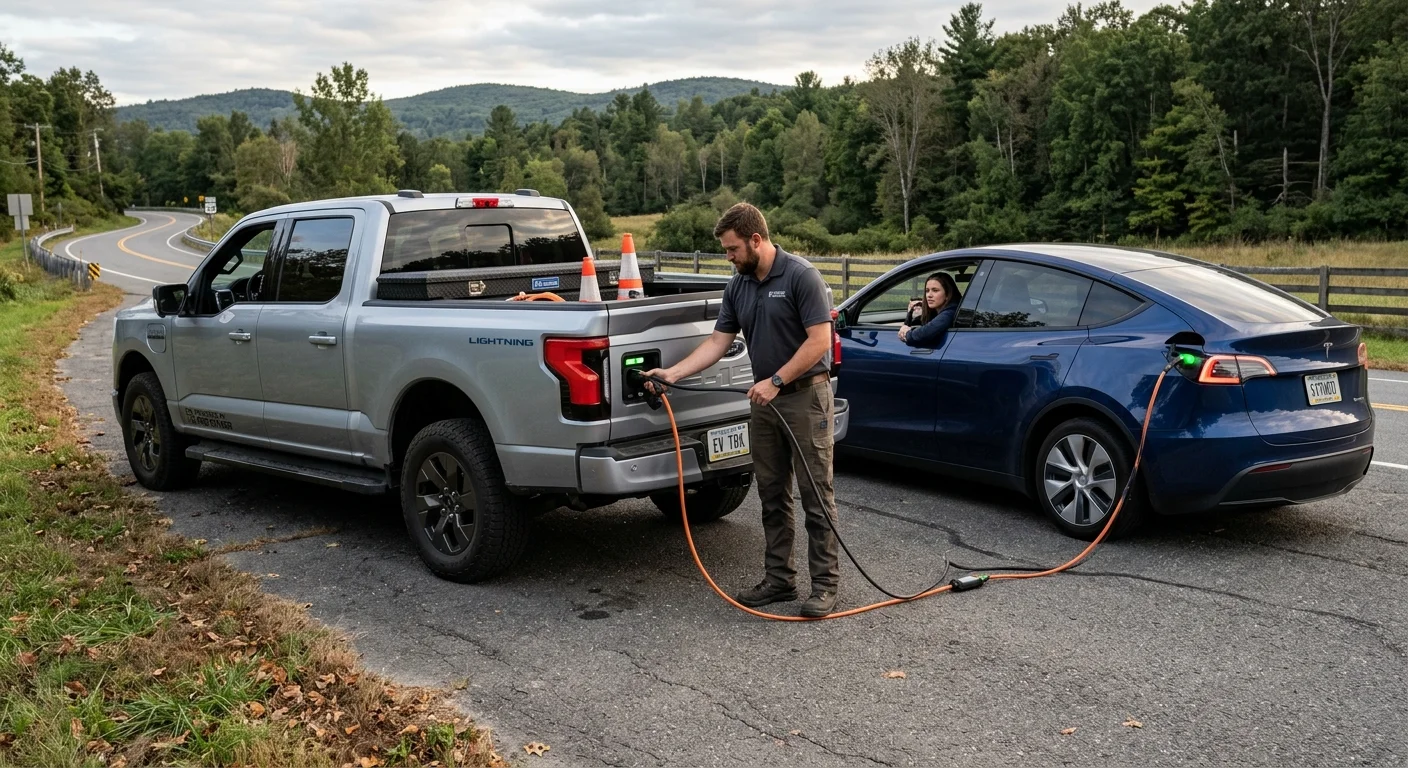
Heat and AC set this clock
South Florida is flat. There’s no grade penalty on range in Miami-Dade or Broward. Miami-Dade’s high point is the Atlantic Coastal Ridge. It sits at roughly 23 to 24 feet. In Broward it’s Pine Island Ridge, at about 29 feet. Range here is heat, air conditioning, and dwell. It’s never terrain.
NWS Miami 1991-2020 normals put the July and August average high at 91F. A normal year sees about 64 days at or above 90F. Recurrent Auto’s fleet study of about 30,000 EVs finds about 5 percent range loss at 90F. At 100F that loss is about 17 to 18 percent. Cooling a 95-degree cabin can take 3 to 5 kW in the first minutes. Holding it cool takes about 1 kW. AAA’s 2019 SAE-standard test found about a 17 percent range drop at 95F with the AC on.
That first blast of AC is why a Lightning session here can run past the spec sheet. You’re replacing energy the cabin already burned. For pack care in this climate, see how to care for an EV battery in South Florida heat.
Two packs, two fill times
Ford sells the Lightning with two battery options. They don’t charge on the same clock.
The Standard Range pack holds about 98 kWh total. Usable capacity is about 89.5 kWh. The Extended Range pack holds about 131 kWh total. Usable capacity is about 120 kWh. A bigger pack takes more hours from empty at home. At a DC fast charger it also accepts a higher peak rate, so the 15 to 80 percent times stay close.
How long a Ford Lightning takes to charge depends on the pack, the plug, and how hard the AC ran.
Overnight on Level 2 still takes hours
A regular 120-volt outlet is Level 1. It works on a Lightning. A full fill from empty can take several days.
Level 2 is the daily habit. Ford’s Charge Station Pro can deliver up to 80 amps on a dedicated circuit. Ford’s published times put an empty-to-full Extended Range charge around 8 to 10 hours. Standard Range is around 6 to 8 hours. Drop to a 48-amp home charger and a full fill stretches toward 12 to 14 hours. Overnight still covers most local driving when the circuit is in.
That circuit is the local split. In North Miami, about 82.7 percent of housing predates 1980. Miami Springs sits at 89.5 percent. Hialeah is at 60.1 percent. A 240-volt EV circuit often isn’t in those walls. Doral is newer stock: about 5.5 percent of housing is pre-1980. A home Level 2 plug is far more common there.
Florida Power and Light serves essentially all of Miami-Dade and all of Broward. Homestead is the confirmed exception. Homestead Public Services Energy covers parts of that city. FPL covers the rest. Confirm your street on the city’s HPS Energy electric services page if you’re on the line. FPL EVolution Home is the utility’s residential Level 2 program. FPL also publishes a residential Time-of-Use rate for home charging. Confirm the current rate with FPL before you pick a plan.
If you don’t have 240 volts yet, that’s an electrician’s project. It isn’t a roadside rescue. For the difference, see 240-volt charging: your home plug versus a mobile rescue.
DC fast charging is a trip tool
Ford lists about 41 minutes from 15 to 80 percent on Extended Range. That’s on a charger that can feed the truck its rated power. Standard Range is about 44 minutes. Those numbers assume a mild pack temperature. They also assume the stall is actually delivering its rated output.
Real sessions often run longer. The Lightning takes power fastest in the middle of a charge. It tapers as the pack nears full. The last 20 percent can take nearly as long as the rest. Stopping around 80 percent is the time-efficient habit. Use it on I-95, the Homestead Extension, or Florida’s Turnpike.
Start already high and you add less range, even if the percentage climbs. A hot pack after a loaded haul can shift the curve too.
FPL EVolution is FPL’s public charging network brand. Confirm a stall in your charging app before you count on it. A full public-stall inventory for the two counties could not be confirmed from the federal station database. Named, verified sites include ChargePoint ports in Miami International’s Ibis Garage. Park 6, the airport’s new long-term garage, opened in summer 2026 with EV charging on site.
A mobile top-up is Level 2
If the truck is already empty, you’re not sitting through a 41-minute DC session. Charge Pro MIA connects stranded drivers with independent local operators. Those operators bring a 240-volt Level 2 source to the vehicle. They use a native NACS plug, or a CCS or J1772 adapter. They typically add 10 to 20 miles of range in 15 to 30 minutes of charging. That’s charging time on the plug. It isn’t an arrival time.
A mobile top-up gets you to a plug or off the shoulder. It doesn’t fill the pack. See EV charging levels when you’re already stranded and mobile EV charging.
When the truck won’t charge at all
A slow session is still a charging-time problem. A Lightning that won’t start or accept a plug is often the 12-volt battery. It’s usually not the high-voltage pack.
Heat here is hard on that small battery. Battery University notes that every roughly 15F rise halves the life of a lead-acid battery. It ages about twice as fast at 93F versus 77F. At 111F it ages about four times as fast. Heat damage doesn’t reverse. After a week in MIA’s Dolphin, Flamingo, or Ibis Garage, many EVs look totally dead. The 12V drained keeping systems alive. The main pack is often still fine.
Walk the checks in Ford F-150 Lightning won’t start: the 12V fix that usually works. If you’re asking whether the Lightning can feed another EV, that’s separate. See Can an F-150 Lightning charge another EV on the roadside.
Empty on a Miami-Dade or Broward road
Florida Statute 316.194 says leave the vehicle off the main-traveled part where you can. Leave room for passing traffic. Keep a clear view from 200 feet each way. A genuinely disabled vehicle that can’t practicably be moved is exempt under 316.194(2).
The Road Ranger Service Patrol is FDOT’s free highway service patrol. Crews jump-start vehicles, change flats, and tow a disabled vehicle off the travel lanes to a safe spot. Dial *FHP (*347). District 6 covers Miami-Dade on I-95, 95 Express, I-195, I-395, I-75, 75 Express, and SR-826, the Palmetto. District 4 covers Broward’s I-95 from the Miami-Dade line north, plus portions of I-595 and I-75. Road Ranger materials don’t mention EV charging. A 12V jump or a tow to a safe spot is still in their toolkit. A Level 2 charge is what independent operators bring.
Hurricane season runs June 1 to November 30. FPL tells EV owners to keep the pack between 50 and 80 percent through the season. Don’t charge or drive a flood-exposed EV until it’s inspected.
Charge Pro MIA is a referral line. It matches stranded EV drivers with independent local mobile rescue operators. It holds no trade license and owns no trucks. The pros we connect you with are licensed and insured. We serve every city in Miami-Dade and Broward. For a Lightning that needs a charge, use non-Tesla EV rescue. If you need a truck at the bumper, call (786) 963-2995. We’ll connect you with a local operator who can quote a Level 2 top-up.
Frequently asked questions
How long does a Ford F-150 Lightning take to charge at home?
On Ford’s Charge Station Pro, a full charge is around 6 to 8 hours for Standard Range. Extended Range is around 8 to 10 hours. A 48-amp home unit can stretch a full fill toward 12 to 14 hours.
How fast does a Ford Lightning charge on a DC fast charger?
Ford’s published specs list about 41 minutes from 15 to 80 percent on Extended Range. Standard Range is about 44 minutes on a charger that matches the truck’s peak rate. Real sessions often run longer.
Does a mobile rescue charge a Lightning as fast as a DC station?
No. A mobile rescue is Level 2. Independent operators typically add 10 to 20 miles in 15 to 30 minutes of charging. That’s enough to reach a plug. It isn’t a 15 to 80 percent DC fill.