A South Florida EV pack lives in heat, not on hills. Miami-Dade’s high ground is the Atlantic Coastal Ridge, about 23 to 24 feet. Broward’s Pine Island Ridge sits near 29 feet. There’s no grade penalty on range in either county. What you manage is cabin cooling, parked dwell, and months of hot afternoons.
Range here is heat, AC, and dwell
NWS Miami’s 1991-2020 normals put July and August average highs at 91F. A normal year still brings about 64 days at or above 90F. That’s the climate your pack trains in, from Key Biscayne through Weston.
Recurrent Auto studied about 30,000 EVs and published the range cost of that heat. At 90F, range fell about 5%. At 100F, the loss was about 17 to 18%. Pulling a 95-degree cabin down can take 3 to 5 kW. Holding it later takes about 1 kW. The first minutes of AC are the expensive ones. AAA ran a 2019 SAE-standard heat test with the AC on. Range dropped about 17% at 95F.
Those are published range figures with named sources. They’re not a life-expectancy number for your traction pack. We can’t confirm a single degradation rate for every EV in Miami-Dade and Broward. If a page hands you one number for every pack, it’s guessing.
Tesla owners can start with a local heat walkthrough. Read how long a Tesla charge lasts in South Florida heat.
Precondition the cabin while you’re still plugged in when you can. That spends grid energy on the expensive cooldown instead of pack energy. Idling on I-95, the Palmetto, or the Dolphin Expressway with the AC on is the same story. Those roads are flat. Range you lose there is cooling and time, not climbing.
Follow the maker, then this climate
Every EV maker publishes its own traction-battery guidance. Tesla, Rivian, Ford, Hyundai, Chevrolet, and Kia each set charge limits, software updates, and service intervals. Your owner’s manual is the source built for your VIN. The maker’s app is the other place to check. Start there, then overlay this climate. A Weston driveway and a Miami Beach garage roof aren’t the same thermal day. Both cars still follow the same maker sheet. For tires and cabin filters, use the EV maintenance schedule owners here actually need.
Florida Power and Light serves essentially all of Miami-Dade and all of Broward. The confirmed exception is Homestead. Homestead Public Services Energy covers parts of that city. FPL covers other parts. Confirm your street on the HPS Energy electric services page. FPL’s EVolution Home program is the residential Level 2 install-and-maintain offer. FPL also publishes a residential Time-of-Use rate for home charging. We aren’t publishing dollar figures for either. Confirm current terms with FPL before you enroll. No EV-specific program turned up on HPS Energy’s pages when we checked. Homestead drivers should ask the utility directly.
The 12V is usually the battery that strands you
An EV has two battery systems, and they fail in different ways. The traction pack moves the car and writes the range number on the dash. When it runs low, you still get warnings. That’s an empty-pack problem.
The 12V auxiliary battery is smaller. It runs locks, the screen, and the computer that wakes the high-voltage system. When the 12V is dead, the car can look fully dead with a full pack. Locks ignore you. The screen stays black. Nothing starts, because the low-voltage side has nothing to run on.
Heat is why that 12V fails so often here. Battery University tracks heat against lead-acid life. Every roughly 15F rise in temperature halves that life. It ages about twice as fast at 93F versus 77F. At 111F, it ages about four times as fast. Heat damage can’t be reversed.
That’s also the airport and cruise story. MIA’s Dolphin, Flamingo, Ibis, and Park 6 garages are the long-stay lots. A week in any of them can kill a 12V. PortMiami and Port Everglades parking do the same thing. A jump or an on-site 12V swap is the usual path, not a flatbed. Read what happens when an EV 12V dies in this climate. If the car won’t respond at all, rule out the 12V first.
Housing, condos, and how long the car sits
Battery care here is also about dwell, and whether the car can plug in at home. Parkland’s housing stock is about 1.7% pre-1980. Doral is about 5.5%. Weston is about 7.0%. Those newer belts are where a home Level 2 is often already in the garage. Overnight charging keeps the pack in the window your maker recommends.
North Miami is about 82.7% pre-1980. Miami Springs is about 89.5%. Hollywood is about 74.7%. Hialeah is about 60.1%. In that older stock, a home charger is often not installable. Drivers there lean on workplace plugs and public Level 2. More time unplugged in the sun is more time the 12V cooks.
Condo towers in Miami Beach, Sunny Isles Beach, Surfside, and Hallandale Beach add another pattern. The car may sit in a hot structure between errands. Then it takes a causeway run with AC already pulling. Preconditioning while plugged in helps when the building actually gives you a plug. If it doesn’t, you’re managing heat with the pack. Stay inside the maker’s published window.
The DOE Alternative Fuels Data Center publishes the verified specs for charging levels. Level 2 uses 240V at home or 208V in many commercial setups. It adds about 25 miles of range per hour. DC fast charging can add about 100 to more than 200 miles in 30 minutes. Those are equipment maximums, not a promise for your car.
Check a current charging map before a long run. That includes I-95, Florida’s Turnpike, the Homestead Extension, I-75, and Tamiami Trail. We couldn’t build a verified site-by-site inventory for this page, so we’re not naming counts. FPL EVolution is FPL’s public charging network brand.
Storm season has its own charge window
Hurricane season runs June 1 to November 30. FPL tells EV owners to keep the pack between 50 and 80% through the season. Unplug during the storm. Don’t charge or drive a flood-exposed EV until it’s inspected.
NHTSA warns that residual salt in a flooded lithium pack can bridge and short. Fires can start days to weeks later. A flood-exposed EV shouldn’t be parked within 50 feet of a structure. It shouldn’t be driven or charged until it’s inspected. About 36 EVs flooded by Hurricane Ian in 2022 later caught fire.
Miami-Dade evacuations are ordered by the County Mayor using Storm Surge Planning Zones. Zone A includes Key Biscayne. Zone B includes Miami Beach and Brickell. Broward uses Plan A east of the Intracoastal for Category 1-2. Plan B is east of US-1 for Category 3 and up. Evacuation routes north are I-95, Florida’s Turnpike, and I-75. If you’re moving a pack through that, stay in FPL’s 50 to 80% window.
King tides and sunny-day flooding run mainly September through November. They last about three hours each. They hit Miami Beach, Fort Lauderdale’s Las Olas Isles, Hollywood, and other low coastal streets. If water reaches the charge port, read what to do after a king tide.
A rescue, a jump, or a shop
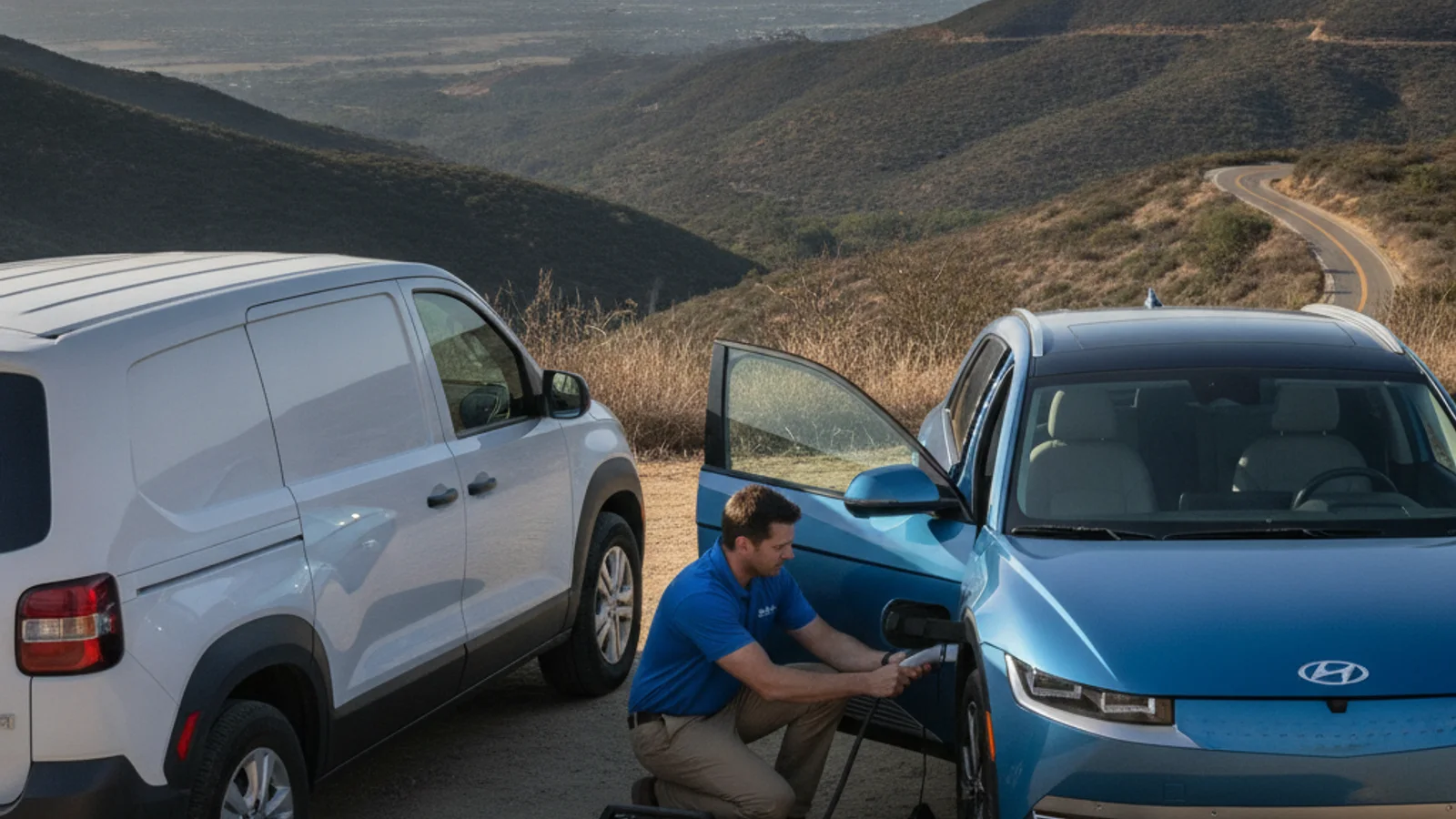
If the traction pack is depleted, and you’re stopped somewhere an operator can reach, request out-of-charge recovery. Independent operators we connect you with bring a 240V Level 2 source to the car. They use a native NACS plug, or a CCS or J1772 adapter for non-Tesla EVs. That typically adds 10 to 20 miles of range in 15 to 30 minutes of charging. That’s charging time, not an arrival time. The operator quotes you before starting and bills you directly. We don’t set the price, and we don’t own the truck.
If the car is silent, the 12V is the likely cause. A jump or on-site 12V swap is usually the faster fix. EV roadside assistance is the path for that kind of call. Florida’s Road Ranger Service Patrol can jump-start a vehicle. Crews can also tow a disabled car off the travel lanes to the nearest safe spot, free. Dial *FHP (*347). Road Ranger materials don’t mention EV charging. A Level 2 top-up isn’t what they bring.
If the car charges, drives, and wakes normally, pack-health questions belong at a shop. State of health and warranty work sit with the manufacturer or an authorized shop. A roadside operator’s job is getting you moving. It isn’t certifying the pack.
Charge Pro MIA is a referral line. We match stranded EV drivers with independent local mobile rescue operators. We don’t perform the work, and we don’t hold a trade license. The pros we connect you with are licensed and insured.
If the traction pack is empty somewhere in South Florida, that’s a roadside call. The same is true if the car won’t wake and you suspect the 12V. Call (786) 963-2995. We’ll connect you with a local operator who can quote the job before they start.