A Tesla charge in South Florida can cover a full day or fall short by afternoon. Heat and air conditioning decide that, not hills. This metro is almost completely flat. Your car’s displayed estimate is the figure that matters for today. Treat it as a planning number, not a promise. Check it against every stop, including the drive home.
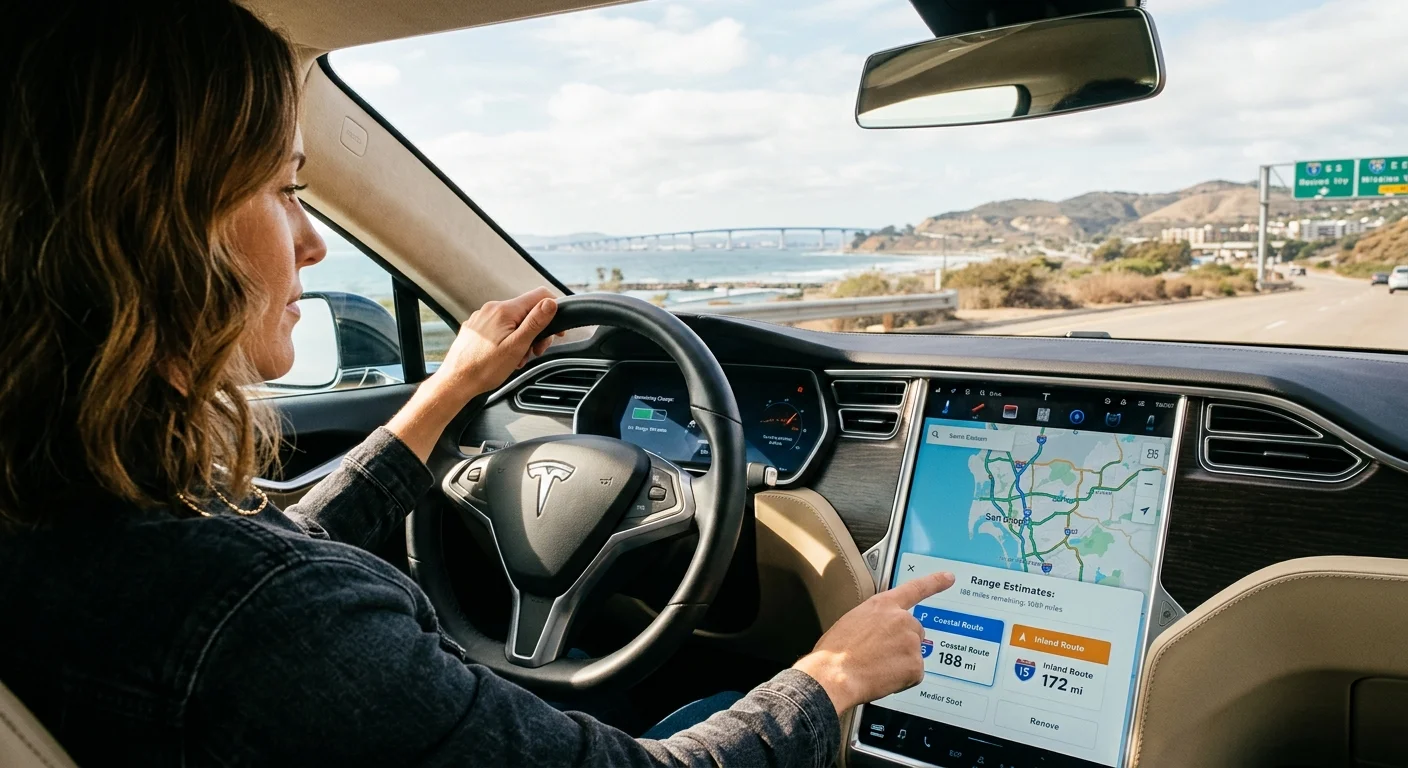
Heat and cabin cooling set daily range here
South Florida doesn’t ask your Tesla to climb. Miami-Dade’s highest natural point is the Atlantic Coastal Ridge, roughly 23 to 24 feet. Broward’s Pine Island Ridge sits around 29 feet. There’s no grade penalty on range in either county. Daily range here is heat, air conditioning, and time in traffic.
NWS Miami’s 1991-2020 normals put the July and August average high at 91F. A normal year sees about 64 days at or above 90F. That’s the climate your pack lives in.
Recurrent Auto studied about 30,000 EVs. It found about 5% range loss at 90F. The same study found about 17 to 18% at 100F. Cooling a 95-degree cabin can take 3 to 5 kW at first. Holding it cool later takes about 1 kW. The first minutes of AC are the expensive ones. AAA’s 2019 SAE-standard test found about a 17% range drop at 95F with the AC on. Don’t treat a sticker range as today’s limit.
Daily charge is not pack lifespan
People asking how long a Tesla battery lasts in a day mix two questions. One is how far you can drive before you need a plug. The other is how long the high-voltage pack stays useful over years of ownership.
Today’s trip uses the charge you have now. Our guide to how long Tesla batteries last, and what heat does here covers pack life. So does how to care for an EV battery in South Florida heat. Warranty talk also won’t finish a Hialeah-to-Coral Gables loop for you.
Read your model, percentage, and on-screen miles
Start with the car you’re sitting in. Note the Tesla model, the percentage, and the estimated distance before you pull out. Recheck that display when you add a destination.
Use that estimate as a planning input. A number from another owner’s Model Y may not match your car. A cooler-month screenshot may not match August. If you need an exact specification, check Tesla’s current documentation for that model.
Then compare the estimate with the whole day. Count the outbound trip, errands, and the return. A Coral Gables commute that ends at a home Level 2 is one kind of day. A Miami Beach tower with street parking is another.
The U.S. Department of Energy describes Level 1 as 120-volt AC. It adds about five miles of range per charging hour for a midsize EV. Level 2 residential charging uses 240-volt power. It adds about 25 miles per charging hour. Actual speeds still vary by battery size, state of charge, and outside temperature. They don’t tell you how far you’ll drive today.
If the displayed miles look tight, change the plan early. Add a stop you can still reach, or skip a leg.
Plan the actual roads, not a sticker range
Write the day’s destinations in order. FPL’s public charging brand is FPL EVolution. Confirm live status with that station’s operator. A listing on a map isn’t the same as a working plug.
Local roads are planning anchors, not range guarantees. I-95 runs the coastal spine through Miami-Dade into Fort Lauderdale. The Palmetto Expressway, SR-826, cuts across the county. The Dolphin Expressway, SR-836, now sits under the Greater Miami Expressway Agency. Florida’s Turnpike Enterprise runs the Turnpike, the Homestead Extension, and the Sawgrass Expressway. Those roads are all-electronic, using SunPass or toll-by-plate.
A comfortable estimate for Brickell can shrink after Aventura Mall and the drive home. Don’t plan only for the farthest point.
Miami Beach is a separate city from Miami. You reach it only by causeway. That crossing is still flat, but it’s extra miles with the AC running. Kendall is a census-designated place, not a city. The University of Miami’s main campus is in Coral Gables, not the City of Miami.
A day at Hard Rock Stadium in Miami Gardens, or at Dadeland Mall, is a dwell-and-AC day. Summer afternoon storms here often run from about 2pm to 6pm.
Overnight access sets tomorrow’s starting charge
Many South Florida Teslas don’t start the day from a garage Level 2. North Miami’s housing is 82.7% pre-1980. Hialeah is 60.1%. Older buildings often make a home charger hard to add. Doral is 5.5% pre-1980. Weston is 7.0%. Those suburbs are where a home plug is much more common.
Florida Power and Light serves essentially all of Miami-Dade and all of Broward. The confirmed exception is Homestead. Homestead Public Services Energy serves parts of that city. FPL serves other parts. Residents confirm the boundary at homesteadfl.gov or (305) 224-4800. FPL EVolution Home is the residential Level 2 install-and-maintain program. We’re not publishing those dollar figures. Confirm the current rate with FPL before you budget around it. No EV-specific program turned up on HPS Energy’s pages.
If you only have a 120-volt outlet, overnight recovery is slow. Plan tomorrow from the percentage you’ll actually wake up with.
A Tesla left a week in an MIA garage often looks totally dead. That includes Dolphin, Flamingo, Ibis, and Park 6. The usual cause is a drained 12-volt battery, not an empty pack. About every 15F rise halves lead-acid 12-volt life. Ibis Garage holds ChargePoint ports across its levels. Park 6 has charging on site. A car that won’t wake still needs a 12-volt check first.
Change the plan while a plug is still reachable
If the remaining estimate no longer covers the original route, stop adding stops. Pick a compatible charger the car can still reach. Confirm that station’s status with its operator before you commit the last miles.
Our notes on a Tesla low battery warning walk that decision. So does what to do before you’re stuck. Don’t keep driving toward a charger you can no longer clearly reach.
If you’re already on a limited-access road, leave the travel lanes when you can. Florida Statute 316.194 covers stopping on a highway outside a municipality. Leave the vehicle off the main-traveled part where practicable. A genuinely disabled vehicle that can’t be moved is exempt under 316.194(2). Call *FHP (*347) for Florida Highway Patrol and the Road Ranger Service Patrol. Road Rangers jump-start vehicles and change flats. They also tow a disabled vehicle off the travel lanes to the nearest safe spot, free of charge. District 6 covers Miami-Dade roads including I-95 and the Palmetto.
Road Ranger materials don’t mention electric vehicles or EV charging. They still jump a 12-volt and tow you off a live lane. They don’t bring a 240-volt Level 2 charge.
If no reachable charger remains, start arranging help. Charge Pro MIA connects you with an independent local operator. We don’t charge the car, tow it, own rescue gear, or do the physical work. The matched operator explains the options and bills you directly.
Decide among a public plug, a mobile charge, or a tow
The right next step depends on the car and the spot you’re in. A low pack isn’t the same problem as a silent 12-volt.
If the Tesla still has usable charge, ordinary charging may be the simplest path. A compatible station still has to be reachable.
If no charger is reachable, ask whether a mobile Level 2 charge can come to you. Operators typically bring a 240-volt source to the car. They use a native NACS plug, or a CCS or J1772 adapter. They typically add 10 to 20 miles of range. That usually takes 15 to 30 minutes of charging. That window is charging time, never an arrival time. Our out-of-charge recovery page explains how we connect stranded drivers with those operators.
A tow may be the better option when a charge on site isn’t a fit. A Tesla that won’t wake may not be an empty pack. The Tesla roadside rescue page outlines the referral path. If you’ve already hit zero, read what to do if your Tesla hits zero on a South Florida road.
Before you authorize work, ask the operator to explain the service and the price. Ask about payment terms and any warranty that operator offers. Charge Pro MIA doesn’t set those prices and doesn’t warrant the work. You contract with the professional and pay that professional directly.
When to call us
Call when the remaining estimate no longer supports a safe trip to a reachable charger. Call when you need an operator to sort a mobile charge from a tow. Call (786) 963-2995 and we’ll connect you with a local EV rescue operator.