On a South Florida shoulder, Hyundai Ioniq 5 charging time is a Level 2 top-up. Independent operators typically add 10 to 20 miles. Charging itself runs 15 to 30 minutes. That’s plug time, not when someone arrives. A home fill and a DC fast stop use different clocks.
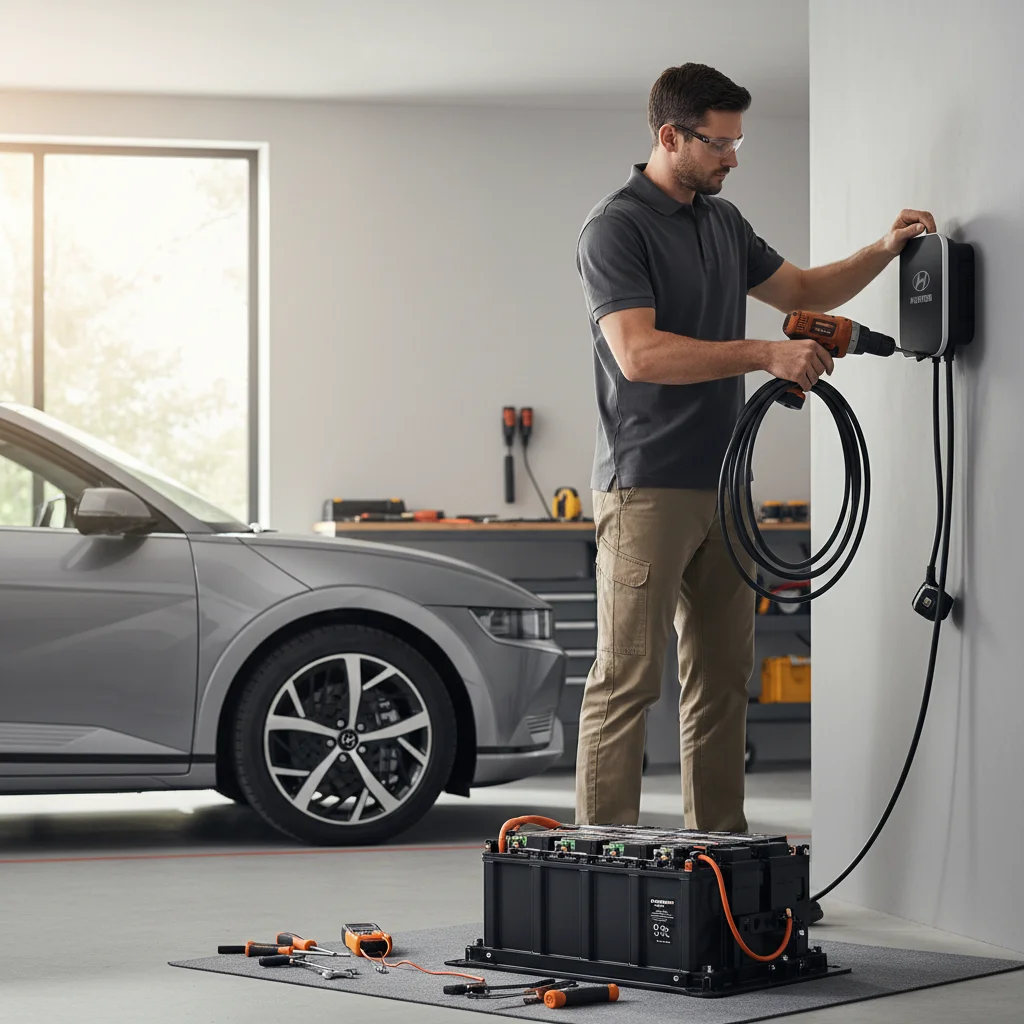
Home, DC, and roadside aren’t the same clock
Hyundai Ioniq 5 charging time depends on the plug in front of you. Overnight at a wall is hours. A capable DC stall is a short stop. A rescue truck is still Level 2. Mix those jobs and the minutes stop lining up.
The 2026 regular U.S. Ioniq 5 uses 800 volts on DC. Home charging is still 240-volt AC. The wall doesn’t use that DC path. The same car can still sit for hours on a Coral Gables wall circuit.
Heat is what stretches the session
South Florida is flat. There’s no grade penalty on range in Miami-Dade or Broward. Miami-Dade’s Atlantic Coastal Ridge tops out around 23 to 24 feet. Broward’s Pine Island Ridge is about 29 feet. Range here is heat, air conditioning, and sitting still.
NWS Miami 1991-2020 normals put the July and August average high at 91F. A normal year sees about 64 days at or above 90F. Recurrent Auto studied about 30,000 EVs. They found about 5% range loss at 90F. At 100F the loss is about 17 to 18%. Cooling a 95-degree cabin can take 3 to 5 kW at first. Holding it cool is closer to 1 kW. AAA’s 2019 SAE test found about a 17% drop at 95F with AC on.
Those lost miles have to come back at the plug. A session after Hard Rock Stadium traffic isn’t a spec-sheet day. The same is true after a Heat night at Kaseya Center.
Overnight Level 2 still takes hours
A 120-volt household outlet is Level 1. It works on an Ioniq 5. From empty, a full fill can run past a day.
Level 2 is 240-volt AC. Hyundai USA publishes home time at 10.9 kW at 240 V AC from 10% to 100%.
| Charger and interval | 63 kWh | 84 kWh |
|---|---|---|
| AC Level 2 at 240 V, 10% to 100% | 5 hours 40 minutes | 7 hours 20 minutes |
| NACS 150 kW 400 V DC, 10% to 80% | 24 minutes | 30 minutes |
| CCS adapter 50 kW DC, 10% to 80% | 61 minutes | 81 minutes |
| CCS adapter above 250 kW 800 V DC, 10% to 80% | 20 minutes | 20 minutes |
These rows cover the regular U.S. 2026 Ioniq 5 only. That includes SE Standard Range, SE, SEL, XRT, and Limited. They don’t describe Ioniq 5 N or earlier years. Confirm your year on the window sticker. Pack sizes for the early U.S. cars sit in Hyundai Ioniq 5 battery size, and what that means in the heat. Charging times for those earlier years weren’t confirmed in this research. Use Hyundai’s spec sheet for that model year. Source: Hyundai USA 2026 IONIQ 5 specifications.
Housing decides whether those home hours even exist. North Miami is 82.7% pre-1980. Miami Springs is 89.5%. Hollywood is 74.7%. Lauderhill is 67.3%. Hialeah is 60.1%. A dedicated 240-volt run often isn’t in those buildings. Doral is 5.5% pre-1980. Parkland is 1.7%. Weston is 7.0%. A wall circuit is a realistic project in that newer stock.
Florida Power and Light serves essentially all of Miami-Dade and all of Broward. Homestead is the confirmed exception. Homestead Public Services Energy covers parts of that city. FPL covers the rest. Confirm your street on the city’s HPS Energy page. FPL EVolution Home is the residential Level 2 install-and-maintain program. FPL also publishes a residential Time-of-Use rate. This page doesn’t print rate numbers. Confirm the current rate with FPL before you enroll. No EV-specific program turned up on HPS Energy’s pages.
If you still need a wall unit, that’s a licensed electrician’s job. Charge Pro MIA doesn’t install chargers. Compare the two paths in 240-volt charging: your home plug versus a mobile rescue.
A DC stop uses a shorter interval
The DC rows stop at 80%. The home row continues to 100%. A fast session isn’t a full charge. Hyundai USA didn’t publish DC to 100% on that spec page.
The 2026 car has a built-in NACS port and an included CCS adapter. The fastest advertised 10% to 80% run is 20 minutes. That’s on a 350 kW, 800 V DC charger using the CCS adapter. Time still depends on starting charge and stall output. Car settings and pack temperature matter too. A public stall isn’t a sure thing. A matching plug doesn’t prove the stall can deliver the listed voltage and power.
The pack takes power fastest in the middle. It tapers as it nears full. The last slice toward 100% can eat a lot of clock. Trip stops usually target 80%. Use that habit on I-95, the Homestead Extension, or the Sawgrass.
FPL EVolution is FPL’s public charging network brand. Named, verified sites include ChargePoint ports in Miami International’s Ibis Garage. Park 6, the airport’s new long-term garage, opened in summer 2026 with EV charging on site. This page doesn’t publish a port count. A full public-stall inventory for the two counties couldn’t be confirmed.
Earlier Ioniq 5s often used a CCS inlet. Look at the port door on your car before you count on a stall.
When you’re already empty, the clock is Level 2
If the traction pack is empty, you’re not sitting on that 20-minute DC row. Charge Pro MIA is a referral line. It matches stranded drivers with independent local operators. The brand performs no work, owns no trucks, and sets no prices. The operator quotes you before starting and bills you directly.
What the operator brings is a 240-volt Level 2 source with a native NACS plug, plus a CCS or J1772 adapter. Operators typically add 10 to 20 miles of range in 15 to 30 minutes of charging. That’s cable time, never an arrival time. It’s enough to reach a plug. It isn’t a 10% to 80% DC fill. See mobile EV charging and non-Tesla EV rescue.
If the bar isn’t moving at all
A slow session is still a charging-time problem. A session that never starts is a different problem.
A cable that won’t release is a known Ioniq 5 issue. Walk through Hyundai Ioniq 5 charge port stuck: how to free the cable. If the car won’t wake, start with the 12-volt battery. After a week in MIA’s Dolphin, Flamingo, or Ibis Garage, many EVs look totally dead. The 12-volt drained keeping systems alive. The traction pack is often still fine. See Hyundai Ioniq 5 won’t start? Check the 12V before the pack.
Empty on a limited-access road
Florida Statute 316.194 says leave the vehicle off the main-traveled part where you can. Leave room for passing traffic. Keep a clear view from 200 feet each way. A genuinely disabled vehicle that can’t practicably be moved is exempt under 316.194(2).
The Road Ranger Service Patrol is FDOT’s free highway service. Crews jump-start vehicles, change flats, and tow a disabled vehicle off the travel lanes to a safe spot. Dial *FHP (*347). District 6 covers Miami-Dade on I-95, 95 Express, I-195, I-395, I-75, 75 Express, and SR-826, the Palmetto. District 4 covers Broward’s I-95 from the Miami-Dade line north, plus portions of I-595 and I-75. Road Ranger materials don’t mention EV charging. A 12-volt jump or a tow to a safe spot is still in their toolkit. A Level 2 charge is what independent operators bring.
Hurricane season runs June 1 to November 30. FPL tells EV owners to keep the pack between 50 and 80% through the season. Unplug during the storm. Don’t charge or drive a flood-exposed EV until it’s inspected. NHTSA warns that residual salt in a flooded lithium pack can short later.
The pros we connect you with are licensed and insured. We serve every city in Miami-Dade and Broward. If you need a Level 2 top-up brought to the bumper, call (786) 963-2995. We’ll connect you with an independent operator who quotes the job before they start.
Frequently asked questions
How long is Hyundai Ioniq 5 charging time on the road?
A mobile Level 2 rescue typically adds 10 to 20 miles. Charging itself usually takes 15 to 30 minutes. That’s cable time, never an arrival time.
How long is a 2026 Ioniq 5 home Level 2 fill?
Use the 10% to 100% Level 2 row in the table above. Starting percent still moves that window.
How fast is a 2026 Ioniq 5 at a DC fast charger?
Use the DC rows in the table. They stop at 80%, not 100%. Real stalls often run longer than the sheet.