After a hurricane makes landfall, the house can sit dark for days. The EV in the driveway is a second problem, not the same one. A home battery keeps selected circuits alive. A mobile EV charge is a truck at the car. It brings 240-volt power when FPL is still out.
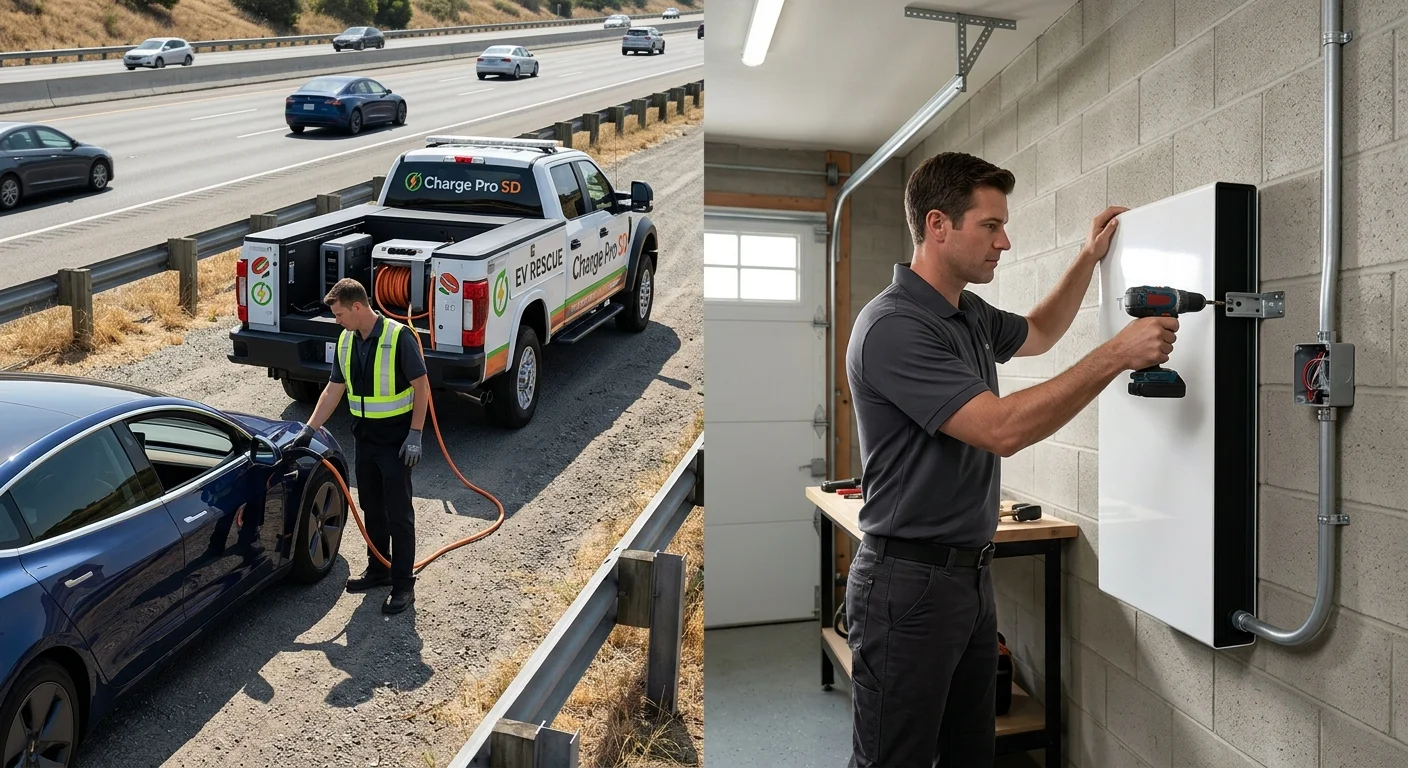
The wall charger is only as alive as the grid
Florida Power and Light serves almost all of Miami-Dade and Broward. Homestead is the confirmed exception. Homestead Public Services Energy covers parts of that city. Other Homestead streets stay on FPL. Confirm your side with the city before you assume a wall plug will work. After landfall, both systems can be down. A Level 2 box in the garage is then just another dead outlet.
FPL tells EV owners to keep the pack between 50 and 80 percent all season. Unplug while the storm is on you. Do not charge or drive a flood-exposed EV until it is inspected. That is FPL’s published EV storm guidance, not a guess.
Hurricane season here runs June 1 through November 30. Miami-Dade evacuations are ordered by the County Mayor using Storm Surge Planning Zones. Zone A is the highest surge risk and includes Key Biscayne. Zone B includes Miami Beach and Brickell. Broward uses Plan A for Category 1 and 2 storms, east of the Intracoastal. Plan B is Category 3 and up, east of US-1. The northbound routes are I-95, Florida’s Turnpike, and I-75.
If you left with a thin pack, the car still has to move. If you sat unplugged through days of outage, you have the same problem. The house battery, if you have one, may not be what gets it moving.
A home battery keeps the house, not the travel lane
Home battery backup is a wall-mounted bank at the residence. Tesla Powerwall is the name most owners use. Other brands store grid power or rooftop solar the same way. When FPL drops, the bank carries selected loads: lights, the fridge, a few outlets. If that bank is tied to the Level 2 charger, the garage car can still take energy. That is a home energy system. It does not leave the lot.
Weston owners hit this split often. Weston home batteries, EVs, and nights with no grid covers a dark suburban night. Homestead has its own twist, because some streets sit on HPS Energy. When Homestead power is out, can your EV run the house covers that south-county case.
Newer housing is where a wall battery is even on the table. Parkland, Weston, and Doral have some of the newest stock in the two counties. Older streets are a different job. North Miami is 82.7 percent pre-1980. Miami Springs is 89.5 percent. Hollywood is 74.7 percent. Hialeah is 60.1 percent. A 240-volt EV circuit and a wall battery on those lots need a licensed electrician and permits. They are not a roadside call.
Charge Pro MIA does not sell, install, or service home batteries. We are a referral line. We match stranded drivers with independent local operators. The contractor who hung a Powerwall in Weston is a different trade.
What a mobile EV charge is after the storm
Mobile EV charging is a 240-volt Level 2 source brought to the car. Tesla gets a native NACS plug. Other brands get CCS or J1772 adapters. Operators typically add 10 to 20 miles of range in 15 to 30 minutes of charging. That window is charging time. It is not an arrival time.
The job is enough range to leave. After landfall that can mean rolling off a dark driveway in Homestead. It can mean getting off a shoulder on the Palmetto Expressway or I-95.
FPL deploys mobile EV charging trailers before some planned outages and during storms, to help evacuations. The Florida Division of Emergency Management has placed temporary EV chargers along the I-75 evacuation corridor. Those are public storm assets. They are not the same as an operator at a house that still has no grid.
If the pack is empty and the car will not roll, that is out-of-charge recovery. It is not a home-energy consult, and it is not a panel upgrade. For how the truck actually feeds the car, read how a mobile EV charging truck gets you enough range to move. If the wall unit failed on a normal night, not a hurricane night, home charger versus a mobile rescue covers that split.
Heat takes range. Sitting takes the 12-volt.
South Florida is flat. Range here is heat, air conditioning, and dwell. It is never grade.
NWS Miami 1991-2020 normals put the July and August average high at 91F. A normal year sees about 64 days at or above 90F. Recurrent Auto studied about 30,000 EVs. It found about 5 percent range loss at 90F, and about 17 to 18 percent at 100F. AAA’s 2019 SAE-standard test put the hit at about 17 percent at 95F with the AC on.
A hot cabin on a pre-storm run can drain more range than the dash showed. Then you unplug for the storm, as FPL asks. Days later the house is still dark. The car has been sitting in the heat.
That sit often kills the 12-volt battery, not the high-voltage pack. Battery University notes that roughly every 15F rise halves the life of a lead-acid battery. Heat damage does not reverse. After a long sit, some cars will not wake, unlock, or roll. Operators we connect you with can jump or replace a dead 12V on site. They can also bring the Level 2 charge if the pack itself is empty.
Flooded packs are not a charging problem
Saltwater is a hard stop. NHTSA warns that residual salt in a flooded lithium battery can bridge and short. Fires can start days to weeks later. About 36 EVs flooded by Hurricane Ian in 2022 later caught fire. A flood-exposed EV should not be parked within 50 feet of a structure. It should not be driven or charged until it is inspected. FPL repeats the same rule.
Do not ask a mobile operator to plug a soaked car. Get it inspected first.
King tides run mainly September through November and last about three hours each. They hit Miami Beach, the Fort Lauderdale Las Olas Isles, Hollywood, and other low coastal streets. Summer afternoon storms are near-daily, roughly 2pm to 6pm. Water in the port after a tide is a stop, not a charge. Dry it and inspect it before anyone plugs in.
Who does which job
For a Powerwall, a panel, or whole-home backup, call a licensed electrician or a solar contractor. FPL EVolution Home is the utility’s residential Level 2 install-and-maintain program. FPL also publishes a residential time-of-use rate for home charging.
When the neighborhood is still dark, a mobile operator is the call for the car. The pros we connect you with are licensed and insured. They quote before they start. They bill you directly.
Road Rangers still matter on the interstate. FDOT’s free highway patrol jump-starts vehicles and changes flats. It tows a disabled vehicle out of the travel lanes to a safe spot. District 6 covers Miami-Dade on I-95, I-75, and the Palmetto. District 4 covers Broward’s I-95 and portions of I-595 and I-75. Dial *FHP, which is *347, from your phone. They do not bring a Level 2 charge. If you are in a travel lane, get the car off the pavement first. Florida Statute 316.194 requires a vehicle to leave the main-traveled part where practicable. A genuinely disabled vehicle is exempt only when it cannot practicably be moved.
When the truck is the backup
Call for a mobile charge when the house is dark. Call when the wall plug is dead and the EV still has to move. That includes a driveway after FPL or HPS Energy is out. It includes a stall on the way north on I-95 or the Turnpike. It includes a pack that ran down while you stayed unplugged, as FPL told you to.
Do not call a mobile charge to power the house. The truck is for the car. Do not call to install a battery. Do not call if the car sat in saltwater. If the dash is dark but the app shows range, start with the 12V.
Charge Pro MIA is a referral line. We connect you with independent local operators across South Florida. We do not own trucks, set prices, or hold a trade license. The operator quotes before any cable goes on.
If that is the situation you are in, call (786) 963-2995.