A search for an ev rapid charger near me is a reach test. Use a confirmed stall if the car can still get there. Tower garage ramps and gates eat those last miles. West of the last dense streets, a truck to you is the honest option.
Confirm the stall before you spend the last miles
A map pin is only a hint. Station access and listed status change. Confirm both before you spend remaining range.
Start with the operator’s app, then your car’s navigation. Aggregated maps help you spot options. They don’t prove a stall works tonight.
FPL’s public charging brand is FPL EVolution. Use it as one source, not a live occupancy promise. Stalls fill, fail, or go customer-only without a map update.
Check these items before you roll:
- Your connector matches the stall.
- The operator still lists it as available.
- You can enter the property when you arrive.
- The stall isn’t limited to customers, residents, or staff.
- Your car’s estimate covers the full route, with buffer.
The DOE charging guide lists CCS, CHAdeMO, and J3400 for DC fast charging. Your EV may not accept every type. An adapter doesn’t make every stall legal for your car.
An available flag is a snapshot. Another driver can take the stall first. A unit can look online while the cable, screen, or reader is dead. If a stall fails when you arrive, stop and diagnose it. Read the charger troubleshooting guide next.
Save more than one compatible stop before you need it. Keep apps for a thin range in that plan. Don’t hop from one unverified pin to the next on fumes.
Causeways and express lanes change the drive
Straight-line distance is a poor test here. Causeways, express lanes, and garage ramps add miles the pin hides.
Miami Beach is its own city. It isn’t a neighborhood of the City of Miami. You reach it only by causeway. A pin across Biscayne Bay can cost a full extra run.
The Greater Miami Expressway Agency now runs the old MDX roads. That includes the Dolphin (SR-836) and the Airport Expressway (SR-112). It also includes the Don Shula (SR-874) and Snapper Creek (SR-878). The Gratigny is SR-924. Florida’s Turnpike Enterprise runs the Turnpike, the Homestead Extension, and the Sawgrass Expressway. FDOT owns 95 Express and 595 Express. All of those roads are all-electronic. They take SunPass or toll-by-plate, not cash. Road Rangers still patrol many of these corridors.
FDOT District 6 Road Rangers cover Miami-Dade’s I-95 and I-75. They also cover I-195, I-395, the Palmetto, 95 Express, and 75 Express. They jump-start vehicles and change tires. They tow a disabled car from the travel lanes to the nearest safe spot. That highway service is free of charge. Dial *FHP (*347). District 4 covers Broward’s I-95 corridor from the Miami-Dade line north. It also covers portions of I-595 and I-75. Road Ranger materials don’t mention EV charging. They still handle a 12V jump and a lane-clearing tow. A Level 2 charge isn’t what they bring.
Florida Statute 316.194 covers a stop on a highway outside a municipality. Leave the vehicle off the main-traveled part where practicable. 316.194(2) exempts a genuinely disabled vehicle that can’t practicably be moved. Roll to a shoulder or a legal lot if the car can still move.
Garage pins need the same honesty. Miami International’s Ibis Garage has ChargePoint EV ports across its levels. Park 6, opened summer 2026, has EV charging on site. Confirm the garage name, the entrance, and the remaining range. A pin that says the airport isn’t a route.
A car that sat in long-term parking often needs a 12V jump. That isn’t a rapid-charge hunt.
Towers without a home plug, and the thin western edge
This is why a truck exists in this metro. A lot of people never control a home Level 2 plug.
North Miami housing is 82.7% pre-1980. Miami Springs is 89.5%. Hollywood is 74.7%. Hialeah is 60.1%. A home charger is often not installable in that older stock. Sunny Isles Beach, Surfside, Hallandale Beach, and Miami Beach are tower-heavy. Many of those drivers live on public plugs and garage rules.
Newer inland places sit at the other extreme. Doral is 5.5% pre-1980. Weston is 7.0%. Home charging is typical there. The westbound run is the catch. Weston sits before Alligator Alley. The Hammocks is where Kendall thins out. Tamiami traffic feeds US-41 toward Shark Valley. Kendall, The Hammocks, Tamiami, and Westchester are census-designated places, not cities.
Everglades National Park has three separate, non-connecting entrances. The main gate is on SR-9336 in Homestead. If the car dies down the Homestead park road, you’re on a dead-end. Turn around while you still have buffer.
The City of Miami is only one of 34 municipalities in Miami-Dade. Most of what people call Miami isn’t the city. Coverage still runs across those lines. The South Florida charging hub maps how those places connect.
Heat cuts range here, not hills
South Florida is flat. There’s no grade penalty on range in Miami-Dade or Broward. Miami-Dade’s highest natural point is the Atlantic Coastal Ridge, about 23 to 24 feet. Broward’s is Pine Island Ridge, about 29 feet. Range here is heat, air conditioning, and time in traffic.
NWS Miami 1991-2020 normals put July and August average highs at 91F. A normal year sees about 64 days at or above 90F. Recurrent Auto studied about 30,000 EVs. That work finds about 5% range loss at 90F. At 100F, the loss is about 17 to 18%. AAA’s 2019 SAE-standard test used 95F with the AC on. Range dropped about 17% in that test.
Treat displayed miles as an estimate. Add exits, ramps, and the last turn. If that total leaves no buffer, stop hunting a better pin.
A truck at the curb versus a wrecker
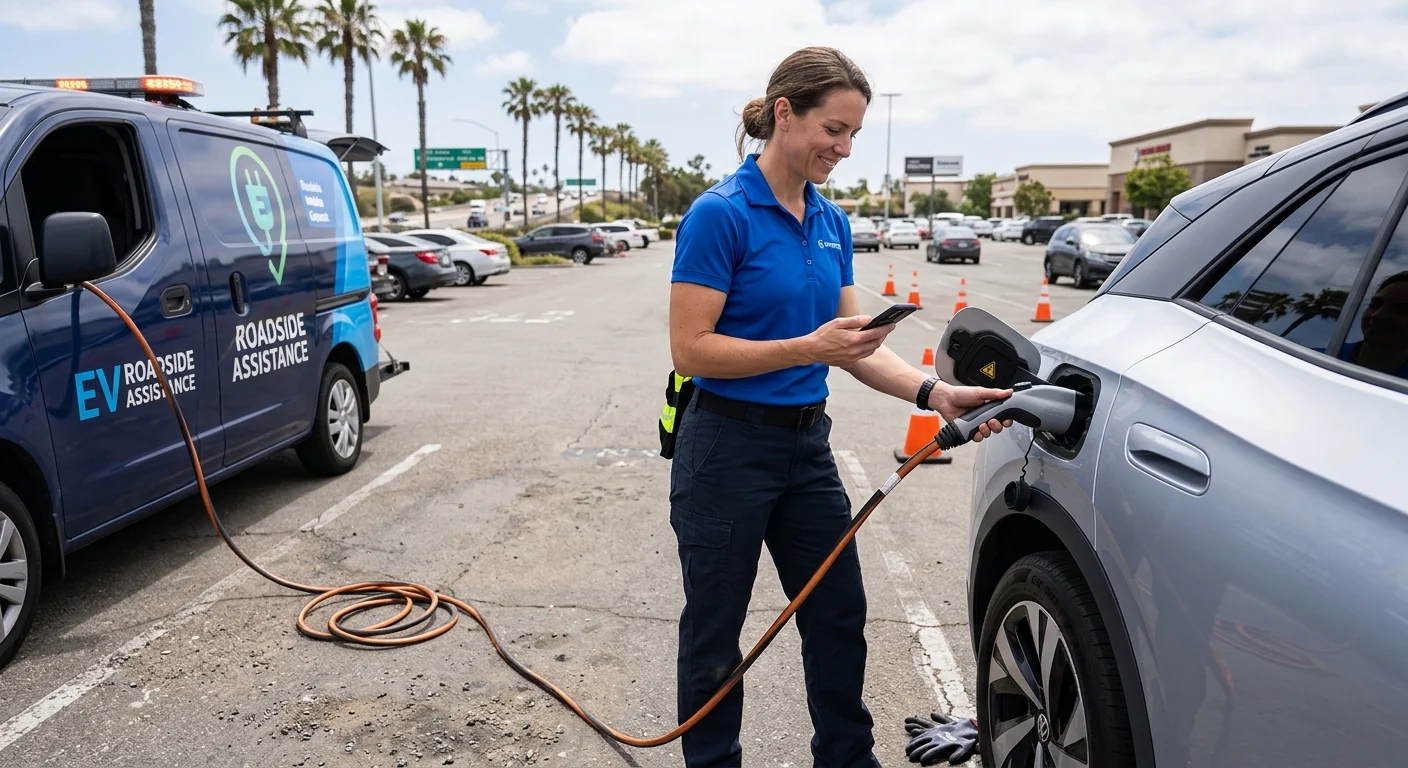
Independent operators bring a 240V Level 2 source to the car. Teslas take a native NACS plug. Other EVs use a CCS or J1772 adapter. Typical added range is 10 to 20 miles. That takes 15 to 30 minutes of charging. That’s charging time, never an arrival time. The goal is enough energy to reach a fixed stall.
Charge Pro MIA is a referral line. We match stranded drivers with independent local mobile rescue operators. We don’t own trucks or employ technicians. We don’t set prices. The operator quotes you before starting and bills you directly. Mobile EV charging fits when the pack is empty. The car needs a safe legal spot, and it has to accept power.
Have this ready before you request a mobile charging truck:
- Year, make, and model.
- The exact dashboard message.
- Pack percentage, if the screen still shows it.
- The connector you can see.
- A precise pin, not Brickell or the Palmetto.
- Gate, height, or garage limits.
- Whether the car can shift, steer, and unlock.
Downtown isn’t a location inside a tower garage. On I-95 or the Dolphin, give direction and nearest exit. In a Sunny Isles or Surfside garage, give the building and the level.
A truck may not fit when the port is damaged. It also fails when the car refuses power or the 12V has locked you out. Describe the symptoms. Don’t diagnose the pack from the sidewalk. The operator confirms whether a charge, a 12V jump, or a recovery is the match.
Recovery fits when charging won’t solve the stop. That includes a charge-port fault, collision damage, or a stop in a live lane. A dark screen and locked doors often mean the 12V, not an empty traction pack. Don’t order a rapid charge for a battery that only needs a jump.
Florida Statute 715.07 governs private-property tows. Appear before the car is fully removed, and the operator must stop. You pay no more than half the posted tow rate. Miami-Dade Code 30-476 and Broward Code 20-176.22 cap nonconsent rates. Confirm the operator’s posted schedule. Follow your maker’s towing instructions. EVs don’t all load the same way.
Out-of-charge recovery is the path when a charge isn’t the fix. We don’t tow. Confirm equipment, destination, and the quote before you agree.
When to call
Call when you can’t safely reach a confirmed rapid charger. Call when a mobile top-up may fit. We’ll connect you with an independent local operator. That operator assesses the stop and quotes the work.
Call (786) 963-2995 to reach the referral line.