Shopping a mobile EV charger for roadside use sounds like a smart backup. The catch is the wall. A portable unit in the trunk still needs 120V or 240V from a building. On I-95 through Fort Lauderdale, the Palmetto, or the Homestead Extension, that outlet isn’t on the shoulder. The operators this line connects you with bring a 240V Level 2 source to the car. You don’t need to own the truck.
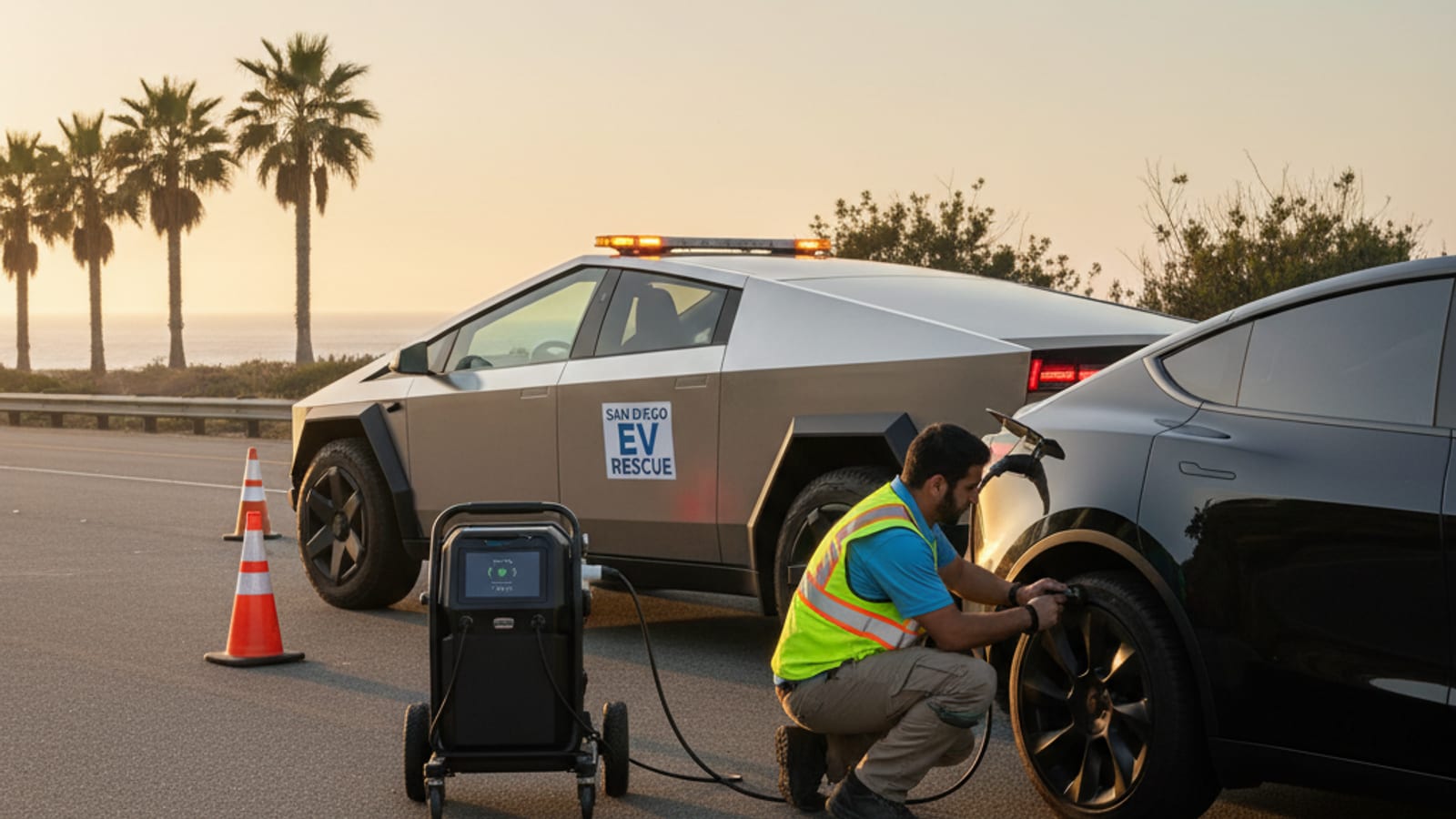
The outlet is the product you cannot pack
People shop these kits after one low-range night. The listing shows a handle, a cable, and a promise. What it doesn’t show is the building. Every personal charger is a converter. It takes power that already exists and feeds it to the pack. On a residential street in Coral Gables that can work. A neighbor’s garage, an RV pedestal, a warehouse dock in Doral: those are walls. A travel lane on the Dolphin Expressway is not.
Florida Statute 316.194 is the rule on the highway outside a municipality. Get the car off the main-traveled part when you can. Leave room for passing traffic and a clear view from 200 feet each way. A truly disabled vehicle gets an exemption if it cannot practicably move. None of that statute hands you a 240V receptacle. The law tells you where to sit. It doesn’t charge the car.
That’s the buy-versus-call fork. You can own a cord. You can’t own the grid on the shoulder.
What a store charger actually is
Two boxes show up in the search results.
A 120V Level 1 brick
This is the emergency cord that came with many cars. It plugs into a household outlet and trickles energy in. Overnight at a friend’s house in Pinecrest, it can add a useful amount. On a shoulder, you still need that household outlet. You won’t find one next to the guardrail on I-595. Even when you do find a wall, you’re looking at hours, not minutes. A Level 1 kit is a house tool that happens to travel. It isn’t a roadside plan.
A 240V portable Level 2
This is the kit that looks serious in the photos. It wants a dryer-style outlet, a NEMA receptacle, or an RV pedestal. At a home in Weston or Parkland, that outlet may already exist. In a warehouse bay near Miami International Airport, it might exist. On Tamiami Trail toward Shark Valley, it doesn’t ride with you. The hardware is fine, but the missing piece is the building. Some kits ship with adapter pucks for different plugs. Those pucks still terminate in a wall. They don’t create power. If you’re shopping a mobile EV charger for roadside use, this is the usual pitch. Independence from buildings is the part it cannot deliver.
What the operator brings so you skip the truck
The mobile EV charging call is a different object. The independent operator arrives with a 240V Level 2 source on the vehicle. Native NACS for Tesla. A CCS or J1772 adapter for everyone else. The car stays where it died. Nobody winches it onto a bed just to find a plug.
Charging time is the number that matters. It isn’t a promise of when someone appears. Typical work is 10 to 20 miles of range in 15 to 30 minutes of charging. That’s time on the cable. It’s enough to leave the shoulder and reach a public station or a home plug. It isn’t a full pack, and it isn’t a Supercharger.
You can read what actually rides on the truck in what’s on a mobile EV rescue van. The short version is power, adapters, and a 12V jump path. Tesla, Rivian, Ford, Hyundai, Chevy, and the rest of the major brands are in scope. The operator quotes before any cable goes in. The operator bills you directly. This line matches the call. It doesn’t own the truck, set the price, or hold a trade license.
Heat burns range here. Hills do not.
South Florida is flat. Miami-Dade’s Atlantic Coastal Ridge tops out around 23 to 24 feet. Broward’s Pine Island Ridge is about 29 feet. There’s no mountain tax on the pack. Range here is heat, air conditioning, and time sitting in traffic.
NWS Miami normals for 1991 through 2020 put July and August average highs at 91F. A normal year sees about 64 days at or above 90F. Recurrent Auto’s fleet study of about 30,000 EVs found about 5% range loss at 90F. The same study found about 17 to 18% loss at 100F. The mechanism is the cabin. Cooling a hot interior can take 3 to 5 kW. Holding it cool is closer to 1 kW. The first minutes of AC are the expensive ones. AAA’s 2019 SAE-standard test found about a 17% range drop at 95F with the AC on.
That’s why a planned commute across Miami-Dade or Broward goes thin on a July afternoon. Thunderstorms stack up from roughly 2pm to 6pm in summer. AC stays on while traffic stacks on I-95, I-595, and the Turnpike. A portable Level 1 cord in the frunk doesn’t fix that math. A 240V operator at the bumper does.
Hurricane season runs June 1 through November 30. FPL tells EV owners to keep the pack between 50 and 80% through the season. Unplug during the storm. Don’t charge or drive a flood-exposed car until it’s inspected. NHTSA warns that residual salt in a flooded lithium pack can short days or weeks later. About 36 EVs flooded by Hurricane Ian in 2022 later caught fire. A flood-exposed EV shouldn’t sit within 50 feet of a structure. A store charger doesn’t make a wet pack safe. Don’t plug one in.
FPL also deploys mobile EV charging trailers before planned outages and during storms. That’s a utility program, not a consumer kit. The Florida Division of Emergency Management has placed temporary chargers along the I-75 evacuation corridor. Evacuation routes north are I-95, Florida’s Turnpike, and I-75. Miami-Dade uses Storm Surge Planning Zones. Zone A includes Key Biscayne. Zone B includes Miami Beach and Brickell. Broward uses Plan A east of the Intracoastal for Category 1 and 2, and Plan B east of US-1 for Category 3 and above. If you’re leaving, you need range on the car, not a box that wants a house.
Older streets, towers, and homes that never got a plug
Florida had about 450,400 registered EVs in 2025, per DOE AFDC registration data. Plenty of those cars live in housing that predates a 240V circuit. North Miami is 82.7% pre-1980 stock. Miami Springs is 89.5%. Golden Glades is 83.6%. Hollywood is 74.7%. Lauderhill is 67.3%. Hialeah is 60.1%. A home charger is often not installable there without a panel fight the owner may never win.
Newer stock is the opposite. Doral is 5.5% pre-1980. Parkland is 1.7%. Weston is 7.0%. Those streets are where FPL EVolution Home actually maps to the building. That’s FPL’s residential Level 2 install-and-maintain program. FPL also publishes a residential Time-of-Use rate for home charging. Confirm current terms on fpl.com. Don’t treat a store portable as a substitute for a proper home circuit.
The Spanish-speaking core of the county isn’t a side note. Hialeah is 95.2% Hispanic or Latino. Sweetwater and Hialeah Gardens sit in the same band. Tamiami is 92.4%. Doral is 85.3%. Westchester is 87.5%. A lot of those households rent, share a driveway, or park on the street. A lecture about installing Level 2 doesn’t meet them. A call that sends a 240V operator does.
Condo and tower life is the other wall. Miami Beach, Surfside, Sunny Isles Beach, Aventura, and Brickell put cars in garages the resident doesn’t control. HOA boards, garage operators, and building electricians set what can be installed. A portable 240V kit still needs the building’s permission and the building’s receptacle. When the car is empty in that garage, the useful move is out-of-charge recovery, not a second cord in the trunk.
Kendall, The Hammocks, Tamiami, and Westchester are census-designated places, not cities. They have no city hall to call about a public pedestal. You deal with Miami-Dade County, FPL, and the property. The City of Miami is one of 34 municipalities in the county. Most of what people call Miami is unincorporated land or another city. That confusion doesn’t charge the car. It does explain why a one-size home-charger plan falls apart.
Places the car sits still, and the 12V dies first
A week in airport parking is the classic false empty. Miami International’s public options include the Dolphin Garage at the North Terminal and the Flamingo Garage at the Central Terminal. The Ibis Garage is in the mix too, and the new Park 6 long-term garage opened in summer 2026. Ibis holds ChargePoint ports across its levels, per the airport’s own page. Park 6 has EV charging on site. None of that changes the 12V story. A car left for a cruise or a long trip keeps modules alive. The small battery drains. The pack can still be full.
Heat makes that worse. Every roughly 15F rise halves the life of a lead-acid 12V. It ages about twice as fast at 93F versus 77F, and about four times as fast at 111F. Heat damage doesn’t reverse. That’s the South Florida airport and cruise pattern. PortMiami parks in northside Garages A through G and southside J and K, plus Lot E. Port Everglades uses the Heron and Palm garages. You come back to dark screens. A portable Level 2 won’t wake a car that never powered up.
The operators this line connects you with jump or replace a dead 12V on site. That’s a different job from a pack top-off. If the dash is black after MIA or a night at Hard Rock Stadium in Miami Gardens, start with the 12V. A store charger aimed at the high-voltage port will sit there doing nothing.
Game and mall days create the same still-car problem. Kaseya Center downtown, loanDepot park in Little Havana, Aventura Mall, Dadeland Mall, Sawgrass Mills in Sunrise, Dolphin Mall near Doral, and Brickell City Centre all mean long sits. University of Miami’s main campus is in Coral Gables, not the City of Miami. FIU’s Modesto Maidique Campus sits in the Sweetwater and Tamiami area. Nova Southeastern’s main campus is in Davie. Campus lots cook a 12V the same way. Bring a jump path, not a dryer cord.
Highways, rangers, and a Level 2 that isn’t on the patrol truck
The Road Ranger Service Patrol is Florida’s free highway service patrol, run by FDOT. Rangers jump-start vehicles, handle minor repairs, change flats, and provide gas, diesel, and water. They also tow a disabled vehicle from the travel lanes to the nearest safe spot. All of that is free. Reach them by dialing *FHP, which is *347. Florida Highway Patrol takes disabled-motorist reports on the same short code. District 6 covers Miami-Dade and patrols I-95, 95 Express, I-195, I-395, I-75, 75 Express, and SR-826, the Palmetto. District 4 covers Broward and the I-95 corridor from the Miami-Dade line north, plus portions of I-595 and I-75.
No Road Ranger material we reviewed mentions electric vehicles or EV charging. A dead EV still needs a 12V jump or a tow off the travel lane, and they do both. A Level 2 charge isn’t in that toolkit. That’s the job a mobile operator takes from there. Don’t wait in a travel lane hoping the next truck is a charger. Get to the shoulder. Call *FHP if you’re in the lanes. Then decide whether you need a jump, a charge, or a bed.
Florida 511 at FL511.com is FDOT’s traffic system in English and Spanish. Use it before you sit in a blockage that burns the last bar. The Turnpike, the Homestead Extension, and the Sawgrass Expressway are Florida’s Turnpike Enterprise. 95 Express and 595 Express are FDOT. The former MDX roads now sit with the Greater Miami Expressway Agency: SR-112, SR-836 the Dolphin, SR-874 the Don Shula, SR-878 Snapper Creek, and SR-924 the Gratigny. All of them are all-electronic, SunPass or toll-by-plate. There’s no cash booth on those roads, and there’s no dryer outlet on the shoulder.
If the car dies on the Homestead park road into Everglades National Park, you’re on SR-9336, a dead-end entrance. Shark Valley is a separate gate on US-41, Tamiami Trail. They don’t connect. A portable charger doesn’t invent a wall at either gate. An operator with 240V Level 2 doesn’t need the gatehouse receptacle.
King tides run mainly September through November and last about three hours. They hit Miami Beach, the Las Olas Isles in Fort Lauderdale, Hollywood, and other low coastal streets. NHTSA’s saltwater warning applies if the car took on water. Don’t force a charge into a flooded car. A store kit makes that mistake easy. A trained operator should refuse it.
Buy the home setup. Call for the roadside.
The honest split is simple. Own charging at the building you control. Don’t try to own the shoulder.
If you have a house in Weston, Parkland, Pinecrest, or Coral Gables, look at a proper Level 2 install. FPL EVolution Home is the published residential path in FPL territory. Homestead is the exception: parts of the city sit on Homestead Public Services Energy. Confirm your utility on the city’s HPS Energy pages before you buy hardware. FPL serves essentially all of Miami-Dade and all of Broward otherwise. Compare a home plug to a rescue call in 240-volt charging: your home plug versus a mobile rescue.
If you rent in Hialeah, share a driveway in North Miami, or park in a Sunny Isles tower, the building is the bottleneck. A portable 240V unit doesn’t remove that bottleneck. It relocates the argument to whatever receptacle you can borrow. When that receptacle isn’t there, mobile EV charging near you is the backup, not another box from an online cart.
The South Florida charging hub is the map of cities this line serves. The operator still quotes on site. Nobody here pretends a trunk kit replaces a 240V truck.
Charge where it died, or take a bed
Towing a dead EV is a different job. Many EVs need a flatbed. A 12V that won’t wake can lock the car in park or hold the charge port. Florida Statute 715.07 governs private-property tows. The operator must stop and return the vehicle if you appear before it’s fully removed. You pay no more than half the posted rate. Storage in Miami-Dade and Broward must sit within a 10-mile radius. Release is supposed to happen within one hour of request. Miami-Dade Code Section 30-476 and Broward Code Section 20-176.22 cap non-consent rates. Confirm the current schedule with the county. Don’t guess a number.
A mobile charge skips that stack when the pack is simply empty and the car will accept power. Compare the two paths in charge on site or tow. If the 12V is the failure, a jump is the first move. If the car took floodwater, don’t charge it. If you’re in a travel lane, the first move is off the lane. Use Road Rangers if that’s what it takes.
What happens when you call this line
Charge Pro MIA is a referral line. It matches stranded EV drivers with independent local mobile rescue operators. It performs no work. It owns no trucks. It employs no technicians. It sets no prices. It publishes no hours. The operator quotes before starting and bills you directly.
You say where you are and what you drive. Tesla or not doesn’t gate the call. Native NACS, CCS, or J1772 covers the fleet. The operator positions to buffer traffic, then connects. You sit through 15 to 30 minutes of charging for those 10 to 20 miles. Then you roll to a public plug or home.
That’s the answer to the shopping question. A mobile EV charger for roadside use, as a product you own, still needs someone else’s wall. A rescue operator brings the wall. You pay for the visit you needed. You don’t store extra hardware for a night that may never match the outlet you bought.
Before you buy anything, run this list
Save *347 and FL511. If you stall in the lanes, that’s the first call, not a shopping tab.
Know whether the car is silent or merely empty. Black screens and a locked charge port point at the 12V. A working dash with a zero pack points at energy.
If you control a driveway, price a real home circuit through FPL EVolution Home or your electrician. A portable Level 2 is a travel adapter for buildings, not a freeway plan.
If you live in a tower, ask the garage what is already installed. Ibis Garage and Park 6 at MIA publish charging on site. Your condo may not. Get the answer from the building, not from a product page.
If you drive Alligator Alley, the Homestead Extension, or the park road off SR-9336, leave with more pack than the estimate. Heat and AC will take their cut. A trunk kit will not grow a receptacle at the roadside.
Keep this number for a charge or a 12V jump: (786) 963-2995. Ask the operator for the quote before any clamp or plug goes on.
Do you need to own a mobile EV charger for roadside use?
Usually no. A personal unit only works where a wall already exists. On a South Florida shoulder the wall is the operator’s truck. Buy home charging if you can install it. Keep rescue as a call for the night you cannot.
How much range does a mobile rescue actually add?
Operators this line connects you with bring 240V Level 2. Typical charging time adds 10 to 20 miles in 15 to 30 minutes on the cable. That’s enough to reach a public station or a home plug.
Can a portable Level 2 replace a rescue truck?
Only if you’re parked next to the right outlet. A garage in Weston, a warehouse in Doral, a house in Pinecrest: maybe. I-95, the Palmetto, a causeway to Miami Beach, or the Homestead park road: the truck is the outlet.